Thursday, December 19, 2013

Why alternative treatments are not accepted by science

It is public knowledge that alternative treatments such as homeopathy and acupuncture (and many others) are not accepted by the scientific community as having effectiveness distinguishable from placebo. It is said that these treatments do not fulfill the criteria for medicine - which is often along the lines of double-blind clinical trials (or other trials of similar level of rigor).

This is easy to say - you just check what the dictionary says about science and check what kind of results previous research has yielded, and hope that the scientific method had worked and researchers and peer reviewers haven't been too dishonest.

But what kind of explanations and ideas do practitioners of alternative treatments have about this? After all, they think their treatments work - their customers' experiences usually support this - and many would like to have their discipline recognized better, even as part of the contemporary medicine, taught at universities.
Fourteen meridians in a Chinese acupuncture chart from the 1340s (source: Wikipedia)

Can the effectiveness be confirmed?

From books, interviews and generally on the Internet I have heard and read many opinions about the position of acupuncture and homeopathy in regards to what they call "school medicine". I'm sharing some of them here.

"Can be confirmed" / "Has been confirmed"

These are based on the idea, that the treatment "works" in the traditional sense and its effect can be confirmed and the treatment could probably be part of contemporary medicine.
  1. Effectiveness could be confirmed, but global conspiracy of Big Pharma corporations is controlling the industry and will not allow alternative practitioners to compete with their lucrative business. They are twisting and possibly sabotaging results of academic studies.
  2. Effectiveness could be confirmed, but due to the bad reputation  and "unscientific" background of the treatments, serious researchers will not attempt it, fearing that they lose their reputation.
  3. Effectiveness could be confirmed, but due to so many hoaxers and unreliable practitioners, it is next to impossible to produce reliable studies on the treatments.
  4. Effectiveness could be confirmed, but the process of doing so is very long and difficult, and it will take time before we can have conclusive results.
  5. Effectiveness has already been confirmed, but the scientific community (or Big Pharma) maintains the illusion that it has not.
  6. Effectiveness has already been confirmed: the placebo effect is the real effect, it has just been misunderstood.

"Cannot be confirmed"

Explanations in this category are based on the idea that for some reason, alternative treatments are fundamentally incompatible with what is usually called contemporary medicine or empirical science.
  1. Cannot be confirmed, because they are based on unknown interactions and laws of nature.
  2. Cannot be confirmed, because they are not based on laws of nature but a spiritual and/or unphysical connection of some kind, and by definition that is outside the reach of science.
  3. Cannot be confirmed, because they treat causes of conditions, not symptoms, and are thus outside the scope of contemporary medicine (which only deals with symptoms).
  4. Cannot be confirmed, because they are tailored for each person, and treatments of different people cannot be compared in a study.
  5. Cannot be confirmed, because they do not have a common methodology which could be evaluated.
  6. Cannot be confirmed, because they are only effective in a delicate, deep practitioner-patient relationship, which makes usual double blind and randomized controlled trials impossible.
  7. Cannot be confirmed, because medicine has distanced itself from natural treatment and spirituality so much that it is simply unable to detect the effectiveness.

"Confirmation is irrelevant"

There are some who abandon the whole idea of a treatment having an effect in the traditional sense.
  1. It is irrelevant whether it can be confirmed, because customers' (patients') own assessment of their own condition is the only possible criteria of effectiveness.
Regardless of the actual effectiveness of acupuncture, homeopathy and others, I think it would be constructive to think about these explanations instead. Some of them are actually not that implausible.

It is my understanding that patients of alternative treatments practitioners are generally (very) happy with their care. They have appointments with a private practitioner who has plenty of time to discuss with the customer, ask about background of the condition, and propose different options, unlike your usual doctor at the health center who will spend the 20 minutes by picking a diagnosis from the ICD-10 manual (or ICD-9 if you are American, I'm sorry) and write a prescription of antibiotics. Thus, general happiness about the experience should not be seen as any kind of evidence about effectiveness of the treatment, even if the harsh public health experience might act as a "nocebo" - making the drug's effect lesser.

Alternative or not?

Assuming that some alternative treatments actually work - and it is apparent that most do not - it would be incredibly useful to find out which ones have potential to be studied more and possibly be introduced to the realm of contemporary medicine. However, it has been noted that there are many ways of doing acupuncture, some of them not using needles at all, so studying one practitioner might not give any insight into how others do it. Homeopathy, on the other hand, is manifested by diluted "drugs" that have consistently been shown to contain no active ingredients (which is not in contrary to the principles of homeopathy), and would be easier to study, however in homeopathy as well it has been stressed that the treatment cannot be distanced from the delicate practitioner-patient dynamic.

Meanwhile, some ordinary health products have been misleadingly labelled as homeopathic to make them more attractive to consumers - these may be a case of products that can be shown to be effective, but as they are not true homeopathic products, they do not add to the knowledge of alternative treatments.

Homeopathy has been studied at various universities (including my alma mater, University of Michigan, which even had a dedicated department for it). Many trained physicians still allege that homeopathy is about medicine in traditional sense, and can be empirically studied and its effectiveness confirmed, thus making it a "non-alternative treatment". At the same time, explanations for how homeopathy might function have been proposed (memory of water), but even if homeopathy was effective (which I doubt), its underlying mechanism would still be unknown. Some also claim that the effectiveness of homeopathy has already been confirmed many times over, but for some reason the credible results are not taken seriously.

Supporters of alternative treatments do not always seem to grasp the breadth of ideas - among the practitioners and supporters - about what the real problem is. For some, whether acupuncture of homeopathy works is just a matter of empirical science. For others, it is a spiritual matter. Thus, homeopathy, acupuncture and others thus present themselves as ambiguous, fuzzy ooze around certain misguided concepts, which explains much of the trouble they have with contemporary medicine.

Sunday, December 8, 2013

Day of Infamy - Roosevelt's humble call to arms?

On December 7, 1941 - 72 years ago - the U.S. president Franklin D. Roosevelt gave one of his most famous speeches, calling that day the "Day of Infamy", and calling all Americans to arms against Japan and its allies - namely Germany. Allies of United States had already been engaged in the war for two years at that time.

As bad as the movie was, Pearl Harbor (2001) reminded the world about Japan's attack on Pearl Harbor, naval warfare mastermind Isoroku Yamamoto's involvement in the attack, and the U.S. response, especially the Doolittle Raid. With some misguided casting and lack of realism, it still featured important parts of the action and showed the attack through the eyes of many people present there, including seamen, pilots and nurses.It also featured Roosevelt giving his famous speech.

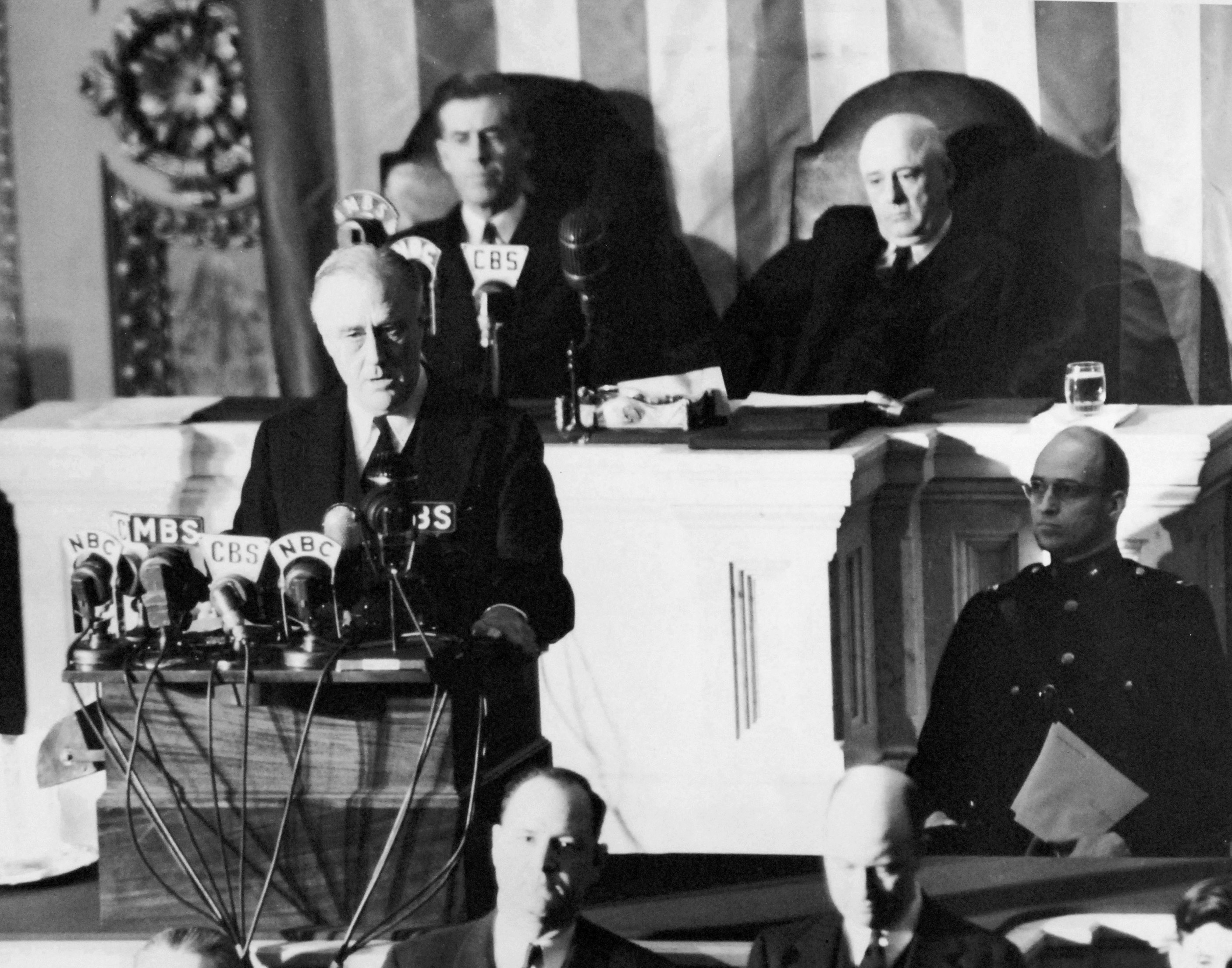
FDR delivering the speech to U.S. Congress

If the shoe fits, wear it

I always thought Roosevelt's wording was very fitting and the speech was an inspiring call to arms (even if I never actually read the whole text). After years of non-interventionist (or even isolationist) politics, leaving its European allies without direct military support, United States was forced to join the global war, and that day - Day of Infamy - showed Americans how unprepared United States was.

Indeed, it was infamy that United States has been caught "pants down". Its naval base in Hawaii had been attacked, after the remarkable failure of U.S. intelligence left it with no warning of the impending attack. It showed how future of naval warfare was aircraft carriers with their unique and flexible power projection capabilities, not battleships that were the mainstay of U.S. fleets. At the same time, the Mitsubishi A6M Zero fighter was to earn its reputation as the most capable naval fighter in the world.

Admiral Isoru Yamamoto, bringer of infamy
From this infamy, United States would rise to a formidable opponent in the war and end up beating up Japan in the Pacific theatre, innovating in naval and other warfare and, in the end, making the only two nuclear attacks in history, threatening to destroy Tokyo next. It had gone through the dramatic circle and avenged Pearl Harbor, and naturally also fought alongside its allies in Europe and elsewhere.

Only a couple of years ago, I realized I had misinterpreted Roosevelt's words.

The other interpretation

As depicted in the film Pearl Harbor - and numerous other films and reenactments - Japanese admirals had masterminded a daring attack to Pearl Harbor Naval Base, using aircraft carriers and naval fighters to bring destruction to the U.S. Pacific fleet. It missed the U.S. aircraft carriers, which - very wisely - the planners considered the main target, because unlike Americans, they realized their potential. However, the strike itself was very successful.

To recap, Imperial Japanese Navy launched a direct attack on United States Navy's base in Hawaii. Japan attempted to abide by the Hague Convention of 1907, by announcing its intentions - declaring war - before the attack, but due to delay caused by translation of the declaration from Japanese to English, war was declared a bit after the launch of the strike.

Apparently Roosevelt - and Americans still this day - thought it was an improper way to start a war. USA and Japan had been engaged in negotiations that were hoped to alleviate any need for war, and it seemed those negotiations had been a sham to make U.S. leadership uncertain about its true intentions, and as a continuation of that, an attack withoug declaring a war first was infamous.

Infamy in another context
Even though on many fronts there were formal declarations of war in WWII - for example, the United Kingdom declaring war on Gemany in September, 1939 - often hostilities were started without warning. Germany's attack on Poland in September, 1939 was one example, Soviet Union's attack on Finland in November of that year (a surprise, after months of negotiations) was another. Unlike many others, Japan made it clear that this was about a war between sovereign nations, and its armed forces engaged the other nation's armed forces, by striking a military target, and apparently honestly tried to make a declaration of war just as international agreements stipulated.

Deception is used in diplomacy and international relations - but to call Japanese tactics "infamy" is blatant exaggeration. Indeed, Japan had malicious intent and it threatened the whole Pacific region and was friends with Germany, but in the context of Second World War, its strike on a U.S. naval base was an exceptionally honest way of starting a war, as awkward as it sounds.


Michael Bay's Pearl Harbor, the awkward reference frame of this post
During the course of WWII, whole cities - with their populations - were effectively wiped off the map, including Coventry, Dresden, Rotterdam, Hiroshima and Nagasaki. The scope of destruction a war can bring was redefined. Was the attack on Pearl Harbor more "wrong" than other military actions of WWII? Was the diplomatic deception more "wrong" than other similar tactics around that time? Was the response less infamous?

I still think the interpretation of "Day of Infamy" meaning "United States got caught pants down by Japan, and it is embarrassing" is more fitting in the context of WWII. However, it should not take away from the remembrance of December 7, 1941, which marked the start of war between USA and Japan, and as such is a day to be remembered, as yet another realization of war being inevitable, and the start of the last war between these countries.

Thursday, December 5, 2013

Private cars vs. public transportation, an epic battle

Ground rule: use public transportation if you can. It is good for the environment and good for the city (if you are in a city) and it increases your sex appeal. However, the whole picture is much more complex than that. City planners and bus manufacturers try to appeal to the public by launching publicity campaigns like this one from the Polish bus manufacturer Solaris Bus & Coach SA:


This photo is from their Facebook page. The photo caption reads (from Google Translate):
So many cars disappear from the streets of our cities, when their owners will fill one bus. Public transportation! This number of cars would be unnecessary, if Their owners changed to a bus. Public transport!
It looks like the bus in the photo is Solaris Urbino 18 Hybrid, which is one of the manufacturer's newest products, and is a very modern hybrid vehicle. Based on the product brochure, it the densest configuration, it can carry 161(!) passengers, which is quite impressive. It looks like there are about thirty rows of private cars, five cars in a row, so let's make a wild guess and assume that there are 161 private cars on the left side of the picture. The point is clear: many private cars actually carry only one passenger, the driver, and when you fully utilize a bus, you can carry lots of people.

The good bus

How many of the 161 passengers - who now have abandoned their cars and only commute by bus - can actually have a seat? Answer: 51. Assuming that all passengers are average-sized and able-bodied, 110 of them will have to stand for the whole journey, and they cannot take any wheelchairs or a baby strollers.

It is true that number of vehicles on the right (1) is less than the number of vehicles on the left (161). The bus full of people would be much more efficient on transporting the people than the cars are, which is the point of mass transportation in general.

These publicity campaigns consistently compare the "best case" scenario for buses and "worst case" for cars, and this may lead to unrealistic expectations. In the scenario of the image, the bus will be as full as it can legally be. It probably won't be comfortable, fast or maybe not even safer than private car (there are no safety belts or air bags on buses, except for the driver). Because it is full, stops will be long and cumbersome, some people might even have to step out to let other passengers out, and then board again. The bus will also use slower and smaller roads to pick up passengers, and will usually not take the passengers to their ultimate destination - they will have to switch to another bus or walk (or use other form of transportation).

The mass transportation model works well in crowded cities for commuting, but actual occupancy rates are often much lower. According to UK Department for Transport's report, the estimated average occupancy rate (vehicle miles divided by passenger miles) of buses in London was 19.3, which is good - but only 9.1 outside of London (11.1 for the whole Great Britain). It also mentions that the current trend is that the rate for outside London is falling, potentially making mass transportation less effective and more challenging to maintain.

The bad private cars

According to University of Michigan Center for Sustainable Systems' report, average occupancy rate of all U.S. vehicles was 1.55 in 2011. The average rate varies by trip purpose - for leisure it is close to 2, for commuting it is often close to 1, and sometimes the car can also be full(!).

1.55 passengers is 31 % of a passenger vehicles maximum capacity (assumed five). 11.1 passengers is only 15.9 % of maximum capacity of a traditional city bus (40 seats and 30 standing, rough estimate). 

With these figures, you only need two or three cars to match the average occupancy rate of a bus, and with a car you can travel from point to point with greater flexibility. Fuel efficiency for new cars is more than 25 miles per gallon (sorry for using non-standard units!) and for an ordinary U.S. city bus, according to National Renewal Energy Laboratory's study, was roughly 4.0 mpg (Appendix C). 

With 11 passengers, this would equal to 44.0 passenger miles per gallon (we're talking approximations here, in reality of course fuel economy changes with the load), which is only slightly better than for a modern passenger vehicle with only 1 occupant! A full passenger vehicle would clock near 150 passenger miles per gallon (assuming no extra hurdles, heavy traffic, stops etc.) - and even with average 1.55 passengers it would still clock an impressive 38.75 pmpg.

Conclusions

Based on these numbers, driving a passenger car alone is approximately as fuel efficient as it is to travel on a bus, and with at least two passenger, it is significantly more efficient. At the same time, it is much more comfortable, flexible, faster and safer, and it allows you to transport groceries, strollers and other items.

However, this is not the complete picture either, for many reasons.

While that 4.0 mpg for a city bus is measured based on actual vehicle miles and fuel consumption, directly comparing it to passenger car fuel deficiency is difficult. Cars are used for much more than commuting, and often buses simply do not go where drivers would like to go. Often bus trip involves somebody driving a private car to pick up a passenger, because the nearest bus stop is too far away (or in a dangerous place) to walk. With newer buses (and hybrid and electric engines) efficiency can be improved - and bus is not the only form of mass transportation in many cities.

Good city and transport planning can improve public transport by planning the city around it and making it easy to catch a bus or train and switch between them. However, it may create dense suburbs without which heavy rail transport might not be worth building there.

And, perhaps most importantly, the average occupancy rate can be vastly improved. If people really would ride the bus when it is practically possible, there could be less traffic on the roads, less pollution and better fuel economy (per passenger) for buses. Owners (and drivers) of private cars are not (all) stupid. Many of them would ride the bus, subway, train or tram if it was feasible, but it is not because of bad route planning. I was unfortunate to experience this myself in 2009 when I started in a new job which was located only about 5 km from my home - but travel time there by bus was almost 40 minutes, and involved one or two switches. I bought a car (Citroën C1, 64.0 mpg) and haven't regretted that decision one second. (I still walked there sometimes.)

Frank Palmer of Daily Kos wrote about the "mpg fallacy" - and made some of the same points I make here. 

We will not and practically cannot achieve the utopian future where private cars have been exchanged for mass transportation - at least not in near future, and meanwhile, a more complete picture of different forms of commuting and transportation should be discussed in public. Mass transit is good, but by average not nearly as good as it is claimed to be. Sadly.

P.S. The modern hybrid bus in the image would achieve around 1000 pmpg.

Sunday, November 3, 2013

Ender's Game and why everyone needs a Petra

Those who have read Orson Scott Card's science fiction classic Ender's Game don't need directions to find the IMAX auditorium at their local multiplex - it's down. The film follows relatively faithfully the original novel and has lots of attention to details, which is important for high-profile book adaptations such as this.

I sat next to a family - parents with their roughly 7-year-old son. After a while, they all moved one seat away from me, which was unexplicable for me, but I guess people behave like that at movie theaters. When the film started, this little guy was quickly served with images of a boy of his age killing another and being rewarded with admission to a school, then becoming a child soldier.

There was more killing and I sometimes glanced upon him to check whether he was ok. At one point he climbed to his mom's lap. When Ender's last game started, he was sitting on the edge of his seat - literally.

Had I seen this film when I was seven, I might have been traumatized for life.

Now, the review.

Ender's Game: the review

The film, directed by David Gavin, was quite good. Of course, it omitted a lot of material from the book and dismissed whole subplots. Very few actual battles were shown, which is a pity, because the book's narrative revolves around them and Ender's responses to the challenges in them - and the challenges that the number and timing of battles pose. The film looked good, mostly what I imagined Battle School to be, and the Command School's simulated battleships were awesome. Roles were well cast and the soundtrack was nice. This film was not 3D, which was awesome, too.

As expected, the 15-year-old Asa Butterfield is excellent as Andrew "Ender" Wiggin, the young boy who gets recruited into International Fleet's training program, to become a future battle commander. He plays the role very well, and even shows emotion well. However, he seems very tall compared to others, even though he is supposed to be much younger than them - six years old at the beginning of the book (they don't reveal his age in the film). Also, it was a bit strange to see girls with breasts among the cadets that are supposed to be little kids. (As a side note, Hailee Steinfeld as Petra Arkanian was 16 years old when this film was shot.)

Moises Arias as Bonzo Madrid is excellent in his role, displaying some genuine passion and being exactly the kind of guy he is in the book. Ender's friends Bean, Petra and Alai are portrayed quite well, but due to constraints film as medium presents, their characters were not fully explored. 

Even more than The Lord of the Rings trilogy by Peter Jackson, this film is is an illustration of a story we already know, and it is not even expected to deviate from it. It doesn't change the story much, but now we have a face for Ender, Anderson, Mazer and so on. I like those faces in general, but Harrison Ford's Graff and Viola Davis' Anderson (changed to a female character) are a bit too grumpy and spend time mumbling instead of showing emotion and caring about Ender's planned mission.

This story would have worked much better as a miniseries, let's say of five one-hour episodes: 1. Before Battle School 2. As a Launchie 3. Dragon Army 4. Combat School 5. Graduation Battle. The film had the correct ingredients but not enough time to use them. The ceremonial nature of Battle Room games was left unexplored, with all the different ways Ender was frustrated with how the system was cheating him and trying to break him down, and how he overcame those challenges.

I liked it. Not because it was a good movie, but because of how it colors the story I know and how it gives me a new perspective to some things from my youth. I'd like to reorient myself to a new reference frame to explain, if you may.

Ender the terrible

Ender is exceptional. After all, he is a product of the system, and the International Fleet aimed to produce and find somebody like him, an ideal commander, who has since childhood conditioned himself to think like a military leader. Still, the story happens in a school setting; Ender has classmates and teachers, he makes friends and enemies, faces bullies, and so on. Each reader surely finds something to relate to, even if Ender as a person feels distant.

I'm not Ender. He's a brutal child soldier who kills, and also a military genius who commands his team and goes beyond duty to accomplish his mission. Did I say he is exceptional? He's young and determined, and he defeats all challenges ever thrown at him, and ultimately commits genocide.

In Ender's Game, many aspects of war and childhood are laid bare in an offending manner. Even if the choices the characters make can be somewhat justified to save the Earth, by any modern rationale Graff and Ender are guilty of horrible crimes, yet they are unquestionably protagonists. Graff and Anderson stage children against each other, to "toughen them up" and find their own solutions, while almost breaking Ender, while Anderson is playing crazy and despicable mind games with them.

When I was a kid, my math teacher would sometimes say at the beginning of a class "Mikko will now list the correct answers to the homework". And I did. It would be stupid not to admit that how Ender made Bean explain the flaws in enemy army's tactics rang the bell. Is alienating good students from others something teachers learn in pedagogical studies? I played the part but I didn't think I had a choice. What the film missed was the fact that Ender was doing to Bean what Graff had done to him, and he was shocked how natural it was for him.

And the thing about enemy's gate. Aside from the two obvious enemy's gates (the goal of the Battle Room and the Bugger homeworld), there are lots of other concepts in Ender's Game that benefit from the idea of reorienting yourself to the correct reference frame. The Battle School makes sense in a certain reference frame. Maybe you'd have to abandon the traditional paradigm about how to treat children, or how to let them treat others, but in a certain reference frame... Rackham's teachings might make sense, too, and in the end, Ender orients himself to the Formics' reference frame and everything looks very different.

This idea of constant reorientation is relevant to the concept of games in the narrative. Games, training, real war, what's the difference? Ah, the reference frame. Children, soldiers, killers. However, to me, Ender's world also seems very unfair from the beginning, and the main method of training in the Battle School is to make it even less fair for him. Now, we get to the ultimate reorientation. For Ender, acknowledgement is humiliation, reward is punishment, friends are enemies, winning is losing, quitting is reorientation, and in the end, playing a game is committing a genocide. The idea of winning and quitting being so closely tied together in the story is intriguing. The idea of abandoning what you thought were rules - since it is apparent that the enemy, or the teachers, don't follow them either - is a key to Ender's victories.

What's Ender's own reference frame? It's revealed at the end of the story, when he becomes the Speaker for the Dead. 

Everyone needs a Petra

Hailee Steinfeld gives her face to Petra Arkanian, the sharpshooter Ender meets right when he reports to the Salamander Army. Unlike so many others at the Battle School, she's friendly and supportive - and she's a girl.

It is explained in the book hat most cadets are male because most women are simply inferior in the type of reasoning that is required in combat. Petra is clearly an exception, but she is also a source of smiles, friendship and affection - especially in contrast to Bonzo Madrid, her commander - and thanks to Steinfeld, she's also extremely pretty. If this was any other story, Ender and Petra would share a nervous but romantic moment in the weightlessness of the Battle Room. 

Yet with all these stereotypes, everyone needs a Petra. She might not be a leader, but she has her stuff together and doesn't have the burden of self-doubt that Ender has. With all the clever and capable friends Ender has, is it Petra whose smile matters in the end, after everything she has done and been for him?

It would be stupid not to admit that I needed a Petra when I was a kid. A supporting character and a sharpshooter. Of course I would have had a crush on her, it would've been a safe bet, even if she was older, like Petra of Ender's Game. She'd have been instrumental in making me understand when to quit and when to reorient for the goal (ok, ok, maybe everyone needs a Bean, too). "Life is cheating, so why aren't you?"

Above all, a Petra is needed to counter the perceived unfairness of life. 

This is the last line of this blog post, so there should be a reference to the direction of the enemy's gate, but we're already there.

Update 2013-11-04: Fixed two typos.

Thursday, October 24, 2013

If I was an insane and well paid troll

A couple of days ago I criticized someone for linking to a website full of conspiracy theories. I did this on Facebook, in a public group. Then, another user attacked me and other critics, all but accusing us being trolls hired by Supo (Finnish Security Intelligence Service), to discredit alternative news websites and make people believe the lies perpetrated by the government.

At first, I thought someone is just trolling. But then again, there are conspiracy theorists in Finland as well, for example claiming that our national airline Finnair, in secret co-operation with U.S. government, is spraying chemicals over innocent citizens, i.e. producing "chemtrails" of unknown purpose. Now we know that Fox News used paid commenters to manipulate social media, and probably some governments do something similar, too. But if I was a (well) paid troll, would I do that kind of boring stuff?


If I was insane and rich and also happened to be a troll, I might find other ways to piss people off, if that was was my motivation...

Adventures in Nigeria


  • I would start using dr.mikko.fedexoffice@yahoo.com.cn as my only email address (I am actually a doctoral student, so I wouldn't be completely lying).
  • I would move to Nigeria to work at a FedEx office there for real.
  • When someone would actually be about to receive an important and urgent shipment, I would send them email from this yahoo.com.cn address, with obvious subject "VERY URGENT COURIER MAIL CONTACT DR.MIKKO IMMEDIATELY".
  • I would start a real lottery company. Then I would harvest email addresses and randomly select a couple of winners. I would send them smutty winning certificates (Word files), explaining that they are among lucky winners whose email addresses were chosen and tell them to contact Dr. Mikko (Lagos, Nigeria) for immediate winning delivery. If someone contacted me, I would of course pay the money.
  • While staying in Nigeria, I would marry a real Nigerian princess. When her very rich dad would die, I would contact random people on the Internet, claiming to be married to a Nigerian princess, having 11.5 million United State Dollars Only that I have to transfer to another country, and would offer 30 % of this sum to a foreigner who would help me. Naturally I would keep my promise.

Changing my name

  • Unlike in Finland, in United States (where I currently live) you don't have to have a surname. Governmental databases can accommodate that. Also, you can change your name quite freely (unlike in Finland). So, I would change my name to JustinBeiber Va1entina.
  • Even though governmental databases would accommodate me with only one name (or without surname), many or most others would not. I would sue everybody for discriminating against me (with the best lawyers, of course).
  • The letter 'l' in Valentina would be replaced with the number 1, to mess up with stupid databases. If it was not possible, I'd buy politicians to have the laws changed so that you can have numbers in your legal name. Also, there is an obvious typo (Beiber vs. Bieber) that would make everyone misspell it every time.
  • The name would obviously split to first name and last name (Justin and Beiber) but they would actually be one word, so everyone would keep spelling my name with a space in between names, unable to find me from any databases.
  • Because I'd still have no surname, Va1entina would appear to be my surname, causing even more confusion. At the same time, Justin is obviously a male name (regardless of what you think about the real Justin Bieber) and Valentina a female one, so assessment of my gender based on my name would also be difficult.
  • Because my middle name would appear after my apparent surname (Beiber), it would often be spelled "Justin Valentina Beiber", which would be so wrong! 
  • I would sue Facebook and Google for not letting me use my real name.
  • I would travel as much as possible to make my name appear (incorrectly) in as many databases as possible.
  • My private jet's registration number would be so long that it couldn't fit in usual air traffic control systems. (Maybe I could even try an SQL injection attack.)
  • If anyone would like to book me to sing at their birthday party in Abu Dhabi etc., I would gladly accept.

Random things

  • I would make the city council of Helsinki change names of some streets a bit, by replacing letter 'a' with a 'q' or swapping two letters. For example changing Mannerheimintie to Mqnnerheimintie and Myllypadontie to Mylylpadontie.  
  • I would secretly buy old military tanker planes (and make deals with some airlines) and start to spray (harmless) chemicals over people for real. Then I would join the conspiracy theorists and demand answers from the government.
  • I would buy all Super Bowl commercial time, then use it to broadcast blank screen with no audio.
  • While I'm at it, I would book the real Justin Bieber to sing at the Super Bowl half-time show. I would also take photos of him in the backstage and post them to my JustinBeiber Facebook fan page.
  • I would buy a supercomputer and hire top scientists to calculate decimals for number zero.
I wouldn't. Except if I was insane and very rich, and maybe not even then, because all these things are despicable and stupid.

Monday, October 14, 2013

What unsuccessful people know

Today, October 13, is The International Day for Failure. It is intended to emphasize that failures are a natural part of life and it is alright to try and sometimes fail, too. I have read and heard different interpretations of successes and failures especially in the enterpreneurial context, where there are many variations of "fail often, fail fast" (and learn something in the process).

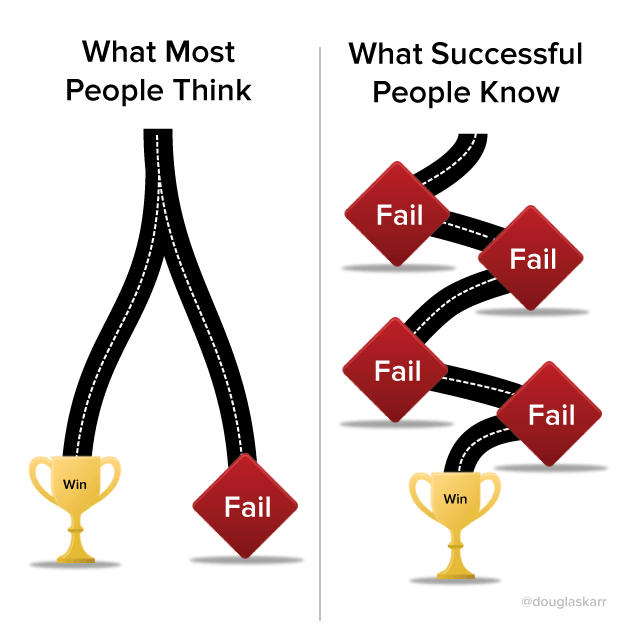
Some time ago, I encountered this image in the social media (attributed to Douglas Karr):
I noticed that at least some of my Facebook friends thought this was good advice - to remind that you cannot usually achieve success without failures, and one failure does not mean the end of the story. This makes sense. It reminds me of what Yoda said in The Empire Strikes Back: "Do or do not. There is no try."  - but isn't it unfair to judge people only based on the results where the only thing they can do is try?

In this "motivational" image, there is a trophy at the end. Successful people know that there is success (because they are successful). In this context, everything you do is a success or a failure, and you do everything because you want to succeed. To see how unsuccessful people might think given these assumptions, I proposed an addition:

Indeed - if almost everything you do is a failure, you may end up believing your whole life is a failure, and it ends in a failure.

I have listened to many wise men and women talk about their accomplishments. I have also succeeded and failed at many occassions. It is true that many experiences we have could easily be labeled as successes or failures - by somebody - but this binary classification might not be justified or fruitful.

If your company goes bust, is that a failure? Maybe you employed ten people for a couple of years, while you developed great products and technology and are now better prepared for anything that comes your way, and your investors knew this might happen and they were willing to take the risk. Doesn't sound like a complete failure (and doesn't make you an "unsuccessful person"), but that might very well be labeled as such, and only as such.

I have always tried to play it safe, and good things have come out of it while I have avoided many pitfalls. In 2010, I abandoned my safe life and financial security in Finland and moved to United States to get a degree. That was a leap of faith and a huge bank loan was part of the commitment. Maybe I also abandoned the idea that there are only successes and failures. In 2013, I'm still in USA, studying my second degree here. It hasn't been easy at all times, but somehow I'm going forward.

If you can't have binary labels, what would be a realistic but motivating framework? Abandoning Yoda's advice, I would say there is only try, and even if you can't do, you can often still try. And regarding Day for Failure, it seems life (or career) is a constant flux of things that can be seen as successes and failures of some sort, and failures are about trying something. Day for Trying, how's that sound?

Monday, October 7, 2013

Gravity: ridiculously implausible action fantasy

Gravity is in many ways the best and most beautiful space movie ever made. It depicts an ill-fated Space Shuttle mission that leaves two astronauts to attempt to survive - and cope with the gravity that is pulling them towards the Earth (well, there are some caveats with this explanation, which will be explained later).

I admit that I was critical of this movie once I read who were cast as the two astronauts for this film. For a realistic-looking serious film about astronauts trying to survive in space they had cast two of the most sexy and beautiful people on this planet - George Clooney and Sandra Bullock. I don't have qualms about their acting skills, but I thought it was strange that actors known for their sexiness were cast.

Casting

According to IMDB, George Clooney was cast as mission commander Matt Kowalski after Robert Downey, Jr. dropped out to scheduling conflicts. Sandra Bullock was cast as mission specialist Ryan Stone after Angelina Jolie dropped out and Rachel Weisz, Naomi Watts, Natalie Portman, Marion Cotillard, Abbie Cornish, Carey Mulligan, Sienna Miller, Scarlett Johansson, Blake Lively, Rebecca Hall and Olivia Wilde were approached. Boy, that is a lot of beautiful women! Is Sandra Bullock only the 13th most beautiful woman on this planet, after all?

Now, we enjoy seeing Clooney's and Bullock's faces. They are incredibly handsome and except for short scenes, that's almost all we see of them. That is probably why producers thought it was paramount that the only two faces seen in the whole film are recognizable and relatable. I still feel uneasy about the thought of how much they appreciated visual beauty of the actors - and the approached actresses are not known for roles as researchers or other technology-related roles. Bullock is especially known for romantic comedies and some action flicks (Speed 2 comes to mind). I was surprised to learn that Carrie-Anne Moss (Matrix, Mission to Mars) or Michelle Yeoh (Sunshine) were not even approached for this role!

Still, Clooney and Bullock perform as professionals and do everything they are expected to do. Their characters have been written to contrast each other: Kowalski is a man, Stone is a woman. Kowalski is a career astronaut, Stone a researcher. Kowalski is experienced and calm, Stone is inexperienced and frightened. Kowalski tells jokes and has good humor, Stone is a serious scientist. Kowalski knows exactly what to do and helps Stone to survive, Stone cries in panic. Kowalski is wearing the Extravehicular Mobility Unit (like a jetpac) needed for survival, Stone is not. Thanks to the Space Shuttle, many kinds of American (and other) astronauts have flown to space, and Eileen Collins (commander of STS-114) is one of the best known ones. In this sense, Kowalski and Stone feel like stereotypes and we have been these before - Robert Duvall's veteran astronaut Spurgeon Tanner in Deep Impact is one example. It is, of course, very convenient to introduce "easy" characters to the audience, so they can concentrate on other elements of the story.

Start of troubles

The film depicts STS-157, a fictional mission for Space Shuttle Explorer, servicing the Hubble Space Telescope, and is thus very much like the real HST Servicing Mission 4 (STS-125), flown in 2009. Near the end of the mission, the crew is told that a Russian space defence experiment goes awry and it results in a chain reaction of debris events which threaten both the shuttle and ISS. Explorer is ordered to abort the mission and ISS evacuated. Before the crew of Explorer can take any action, approaching debris destroys the shuttle and kills its crew, save for Kowalski and Stone, who are left hurtling in orbit.

It seems that Kowalski couldn't care much less about what has happened - he stays calm and helps Stone to come to terms with the new situation. The situation is depicted very realistically and it looks extremely good on the screen (expect for the 3D experience which I still think is a sham). Kowalski has the principle of concentrating to the task at hand and thinking methodologically, which is what all good pilots and astronauts do, and first they check out Explorer, which is a wreck. Knowing that they must find a safe haven in any case - to protect themselves for any additional debris and to make any rescue possible - they head for the ISS which is on the exact same orbit. What?! Since when has Hubble and ISS been on the same orbit?

This is where the film goes ridiculous. Kowalski says ISS is indeed nearby and we can see it clearly in the horizon. In real life, Hubble orbits at an altitude of roughly 650 km, with orbital inclination of 28.5 degrees. ISS orbits at 450 km and 51.65 degrees. Even though there are some passages in the dialog suggesting that they are, in fact, not on the same orbit, they have no trouble traveling from Explorer/Hubble to ISS in a couple of minutes, using EMU's thrusters.

From implausible to ridiculous

As implausible it is, they are able to reach the ISS and grasp the Soyuz spacecraft's deployed parachute, clinging to survival. Even though ISS has suffered some damage, it is intact. This is where Kowalski's extensive spaceflight experience would be crucial, as they might have to fly the Soyuz to the Chinese space station Tiangong (which is also on the same orbit!). However, without explaining why, Kowalski refuses to help Stone any more and sacrifices himself. Just like that he floats away, even though they had already succeeded in the most difficult part of the rescue.

For some mysterious reason, ISS does not have contact with Houston. It is difficult to understand why, because ISS is in constant contact with the TDRS communications satellites in the geostationary orbit, which is not affected by the debris in LEO. Anyway, ISS then blows up and Stone escapes in Soyuz, however she uses all its maneuvering fuel while trying to break free from its parachute. She also removes her helmet many times, even though it is clear that there is a great danger of depressurization. Even though she has spacewalk training, she has no trouble performing an unplanned EVA to detach the parachute, using the Russian Orlan space suit without its backpack. It is not explained why there was a Soyuz docked to ISS - a normal crew of six would have required both Soyuzes as escape ships!

Stone decides to commit suicide because she doesn't know what to do. Hallucinating, she sees Kowalski to return and give her advice. As implausible as this scene is, it is sadly almost believable in the context of the events in this film. Anyway, then Stone uses Soyuz's landing engines to propel it to Tiangong and she reaches it in minutes, and then ejects herself to the station. Now, it seems that they have a velocity difference of perhaps 1 km/s but that is rendered to nil with the help of a fire extinguisher. Stone has no trouble getting inside the space station, but at the same time, the station is reentering the atmosphere with no explanation. Why has its orbital altitude dropped from nominal 450 km to 150 km where it would reenter? With only minutes left, Stone enters the docked Shenzhou spacecraft (its crew having disappeared without explanation) and successfully lands it.

Stone clearly does not like to wear a helmet, even though there is a clear danger of depressurization. This disregard for safety achieves its climax when the ship lands in a lake. You see - even though 70 % of the Earth is water, for some reason this ship lands on land, except that it happens to find a small lake to land on. This has happened with a Soyuz spacecraft once. In 1976, Soyuz_23 landed on frozen Lake Tenzig and the crew waited in the capsule overnight for the rescue crew to arrive, with no immediate danger. All Soyuz landing capsules are equipped with an inflatable raft, food and even a gun to shoot wolves (no joke). I guess we can assume Stone had some reason to exit the craft, but then she almost drowned, as water poured in and she was not wearing a helmet. In seconds, she was able to exit from the Orlan spacesuit and swim to the shore.

The beautiful space

Practically never before have realistic (and real) spacecraft been shown on the screen in such a glory. I have never seen such advanced special effects - everything looked totally real. Before this film, Alfonso Cuarón had directed Children of Men, a thrilling yet very realistic-looking science fiction film that was met with high praise. Gravity sets new standards in the use of special effects that support the story. The depiction of zero-gravity environments is incredibly good and Bullock seems to have no trouble navigating through the ISS in the absence of gravity. Also, the idea of having only two actors in the movie and almost no sound except the masterful music by Steven Price is excellent and was realized surprisingly well and is a bold approach.

As beautifully as spaceships and debris in Gravity are done, there are many compromises. The dangerous space debris looks like a mild wind, bringing trash and dust. In reality, it might approach at 17 km/s, making it impossible to see it before it hits. It is also interesting how the debris hits and destroys absolutely everything except our protagonist astronauts and whatever spacecraft Stone happens to be in. 

This film is also an action fantasy film, like Armageddon. Very implausible things happen and we are supposed to believe them for the sake of entertainment, except that Gravity is portrayed as being a serious film. Instead of everything keeping blowing up, a very interesting and realistic story could have been built around the concept of escaping to ISS and then somehow managing to get rescued, with Kowalski, of course. Instead, ISS blows up and Stone escapes to Tiangong, which then blows up. In many ways, Armageddon was much more plausible - and it had official support from NASA, too.

This is the kind of semi-realistic science fiction that a couple of space-buff high school boys might come up with in their fantasies. In this case, they were given 55 million dollars to realize their fantasy and while the result is spectacular, it is also spectacularly implausible, which is a very bad thing for such an amicable attempt in original moviemaking. The packed and episodic script does not leave much room for reflection and more peaceful sequences where Stone might have come to terms with the situation.