Thursday, October 24, 2013

If I was an insane and well paid troll

A couple of days ago I criticized someone for linking to a website full of conspiracy theories. I did this on Facebook, in a public group. Then, another user attacked me and other critics, all but accusing us being trolls hired by Supo (Finnish Security Intelligence Service), to discredit alternative news websites and make people believe the lies perpetrated by the government.

At first, I thought someone is just trolling. But then again, there are conspiracy theorists in Finland as well, for example claiming that our national airline Finnair, in secret co-operation with U.S. government, is spraying chemicals over innocent citizens, i.e. producing "chemtrails" of unknown purpose. Now we know that Fox News used paid commenters to manipulate social media, and probably some governments do something similar, too. But if I was a (well) paid troll, would I do that kind of boring stuff?



If I was insane and rich and also happened to be a troll, I might find other ways to piss people off, if that was was my motivation...

Adventures in Nigeria


  • I would start using dr.mikko.fedexoffice@yahoo.com.cn as my only email address (I am actually a doctoral student, so I wouldn't be completely lying).
  • I would move to Nigeria to work at a FedEx office there for real.
  • When someone would actually be about to receive an important and urgent shipment, I would send them email from this yahoo.com.cn address, with obvious subject "VERY URGENT COURIER MAIL CONTACT DR.MIKKO IMMEDIATELY".
  • I would start a real lottery company. Then I would harvest email addresses and randomly select a couple of winners. I would send them smutty winning certificates (Word files), explaining that they are among lucky winners whose email addresses were chosen and tell them to contact Dr. Mikko (Lagos, Nigeria) for immediate winning delivery. If someone contacted me, I would of course pay the money.
  • While staying in Nigeria, I would marry a real Nigerian princess. When her very rich dad would die, I would contact random people on the Internet, claiming to be married to a Nigerian princess, having 11.5 million United State Dollars Only that I have to transfer to another country, and would offer 30 % of this sum to a foreigner who would help me. Naturally I would keep my promise.

Changing my name

  • Unlike in Finland, in United States (where I currently live) you don't have to have a surname. Governmental databases can accommodate that. Also, you can change your name quite freely (unlike in Finland). So, I would change my name to JustinBeiber Va1entina.
  • Even though governmental databases would accommodate me with only one name (or without surname), many or most others would not. I would sue everybody for discriminating against me (with the best lawyers, of course).
  • The letter 'l' in Valentina would be replaced with the number 1, to mess up with stupid databases. If it was not possible, I'd buy politicians to have the laws changed so that you can have numbers in your legal name. Also, there is an obvious typo (Beiber vs. Bieber) that would make everyone misspell it every time.
  • The name would obviously split to first name and last name (Justin and Beiber) but they would actually be one word, so everyone would keep spelling my name with a space in between names, unable to find me from any databases.
  • Because I'd still have no surname, Va1entina would appear to be my surname, causing even more confusion. At the same time, Justin is obviously a male name (regardless of what you think about the real Justin Bieber) and Valentina a female one, so assessment of my gender based on my name would also be difficult.
  • Because my middle name would appear after my apparent surname (Beiber), it would often be spelled "Justin Valentina Beiber", which would be so wrong! 
  • I would sue Facebook and Google for not letting me use my real name.
  • I would travel as much as possible to make my name appear (incorrectly) in as many databases as possible.
  • My private jet's registration number would be so long that it couldn't fit in usual air traffic control systems. (Maybe I could even try an SQL injection attack.)
  • If anyone would like to book me to sing at their birthday party in Abu Dhabi etc., I would gladly accept.

Random things

  • I would make the city council of Helsinki change names of some streets a bit, by replacing letter 'a' with a 'q' or swapping two letters. For example changing Mannerheimintie to Mqnnerheimintie and Myllypadontie to Mylylpadontie.  
  • I would secretly buy old military tanker planes (and make deals with some airlines) and start to spray (harmless) chemicals over people for real. Then I would join the conspiracy theorists and demand answers from the government.
  • I would buy all Super Bowl commercial time, then use it to broadcast blank screen with no audio.
  • While I'm at it, I would book the real Justin Bieber to sing at the Super Bowl half-time show. I would also take photos of him in the backstage and post them to my JustinBeiber Facebook fan page.
  • I would buy a supercomputer and hire top scientists to calculate decimals for number zero.
I wouldn't. Except if I was insane and very rich, and maybe not even then, because all these things are despicable and stupid.

Monday, October 14, 2013

What unsuccessful people know

Today, October 13, is The International Day for Failure. It is intended to emphasize that failures are a natural part of life and it is alright to try and sometimes fail, too. I have read and heard different interpretations of successes and failures especially in the enterpreneurial context, where there are many variations of "fail often, fail fast" (and learn something in the process).

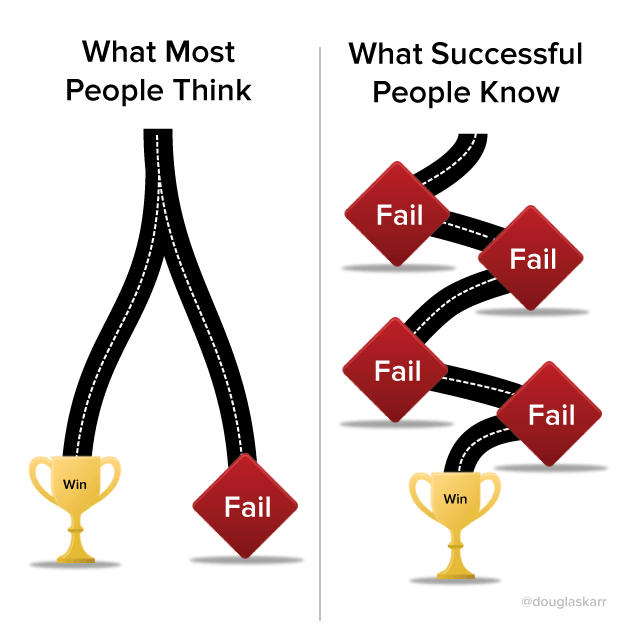
Some time ago, I encountered this image in the social media (attributed to Douglas Karr):
I noticed that at least some of my Facebook friends thought this was good advice - to remind that you cannot usually achieve success without failures, and one failure does not mean the end of the story. This makes sense. It reminds me of what Yoda said in The Empire Strikes Back: "Do or do not. There is no try."  - but isn't it unfair to judge people only based on the results where the only thing they can do is try?

In this "motivational" image, there is a trophy at the end. Successful people know that there is success (because they are successful). In this context, everything you do is a success or a failure, and you do everything because you want to succeed. To see how unsuccessful people might think given these assumptions, I proposed an addition:

Indeed - if almost everything you do is a failure, you may end up believing your whole life is a failure, and it ends in a failure.

I have listened to many wise men and women talk about their accomplishments. I have also succeeded and failed at many occassions. It is true that many experiences we have could easily be labeled as successes or failures - by somebody - but this binary classification might not be justified or fruitful.

If your company goes bust, is that a failure? Maybe you employed ten people for a couple of years, while you developed great products and technology and are now better prepared for anything that comes your way, and your investors knew this might happen and they were willing to take the risk. Doesn't sound like a complete failure (and doesn't make you an "unsuccessful person"), but that might very well be labeled as such, and only as such.

I have always tried to play it safe, and good things have come out of it while I have avoided many pitfalls. In 2010, I abandoned my safe life and financial security in Finland and moved to United States to get a degree. That was a leap of faith and a huge bank loan was part of the commitment. Maybe I also abandoned the idea that there are only successes and failures. In 2013, I'm still in USA, studying my second degree here. It hasn't been easy at all times, but somehow I'm going forward.

If you can't have binary labels, what would be a realistic but motivating framework? Abandoning Yoda's advice, I would say there is only try, and even if you can't do, you can often still try. And regarding Day for Failure, it seems life (or career) is a constant flux of things that can be seen as successes and failures of some sort, and failures are about trying something. Day for Trying, how's that sound?

Monday, October 7, 2013

Gravity: ridiculously implausible action fantasy

Gravity is in many ways the best and most beautiful space movie ever made. It depicts an ill-fated Space Shuttle mission that leaves two astronauts to attempt to survive - and cope with the gravity that is pulling them towards the Earth (well, there are some caveats with this explanation, which will be explained later).

I admit that I was critical of this movie once I read who were cast as the two astronauts for this film. For a realistic-looking serious film about astronauts trying to survive in space they had cast two of the most sexy and beautiful people on this planet - George Clooney and Sandra Bullock. I don't have qualms about their acting skills, but I thought it was strange that actors known for their sexiness were cast.

Casting

According to IMDB, George Clooney was cast as mission commander Matt Kowalski after Robert Downey, Jr. dropped out to scheduling conflicts. Sandra Bullock was cast as mission specialist Ryan Stone after Angelina Jolie dropped out and Rachel Weisz, Naomi Watts, Natalie Portman, Marion Cotillard, Abbie Cornish, Carey Mulligan, Sienna Miller, Scarlett Johansson, Blake Lively, Rebecca Hall and Olivia Wilde were approached. Boy, that is a lot of beautiful women! Is Sandra Bullock only the 13th most beautiful woman on this planet, after all?

Now, we enjoy seeing Clooney's and Bullock's faces. They are incredibly handsome and except for short scenes, that's almost all we see of them. That is probably why producers thought it was paramount that the only two faces seen in the whole film are recognizable and relatable. I still feel uneasy about the thought of how much they appreciated visual beauty of the actors - and the approached actresses are not known for roles as researchers or other technology-related roles. Bullock is especially known for romantic comedies and some action flicks (Speed 2 comes to mind). I was surprised to learn that Carrie-Anne Moss (Matrix, Mission to Mars) or Michelle Yeoh (Sunshine) were not even approached for this role!

Still, Clooney and Bullock perform as professionals and do everything they are expected to do. Their characters have been written to contrast each other: Kowalski is a man, Stone is a woman. Kowalski is a career astronaut, Stone a researcher. Kowalski is experienced and calm, Stone is inexperienced and frightened. Kowalski tells jokes and has good humor, Stone is a serious scientist. Kowalski knows exactly what to do and helps Stone to survive, Stone cries in panic. Kowalski is wearing the Extravehicular Mobility Unit (like a jetpac) needed for survival, Stone is not. Thanks to the Space Shuttle, many kinds of American (and other) astronauts have flown to space, and Eileen Collins (commander of STS-114) is one of the best known ones. In this sense, Kowalski and Stone feel like stereotypes and we have been these before - Robert Duvall's veteran astronaut Spurgeon Tanner in Deep Impact is one example. It is, of course, very convenient to introduce "easy" characters to the audience, so they can concentrate on other elements of the story.

Start of troubles

The film depicts STS-157, a fictional mission for Space Shuttle Explorer, servicing the Hubble Space Telescope, and is thus very much like the real HST Servicing Mission 4 (STS-125), flown in 2009. Near the end of the mission, the crew is told that a Russian space defence experiment goes awry and it results in a chain reaction of debris events which threaten both the shuttle and ISS. Explorer is ordered to abort the mission and ISS evacuated. Before the crew of Explorer can take any action, approaching debris destroys the shuttle and kills its crew, save for Kowalski and Stone, who are left hurtling in orbit.

It seems that Kowalski couldn't care much less about what has happened - he stays calm and helps Stone to come to terms with the new situation. The situation is depicted very realistically and it looks extremely good on the screen (expect for the 3D experience which I still think is a sham). Kowalski has the principle of concentrating to the task at hand and thinking methodologically, which is what all good pilots and astronauts do, and first they check out Explorer, which is a wreck. Knowing that they must find a safe haven in any case - to protect themselves for any additional debris and to make any rescue possible - they head for the ISS which is on the exact same orbit. What?! Since when has Hubble and ISS been on the same orbit?

This is where the film goes ridiculous. Kowalski says ISS is indeed nearby and we can see it clearly in the horizon. In real life, Hubble orbits at an altitude of roughly 650 km, with orbital inclination of 28.5 degrees. ISS orbits at 450 km and 51.65 degrees. Even though there are some passages in the dialog suggesting that they are, in fact, not on the same orbit, they have no trouble traveling from Explorer/Hubble to ISS in a couple of minutes, using EMU's thrusters.

From implausible to ridiculous

As implausible it is, they are able to reach the ISS and grasp the Soyuz spacecraft's deployed parachute, clinging to survival. Even though ISS has suffered some damage, it is intact. This is where Kowalski's extensive spaceflight experience would be crucial, as they might have to fly the Soyuz to the Chinese space station Tiangong (which is also on the same orbit!). However, without explaining why, Kowalski refuses to help Stone any more and sacrifices himself. Just like that he floats away, even though they had already succeeded in the most difficult part of the rescue.

For some mysterious reason, ISS does not have contact with Houston. It is difficult to understand why, because ISS is in constant contact with the TDRS communications satellites in the geostationary orbit, which is not affected by the debris in LEO. Anyway, ISS then blows up and Stone escapes in Soyuz, however she uses all its maneuvering fuel while trying to break free from its parachute. She also removes her helmet many times, even though it is clear that there is a great danger of depressurization. Even though she has spacewalk training, she has no trouble performing an unplanned EVA to detach the parachute, using the Russian Orlan space suit without its backpack. It is not explained why there was a Soyuz docked to ISS - a normal crew of six would have required both Soyuzes as escape ships!

Stone decides to commit suicide because she doesn't know what to do. Hallucinating, she sees Kowalski to return and give her advice. As implausible as this scene is, it is sadly almost believable in the context of the events in this film. Anyway, then Stone uses Soyuz's landing engines to propel it to Tiangong and she reaches it in minutes, and then ejects herself to the station. Now, it seems that they have a velocity difference of perhaps 1 km/s but that is rendered to nil with the help of a fire extinguisher. Stone has no trouble getting inside the space station, but at the same time, the station is reentering the atmosphere with no explanation. Why has its orbital altitude dropped from nominal 450 km to 150 km where it would reenter? With only minutes left, Stone enters the docked Shenzhou spacecraft (its crew having disappeared without explanation) and successfully lands it.

Stone clearly does not like to wear a helmet, even though there is a clear danger of depressurization. This disregard for safety achieves its climax when the ship lands in a lake. You see - even though 70 % of the Earth is water, for some reason this ship lands on land, except that it happens to find a small lake to land on. This has happened with a Soyuz spacecraft once. In 1976, Soyuz_23 landed on frozen Lake Tenzig and the crew waited in the capsule overnight for the rescue crew to arrive, with no immediate danger. All Soyuz landing capsules are equipped with an inflatable raft, food and even a gun to shoot wolves (no joke). I guess we can assume Stone had some reason to exit the craft, but then she almost drowned, as water poured in and she was not wearing a helmet. In seconds, she was able to exit from the Orlan spacesuit and swim to the shore.

The beautiful space

Practically never before have realistic (and real) spacecraft been shown on the screen in such a glory. I have never seen such advanced special effects - everything looked totally real. Before this film, Alfonso Cuarón had directed Children of Men, a thrilling yet very realistic-looking science fiction film that was met with high praise. Gravity sets new standards in the use of special effects that support the story. The depiction of zero-gravity environments is incredibly good and Bullock seems to have no trouble navigating through the ISS in the absence of gravity. Also, the idea of having only two actors in the movie and almost no sound except the masterful music by Steven Price is excellent and was realized surprisingly well and is a bold approach.

As beautifully as spaceships and debris in Gravity are done, there are many compromises. The dangerous space debris looks like a mild wind, bringing trash and dust. In reality, it might approach at 17 km/s, making it impossible to see it before it hits. It is also interesting how the debris hits and destroys absolutely everything except our protagonist astronauts and whatever spacecraft Stone happens to be in. 

This film is also an action fantasy film, like Armageddon. Very implausible things happen and we are supposed to believe them for the sake of entertainment, except that Gravity is portrayed as being a serious film. Instead of everything keeping blowing up, a very interesting and realistic story could have been built around the concept of escaping to ISS and then somehow managing to get rescued, with Kowalski, of course. Instead, ISS blows up and Stone escapes to Tiangong, which then blows up. In many ways, Armageddon was much more plausible - and it had official support from NASA, too.

This is the kind of semi-realistic science fiction that a couple of space-buff high school boys might come up with in their fantasies. In this case, they were given 55 million dollars to realize their fantasy and while the result is spectacular, it is also spectacularly implausible, which is a very bad thing for such an amicable attempt in original moviemaking. The packed and episodic script does not leave much room for reflection and more peaceful sequences where Stone might have come to terms with the situation. 


Sunday, September 29, 2013

Rush: the new 'Apollo 13'

I have been following Formula 1 racing since the late 1980's - and I have watched most races after Keke Rosberg's (champion 1982) protegee Mika Häkkinen started his career there in 1991. It's something I have discussed with my friends and other young people. But today, when I entered the auditorium 15 at Goodrich Quality 16 in Savoy, I saw mostly older people, in their fifties, sixties and seventies, in the audience. I double checked my ticket and yes, this was the right auditorium.

It is up to speculation why such large portion of the audience were not - as I anticipated - young adults. This is, after all, an intense film about racing, with some gore, sex, boobs and even drugs thrown in.

The film

This film is a depiction of the real story of two racing drivers' rivalry from 1970 to 1976, with special focus in the second half of the 1976 Formula 1 season.. It focuses very intensely on these two drivers and little on anything or anyone else. Just like the same director's (Ron Howard) Apollo 13 had James Lovell, NASA, Rockwell, Cape Canaveral, and just the right brand of peanuts, Rush has James Hunt, Niki Lauda, Marlboro Team McLaren, Scuderia Ferrari, Watkins Glen, Crystal Palace.

In addition to real people, real racing teams and real events, the real danger is depicted in the film. Many drivers really died during races (or during practice and qualification sessions) and Hunt often cites this as a driving force in his profession. Of his playboy lifestyle with passion and danger, he says "this is a nice way to live, but the only way to race". Seize the moment, because it may be your last - and we see on screen how people die - and yet the show goes on.

The 1970's as it happened

When I visited London in 2004, I found an interesting book at a bookstore. It was about the Formula One in 1970's, as told by a British photojournalist's photos. They were not faded black and white newspaper photos of red-tinted Polaroids but vivid glimpses into a colorful and exciting but also dirty and dangerous world, where big personalities fought but the order in which they crossed the finish line decided who won and championship points decided who was the champion. It was the very same world that I enterd in Rush.

Now, it is clear that the film takes some artistic liberties when depicting Hunt's and Lauda's rivalry, but exaggerating their differences and excluding almost everyone else - drivers and others alike - from the story. Especially the women are stereotypical supporting characters (often targets of Hunt's lust) - just like you might imagine wifes of racing drivers to be. The later part of the film revolves around individual races in 1975 and 1976 and the unpredictable and sometimes anticlimatic nature of racing may be problematic to screenwriting. Sometimes drivers just retire after a few laps because of technical problems, and these are depicted in the film - I am sure that if this was not based on a true story, the actual races would have been made more exciting!

Chris Hemsworth (Star Trek, Thor) is James Hunt. As Thor, he was somewhat awkward (as Thor is an awkward superhero), but here he is natural as a racer with passion, living in the moment. The experienced actor Daniel Brühl (Inglouriour Basterds) is Niki Lauda, methodological, disciplined businessman and talented Formula 2 racer who gets a surprise stint in Formula 1, being followed by Hunt, who despises his arrogant but intellectual attitude. I remember Hunt from some old photos and I remember I wondered how anybody would actually have hair like that - and how such a funny-looking guy could be a "playboy". But I was a kid, then.

Even though everything about this film is just supporting, the real persons depicted around Lauda and Hunt are portrayed very nicely. We meet Clay Regazzoni, Lauda's early teammate, Marlene, future Mrs. Lauda, Suzy, Hunt's first wife, and numerous team bosses and racers. Suzy ends up being a victim of Hunt's lifestyle (which apparently continued until his death in 1989), while Lauda is a determined family man. It seems that the film's portrayal of Hunt having sex with all ladies he meets is overshadowed by reality - he actually had sex with about five thousand women during his life.

Another Apollo 13

How good is this film? Very good. Just like Apollo 13, it brings into life a very specific historical period or event with ugly, beautiful and sometimes horrific things taking place, while anchoring the events to the world where they happen. Formula One of 2013 may be very different from 1976, but something is universal: fascination of auto racing - and while safer, the current series still has the speed and danger - and beautiful women.

And Niki Lauda. The serious, calculating Austrian racer, and survivor of the horrible accident during the German Grand Prix in 1976 which is the culmination of this film. In the 1980's - after retiring once - Lauda returned to F1 and won yet another championship in 1985. He became a businessman and airline CEO and still carries the scars of that near-fatal accident on his face. It is said that he was one of the first racers of the new type - the professional, methodological drivers, of whom Alain Prost, Mika Häkkinen and Michael Schumacher are good examples.

With a combination of real cars, places, people and computer-generated effects, the races are recreated in astonishing detail and naturalness. Especially the Japanese Grand Prix of 1976 looks... real. Cinematography is top-notch and supports the story.

Comparisons

As a film about racing, there are two other films I would compare it with. The first is Lee Katzin's Le Mans from 1971. It focuses on a single Le Mans 24-hour race with Steve McQueen as a fictional driver. The film concentrates on the aesthetics of driving, with much less emphasis on actual story. It is still a landmark in depiction of race driving. (I haven't seen the earlier film Grand Prix which is about Formula 1.)


Another comparison could be Robbie Williams' music video for Supreme, directed by Vaughan Arnell in 2001. Even though the song is not about racing, the video is a four-minute short film about  a fictious Formula 1 driver Bob Williams during the 1970 season, racing against Jackie Stewart. It combines archival footage and new video, placing Williams among real drivers of the 1970s. The character of Bob Williams might even be based on (in addition to Robbie Williams) James Hunt and Niki Lauda!

Conclusions

Why was this film made? What is its message? After seeing it, I don't know. Many times in the story, Hunt and Lauda discuss why they race. Hunt may do it for the passion and rush, Lauda because he is a businessman and it's his profession and while they cannot agree on this, they respect each other (though in real life, they were much less enemies than depicted here). I see different approaches to the same question which in itself is mindless: do you even need a reason?

In the beginning of Apollo 13, a congressman questions the whole space program. Jim Lovell and his crew had the passion, but lawmakers and the public were struggling to understand the motivation to fly to the Moon - as Armstrong & co. had already gone there. Now, the same question is still in air almost fifty years later, when people think about the past and future projects of the grand U.S. space program and ask why. For the overarching, super expensive, multinational and dangerous space programs, the motivation could be summarized "because it is there", which is not that much better than the motivation racers have for their sports.

A fascinating story about how skilled and fearless individuals tackle laws of physics and turn into immortal champions of the mankind. Am I talking about Rush or Apollo 13?

Monday, August 12, 2013

Second Amendment for gadgets

Many americans proudly carry a gun and enjoy the right to bear arms. This right is based on the Second Amendment to the United States Constitution and while it has been and still is controversial, it is accepted as part of rights every citizen of United State has (or should have).

Enter the third millennium. Personal electronic devices - gadgets - are everywhere, and not oly in the western world. They are used to make phone calls, receive and send emails, update Facebook statuses, send photos, listen to music, process (send and receive) payments, do airline check-ins and so on. This use may be impolite, improper or even illegal in some cases, but most of it augments our connectivity and communication in the society and enables many things that would otherwise be impossible.

In the post-9/11 craze (or security theatre) gadgets are seen as suspicious. Certain digital wrist watch model makes you a terrorist suspect. Cinemas tell you to switch your gadgets off for no purpose (ok ok, they want you not to disturb others and also not to take video of the movie, but the first can be accomplished by putting the phone to silent mode and latter can be accomplished by not doing it). In many public spaces there are signs telling you that you must not take photos (even though based on the law you can). Police officers seem to have a problem with recording devices, as there are so many stories of them telling citizens to stop recording what they say.

Gadgets, as electronic devices, should be turned off for takeoff and landing of an airplane and there are limits for their use. At the same time, they don't kill people and taking photos of governmental buildings and recording what a police officer says are not criminal or improper actions. They could even be self-defence - the right to which Americans hold so dear.

Perhaps there should be a "second amendment" for gadgets as well? It would define, for example, that everyone have the right to own and carry gadgets everywhere without fear of inspection or limitations, except for in separately defined situations where misuse could violate privacy or cause danger to others (hospitals, airplanes).

It would also limit or at least make clear what authorities can do with mobile devices. For example, can they remotely interfere with their operation, like disable certain features? Are the contents of a mobile device subject to search at the border? Is the owner required to let authorities inspect the contents (and give access to encrypted mass storage)? What is the definition of "property" in the case of the contents of mobile devices?

On the other hand, the concept of gadgets is relatively new, and in ten years the situation might be different. But in the meantime, the world still has trouble relating to them and authorities and lawyers debate on what the legal status of the devices and their use is, and what rights the owner (and carrier) has or has not over them. A more general law of digital property and "digital rights" is clearly needed.

Sunday, August 11, 2013

My take on Elysium

The long-awaited Elysium, Neill Blomkamp's grim vision of Earth in 2154, arrived to theaters in USA this week. It is Blompamp's - a young collaborator of Peter Jackson's - only second feature film, after the acclaimed District 9. A native of South Africa, Blomkamp seems attracted to overpopulation, ravaged cities and social injustice, and in this sense Elysium looks like another District 9 (2009), just one with bigger budget and Matt Damon.


I enjoyed District 9. It was a fresh look into the theme of aliens arriving to Earth for whatever reason. Its special effects were refreshing too, and Sharlto Copley's main character was an official with personality and humor. Copley is back in Elysium as well, and so are so many other things from Blomakmp's South African team.

I enjoyed Elysium. It is indeed a well made movie, but not different enough from the director's previous movie and it suffers from some of the same problems.

The idea of the mankind having split into two populations - one rich and privileged, other poor and disadvantaged - isn't a new concept, even H. G. Wells explored this idea in The Time Machine. The space habitat Elysium is reminiscent of visions of Wehrner von Braun and others. The dystopian Earth reminds me of worlds of RoboCop, Judge Dredd and Blade Runner (well, at least a bit). The plot just isn't that novel, but execution is mostly outstanding, with Matt Damon as an English-speaking hero who ends up carrying Elysium's bootstrap code in his head.

The first problem is the casting of a big name like Matt Damon. He is a well-known American (action) movie star. The scenes of Earth were filmed around Mexico City, with most of the people on screen being Spanish-speaking Mexicans. Of course, this is supposed to be the future Los Angeles, but the friendly English-speaking Matt Damon sticks out. A less-known Mexican actor would have been a more suitable choice for the main role. Damon still plays the character of da Costa well and delivers a good performance both dramatically and actionwise - and there is maybe too much action in this film.

However, then there is Jodie Foster. I fet like her role as the "evil", overprotective secretary Jessica Delacourt was one-dimensional and just a rehash of her role as Madeleine White in Inside Man (2006). There was no real justification for her actions, she is just the classic stupid antagonist. Sadly, she reminds me of the evil bad guy Hein of Final Fantasy (2001).

The most delicious part of the film is whenever the insane mercenary Kruger - played by Sharlto Copley - is on the screen. He heads an apparently South African mercenary team supported by Elysium and Jessica Delacourt. He is blatantly repulsive, ugly and wicked. However, his interactions with da Costa are largely about shooting weapons and hitting each other with the help of their exoskeletons. This is what plagued District 9 as well - there is too much action and too many explosions that take the stage from drama and meaningful story.


I generally liked the use of information technology in the story, but even though some thought had been put into the design of all the technology, it is still plagued by some classic Hollywood  shortcomings - such as source code showing when a program is loaded and executed, errors appearing in huge popup dialogs instead of command line and so on. Come on, you can do better. In so many instances in this film, they knew what they were doing, so why deviate from that?

Since Elysium is in space (low Earth orbit), you need a spacecraft to travel there. Perhaps surprisingly, the airships (jet-powered craft with no wings) can fly there without problems. Generally, the spaceflight part of the movie was handled very badly - it is like nobody cared a bit how you actually fly to space. In order to reach the orbit of Elysium, you need a delta-v of about 8.5 km/s and it is not easy to imagine how a simple helicopter-like craft could possible carry enough fuel to attain that speed. In addition, it seems all you have to do is to aim for Elysium and accelerate. Orbital mechanics don't work that way. It was also showed how craft approach directly from Earth's direction, constantly accelerating. If they were already on the same orbit, they could have just approached, using their fuel to try to evade the interceptor missiles, and of course decelerated to be able to match their speed with Elysium's habitat ring.

Elysium itself was nice, but boring. The idea of the habitat lacking a "ceiling" is interesting. The centrifugal force might not be able to hold the atmosphere against the habitat in real life, but if Elysium was larger, it might. In any case, the construction and early evolution of Elysium might be a good topic for a comic book treatment (and another movie?).

Even though the supporting cast was excellent, the characters of Damon and Foster did much for the film to appear like another bland blockbuster. Production design by Philip Ivey was excellent, and he was the production designer for District 9 as well.

Social commentary? Just like in District 9, there is a lot, sometimes even stereotypical (overpopulation, electronic music). The director readily says this is an allegory of the world today. Maybe that justifies some of the blockbuster approach, to appeal bigger audience and introduce them to the scifi world that is not too far away from our reality?

The ending was nice with the medical shuttles. It's difficult to say how well Elysium's resources would have helped Earth's population, but the ending implies they now get the equal treatment. Much of the film I was wondering whether Elysium was like royal courts of Middle Ages where a very small minority of population enjoyed high standards of living, with art and sciences supported by them, with no means to actually spread that wealth to the ordinary folk ravaged by plague and famine.

Tuesday, July 30, 2013

Reflections on Second Reality's 20 years

It's easy to say that Second Reality is one of the best known demos ever - that is, creative computer art productions combining software-generated visual effects and electronic music, being the cornerstone of the international demoscene.


Assembly '93

In the evening of Saturday, July 31, 1993, I was in Kerava, Finland, attending Assembly '93 computer party with around 1,500 other male demosceners (and maybe 5 female ones). I had met many new friends, shared some music I'd composed with my Amiga 500 and discussed about what the future of PC demoscene might be - so far, most of the interesting stuff was released on Amiga 500 (and some still on Commodore 64, too). Even though Amiga 500 was already about six years old, new and fantastic demos were being released every month, and Spaceballs' State of the Art was only eight months old at that time.

The gymnastics hall of Nikkari School was packed full and it was difficult to get a good view of the picture which was projected on the wall. I missed most of the PC productions - running on a PC with i486 processor running at 33 MHz - and they looked like uninspired technology demos anyway, avoid of real awesomeness and flowing creativity Amiga demos had. After all, Amiga had been conceived as a multimedia machine with special processors for video and sound, making very impressive effects possible. Indeed, I got bored with Second Reality when it was shown and went to see if any DDG members were around.

I couldn't find my friends, so I went back to the main hall, where I saw the Future Crew logo turn up on the screen and heard the crowd going nuts with cheering and applauding. One of my new friends came to me and said "did you see that? that was an insane demo!". Well, I didn't, and while the Amiga demo competition was a disappointment, I was very impressed with Pygmy Projects' Extension (which won that competition).

Later, when I had already returned home I heard Future Crew won the PC demo competition with its demo Second Reality. Silents' Optic Nerve came second. At that point, I didn't care that much - more attention was brought to the status of Amiga scene, now that the Assembly '93 Amiga demo competition was not on par with the PC demo competition. Only later - actually, at Aggressive Party - I heard rumors that the demo had been something special, or there might actually even be cheating involved.

People told me that Second Reality, made by people who also organized the Assembly '93 event, had been disqualified and Silents won the competition instead. This was due to the fact that the demo contained a picture "Ice Kingdom" by Marvel that entered the PC graphics competition (and won it) and this was against rules. Some also thought it was unfair that the demo used Dolby Surround sound and others didn't, and blamed Future Crew to be some kind of "Microsoft of the demoscene", a bunch of arrogant spoiled kids. I was also told that the demo wasn't even good, because it required such a powerful machine to run. This made sense, because the scrolling scenery at the start looked uglier that it would have on Amiga 500. In any case, I liked Silents' demo better, because it was more traditional and "Amiga-like".

Here's a documentary video of Future Crew making some final touches to their almost complete demo:

Reputation grows

Remember, we (or most of us) didn't have Internet at the time, and information was exchanged on bulletin board systems. Many of them were underground, or "elite", so that they were not listed in public BBS lists, and centered about demoscene and/or warez (cracked games). Sometimes information was unreliable, usually it was just old, unless you knew the right people and had access to the right BBS's.

Sure, Silent's Optic Nerve was a fine demo, but... Second Reality just became more and more popular. The Assembly demoparty grew as well and while it was no longer officially organized by Future Crew (but "Assembly Organizing"), many of its core organizers (Gore and Abyss) were from FC, which helped Second Reality's visibility. At Assembly '94 it was shown on the big screen, and many visitors' own computers. And also at Assembly '95, '96 and '97...

The "vector city" end part which was considered quite a feat back then...
Future Crew itself seemed to implode after Second Reality. There were rumors (which later turned out to be true) tha they were indeed preparing a demo for Assembly '94, but as it wouldn't have been completed in time, it wasn't released. Instead, FC participated in the PC intro competition with their Soppa, an unremarkable production that became the last release from Future Crew, ever.

People kept talking about Second Reality while they also debated the sad state of Amiga. Commodore had declared bankrupcy in 1994 and while the new Amiga models with AGA chipset showed a renewed interest in the platform, it was still very much a hobbyist scene, whereas PC's became more and more powerful with standardized SuperVGA graphics and soon, 16-bit sound, and seemed to be the platform of the future, Windows or not. Second Reality became a showcase item - to be shown to new people interested in demoscene.

What makes Second Reality special

It was (and is?) easy to hate PC's. They were clumsy, expensive business machines. Maybe powerful, but not suitable for games or anything fun. Many early PC demos lacked design and synchronization with the soundtrack. Future Crew had already shown promise with its demos Unreal (which Second Reality was a sequel to) and Panic, but Second Reality was a seamless (yet a bit episodic) combination of sound and visuals. And unlike fancy but boring tech demos, Second Reality had a lot of novel new effects and fresh treatments of traditional effects, and of course stuff that couldn't be done on Amiga, such as the vector city in the end.

Everything (except for the scenery at the start) was smooth, flowing, seamless. The masterful soundtrack by Jonne "Purple Motion" Valtonen and Peter "Skaven" Hajba was a critical part of the demo, combining trendy electronic music and orchestral elements. It was composed using the group's own composer software, ScreamTracker 3 (which was not yet released to the public at that time). The soundtrack used high-quality samples, melodies and rhythms in a creative fashion, which distinguished it from usual "mod techno" soundtracks of many Amiga demos. For me, the credits part's orchestration is a textbook example of how to make other than typical electronic dance music with a tracker software.

Commodore 64 version


Second Reality was a benchmark in many ways. The Commodore 64 demoscene (which will probably never die) was looking for modern inspiration and in 1997, the Smash Designs released a Commodore 64 version of the demo at The Party '97. It won the Commodore 64 demo competition and has often been cited as one of the best demos on the platform, but has also drawn criticism to the fact that it is not a completely original production, but just a C64 version of an existing production.

The C64 version of the classic demo is both a tribute to the PC demo and also an outstanding attempt to replicate the effects on the ancient 8-bit platform. I saw this at the demo showing by Club for Digital Media DOT and was astonished. This "conversion" was so well done yet still stylish and the music was awesome.
Sure, you don't have all the CPU power of an 80486, but this demo makes the best of what it has.

At this point is was evident that Second Reality had left its mark in the computer culture and visual arts. Later, I heard the demo had spread outside the demoscene quite early, with U.S. business people wondering how this production was even possible.

In 1999, Slashdot voted Second Reality as one of the "Slashdot's Top 10 Hacks of All Time", among Mars Pathfinder, AK-47 and Lockheed SR-71 Blackbird.

Legacy

In 2013, Second Reality still matters, whether we like it or not. ;-) It is one of the best known demos ever and often mentioned in the company of Spaceballs' State of the Art, Complex's Mental Hangover and Mature Furk's Lapsuus.

Now that Second Reality's 20th anniversary is approaching, members of the defunct Future Crew are planning to release the source code for the demo. Like many other demosceners, members of Future Crew have ended up as designers, coders and musicians in the Finnish (or international) game industry, with companies like Remedy, Futuremark, Remedy, Bugbear and Recoil having been (co-)founded by them.

While Second Reality has been a good starting point or portal to the demoscene for many, now it may take some explaining to tell people (who might not have been born in 1993!) what makes this demo special, or why producing visual effects on the computers of the 1980's and 1990's was so difficult. Still, people who have no idea how they are made, can (often) still appreciate the "music video" aspect of demos, being fascinating audiovisual experiences even for the uninitiated.

The Amiga demo competition at Assembly '93 was a disappointment, but Amiga did strike back in 1994 and it still hasn't died. The Amiga group The Black Lotus, among others, have shown that production of quality demos on the Amiga did not end in 1993. Aside from being a milestone in PC demoscene, Second Reality is a milestone in creative approach to programming and computing in general, something which is way too much missing in the education, profession and hobby of computing 2013.