Sunday, September 29, 2013

Rush: the new 'Apollo 13'

I have been following Formula 1 racing since the late 1980's - and I have watched most races after Keke Rosberg's (champion 1982) protegee Mika Häkkinen started his career there in 1991. It's something I have discussed with my friends and other young people. But today, when I entered the auditorium 15 at Goodrich Quality 16 in Savoy, I saw mostly older people, in their fifties, sixties and seventies, in the audience. I double checked my ticket and yes, this was the right auditorium.

It is up to speculation why such large portion of the audience were not - as I anticipated - young adults. This is, after all, an intense film about racing, with some gore, sex, boobs and even drugs thrown in.

The film

This film is a depiction of the real story of two racing drivers' rivalry from 1970 to 1976, with special focus in the second half of the 1976 Formula 1 season.. It focuses very intensely on these two drivers and little on anything or anyone else. Just like the same director's (Ron Howard) Apollo 13 had James Lovell, NASA, Rockwell, Cape Canaveral, and just the right brand of peanuts, Rush has James Hunt, Niki Lauda, Marlboro Team McLaren, Scuderia Ferrari, Watkins Glen, Crystal Palace.

In addition to real people, real racing teams and real events, the real danger is depicted in the film. Many drivers really died during races (or during practice and qualification sessions) and Hunt often cites this as a driving force in his profession. Of his playboy lifestyle with passion and danger, he says "this is a nice way to live, but the only way to race". Seize the moment, because it may be your last - and we see on screen how people die - and yet the show goes on.

The 1970's as it happened

When I visited London in 2004, I found an interesting book at a bookstore. It was about the Formula One in 1970's, as told by a British photojournalist's photos. They were not faded black and white newspaper photos of red-tinted Polaroids but vivid glimpses into a colorful and exciting but also dirty and dangerous world, where big personalities fought but the order in which they crossed the finish line decided who won and championship points decided who was the champion. It was the very same world that I enterd in Rush.

Now, it is clear that the film takes some artistic liberties when depicting Hunt's and Lauda's rivalry, but exaggerating their differences and excluding almost everyone else - drivers and others alike - from the story. Especially the women are stereotypical supporting characters (often targets of Hunt's lust) - just like you might imagine wifes of racing drivers to be. The later part of the film revolves around individual races in 1975 and 1976 and the unpredictable and sometimes anticlimatic nature of racing may be problematic to screenwriting. Sometimes drivers just retire after a few laps because of technical problems, and these are depicted in the film - I am sure that if this was not based on a true story, the actual races would have been made more exciting!

Chris Hemsworth (Star Trek, Thor) is James Hunt. As Thor, he was somewhat awkward (as Thor is an awkward superhero), but here he is natural as a racer with passion, living in the moment. The experienced actor Daniel Brühl (Inglouriour Basterds) is Niki Lauda, methodological, disciplined businessman and talented Formula 2 racer who gets a surprise stint in Formula 1, being followed by Hunt, who despises his arrogant but intellectual attitude. I remember Hunt from some old photos and I remember I wondered how anybody would actually have hair like that - and how such a funny-looking guy could be a "playboy". But I was a kid, then.

Even though everything about this film is just supporting, the real persons depicted around Lauda and Hunt are portrayed very nicely. We meet Clay Regazzoni, Lauda's early teammate, Marlene, future Mrs. Lauda, Suzy, Hunt's first wife, and numerous team bosses and racers. Suzy ends up being a victim of Hunt's lifestyle (which apparently continued until his death in 1989), while Lauda is a determined family man. It seems that the film's portrayal of Hunt having sex with all ladies he meets is overshadowed by reality - he actually had sex with about five thousand women during his life.

Another Apollo 13

How good is this film? Very good. Just like Apollo 13, it brings into life a very specific historical period or event with ugly, beautiful and sometimes horrific things taking place, while anchoring the events to the world where they happen. Formula One of 2013 may be very different from 1976, but something is universal: fascination of auto racing - and while safer, the current series still has the speed and danger - and beautiful women.

And Niki Lauda. The serious, calculating Austrian racer, and survivor of the horrible accident during the German Grand Prix in 1976 which is the culmination of this film. In the 1980's - after retiring once - Lauda returned to F1 and won yet another championship in 1985. He became a businessman and airline CEO and still carries the scars of that near-fatal accident on his face. It is said that he was one of the first racers of the new type - the professional, methodological drivers, of whom Alain Prost, Mika Häkkinen and Michael Schumacher are good examples.

With a combination of real cars, places, people and computer-generated effects, the races are recreated in astonishing detail and naturalness. Especially the Japanese Grand Prix of 1976 looks... real. Cinematography is top-notch and supports the story.

Comparisons

As a film about racing, there are two other films I would compare it with. The first is Lee Katzin's Le Mans from 1971. It focuses on a single Le Mans 24-hour race with Steve McQueen as a fictional driver. The film concentrates on the aesthetics of driving, with much less emphasis on actual story. It is still a landmark in depiction of race driving. (I haven't seen the earlier film Grand Prix which is about Formula 1.)


Another comparison could be Robbie Williams' music video for Supreme, directed by Vaughan Arnell in 2001. Even though the song is not about racing, the video is a four-minute short film about  a fictious Formula 1 driver Bob Williams during the 1970 season, racing against Jackie Stewart. It combines archival footage and new video, placing Williams among real drivers of the 1970s. The character of Bob Williams might even be based on (in addition to Robbie Williams) James Hunt and Niki Lauda!

Conclusions

Why was this film made? What is its message? After seeing it, I don't know. Many times in the story, Hunt and Lauda discuss why they race. Hunt may do it for the passion and rush, Lauda because he is a businessman and it's his profession and while they cannot agree on this, they respect each other (though in real life, they were much less enemies than depicted here). I see different approaches to the same question which in itself is mindless: do you even need a reason?

In the beginning of Apollo 13, a congressman questions the whole space program. Jim Lovell and his crew had the passion, but lawmakers and the public were struggling to understand the motivation to fly to the Moon - as Armstrong & co. had already gone there. Now, the same question is still in air almost fifty years later, when people think about the past and future projects of the grand U.S. space program and ask why. For the overarching, super expensive, multinational and dangerous space programs, the motivation could be summarized "because it is there", which is not that much better than the motivation racers have for their sports.

A fascinating story about how skilled and fearless individuals tackle laws of physics and turn into immortal champions of the mankind. Am I talking about Rush or Apollo 13?

Monday, August 12, 2013

Second Amendment for gadgets

Many americans proudly carry a gun and enjoy the right to bear arms. This right is based on the Second Amendment to the United States Constitution and while it has been and still is controversial, it is accepted as part of rights every citizen of United State has (or should have).

Enter the third millennium. Personal electronic devices - gadgets - are everywhere, and not oly in the western world. They are used to make phone calls, receive and send emails, update Facebook statuses, send photos, listen to music, process (send and receive) payments, do airline check-ins and so on. This use may be impolite, improper or even illegal in some cases, but most of it augments our connectivity and communication in the society and enables many things that would otherwise be impossible.

In the post-9/11 craze (or security theatre) gadgets are seen as suspicious. Certain digital wrist watch model makes you a terrorist suspect. Cinemas tell you to switch your gadgets off for no purpose (ok ok, they want you not to disturb others and also not to take video of the movie, but the first can be accomplished by putting the phone to silent mode and latter can be accomplished by not doing it). In many public spaces there are signs telling you that you must not take photos (even though based on the law you can). Police officers seem to have a problem with recording devices, as there are so many stories of them telling citizens to stop recording what they say.

Gadgets, as electronic devices, should be turned off for takeoff and landing of an airplane and there are limits for their use. At the same time, they don't kill people and taking photos of governmental buildings and recording what a police officer says are not criminal or improper actions. They could even be self-defence - the right to which Americans hold so dear.

Perhaps there should be a "second amendment" for gadgets as well? It would define, for example, that everyone have the right to own and carry gadgets everywhere without fear of inspection or limitations, except for in separately defined situations where misuse could violate privacy or cause danger to others (hospitals, airplanes).

It would also limit or at least make clear what authorities can do with mobile devices. For example, can they remotely interfere with their operation, like disable certain features? Are the contents of a mobile device subject to search at the border? Is the owner required to let authorities inspect the contents (and give access to encrypted mass storage)? What is the definition of "property" in the case of the contents of mobile devices?

On the other hand, the concept of gadgets is relatively new, and in ten years the situation might be different. But in the meantime, the world still has trouble relating to them and authorities and lawyers debate on what the legal status of the devices and their use is, and what rights the owner (and carrier) has or has not over them. A more general law of digital property and "digital rights" is clearly needed.

Sunday, August 11, 2013

My take on Elysium

The long-awaited Elysium, Neill Blomkamp's grim vision of Earth in 2154, arrived to theaters in USA this week. It is Blompamp's - a young collaborator of Peter Jackson's - only second feature film, after the acclaimed District 9. A native of South Africa, Blomkamp seems attracted to overpopulation, ravaged cities and social injustice, and in this sense Elysium looks like another District 9 (2009), just one with bigger budget and Matt Damon.


I enjoyed District 9. It was a fresh look into the theme of aliens arriving to Earth for whatever reason. Its special effects were refreshing too, and Sharlto Copley's main character was an official with personality and humor. Copley is back in Elysium as well, and so are so many other things from Blomakmp's South African team.

I enjoyed Elysium. It is indeed a well made movie, but not different enough from the director's previous movie and it suffers from some of the same problems.

The idea of the mankind having split into two populations - one rich and privileged, other poor and disadvantaged - isn't a new concept, even H. G. Wells explored this idea in The Time Machine. The space habitat Elysium is reminiscent of visions of Wehrner von Braun and others. The dystopian Earth reminds me of worlds of RoboCop, Judge Dredd and Blade Runner (well, at least a bit). The plot just isn't that novel, but execution is mostly outstanding, with Matt Damon as an English-speaking hero who ends up carrying Elysium's bootstrap code in his head.

The first problem is the casting of a big name like Matt Damon. He is a well-known American (action) movie star. The scenes of Earth were filmed around Mexico City, with most of the people on screen being Spanish-speaking Mexicans. Of course, this is supposed to be the future Los Angeles, but the friendly English-speaking Matt Damon sticks out. A less-known Mexican actor would have been a more suitable choice for the main role. Damon still plays the character of da Costa well and delivers a good performance both dramatically and actionwise - and there is maybe too much action in this film.

However, then there is Jodie Foster. I fet like her role as the "evil", overprotective secretary Jessica Delacourt was one-dimensional and just a rehash of her role as Madeleine White in Inside Man (2006). There was no real justification for her actions, she is just the classic stupid antagonist. Sadly, she reminds me of the evil bad guy Hein of Final Fantasy (2001).

The most delicious part of the film is whenever the insane mercenary Kruger - played by Sharlto Copley - is on the screen. He heads an apparently South African mercenary team supported by Elysium and Jessica Delacourt. He is blatantly repulsive, ugly and wicked. However, his interactions with da Costa are largely about shooting weapons and hitting each other with the help of their exoskeletons. This is what plagued District 9 as well - there is too much action and too many explosions that take the stage from drama and meaningful story.


I generally liked the use of information technology in the story, but even though some thought had been put into the design of all the technology, it is still plagued by some classic Hollywood  shortcomings - such as source code showing when a program is loaded and executed, errors appearing in huge popup dialogs instead of command line and so on. Come on, you can do better. In so many instances in this film, they knew what they were doing, so why deviate from that?

Since Elysium is in space (low Earth orbit), you need a spacecraft to travel there. Perhaps surprisingly, the airships (jet-powered craft with no wings) can fly there without problems. Generally, the spaceflight part of the movie was handled very badly - it is like nobody cared a bit how you actually fly to space. In order to reach the orbit of Elysium, you need a delta-v of about 8.5 km/s and it is not easy to imagine how a simple helicopter-like craft could possible carry enough fuel to attain that speed. In addition, it seems all you have to do is to aim for Elysium and accelerate. Orbital mechanics don't work that way. It was also showed how craft approach directly from Earth's direction, constantly accelerating. If they were already on the same orbit, they could have just approached, using their fuel to try to evade the interceptor missiles, and of course decelerated to be able to match their speed with Elysium's habitat ring.

Elysium itself was nice, but boring. The idea of the habitat lacking a "ceiling" is interesting. The centrifugal force might not be able to hold the atmosphere against the habitat in real life, but if Elysium was larger, it might. In any case, the construction and early evolution of Elysium might be a good topic for a comic book treatment (and another movie?).

Even though the supporting cast was excellent, the characters of Damon and Foster did much for the film to appear like another bland blockbuster. Production design by Philip Ivey was excellent, and he was the production designer for District 9 as well.

Social commentary? Just like in District 9, there is a lot, sometimes even stereotypical (overpopulation, electronic music). The director readily says this is an allegory of the world today. Maybe that justifies some of the blockbuster approach, to appeal bigger audience and introduce them to the scifi world that is not too far away from our reality?

The ending was nice with the medical shuttles. It's difficult to say how well Elysium's resources would have helped Earth's population, but the ending implies they now get the equal treatment. Much of the film I was wondering whether Elysium was like royal courts of Middle Ages where a very small minority of population enjoyed high standards of living, with art and sciences supported by them, with no means to actually spread that wealth to the ordinary folk ravaged by plague and famine.

Tuesday, July 30, 2013

Reflections on Second Reality's 20 years

It's easy to say that Second Reality is one of the best known demos ever - that is, creative computer art productions combining software-generated visual effects and electronic music, being the cornerstone of the international demoscene.


Assembly '93

In the evening of Saturday, July 31, 1993, I was in Kerava, Finland, attending Assembly '93 computer party with around 1,500 other male demosceners (and maybe 5 female ones). I had met many new friends, shared some music I'd composed with my Amiga 500 and discussed about what the future of PC demoscene might be - so far, most of the interesting stuff was released on Amiga 500 (and some still on Commodore 64, too). Even though Amiga 500 was already about six years old, new and fantastic demos were being released every month, and Spaceballs' State of the Art was only eight months old at that time.

The gymnastics hall of Nikkari School was packed full and it was difficult to get a good view of the picture which was projected on the wall. I missed most of the PC productions - running on a PC with i486 processor running at 33 MHz - and they looked like uninspired technology demos anyway, avoid of real awesomeness and flowing creativity Amiga demos had. After all, Amiga had been conceived as a multimedia machine with special processors for video and sound, making very impressive effects possible. Indeed, I got bored with Second Reality when it was shown and went to see if any DDG members were around.

I couldn't find my friends, so I went back to the main hall, where I saw the Future Crew logo turn up on the screen and heard the crowd going nuts with cheering and applauding. One of my new friends came to me and said "did you see that? that was an insane demo!". Well, I didn't, and while the Amiga demo competition was a disappointment, I was very impressed with Pygmy Projects' Extension (which won that competition).

Later, when I had already returned home I heard Future Crew won the PC demo competition with its demo Second Reality. Silents' Optic Nerve came second. At that point, I didn't care that much - more attention was brought to the status of Amiga scene, now that the Assembly '93 Amiga demo competition was not on par with the PC demo competition. Only later - actually, at Aggressive Party - I heard rumors that the demo had been something special, or there might actually even be cheating involved.

People told me that Second Reality, made by people who also organized the Assembly '93 event, had been disqualified and Silents won the competition instead. This was due to the fact that the demo contained a picture "Ice Kingdom" by Marvel that entered the PC graphics competition (and won it) and this was against rules. Some also thought it was unfair that the demo used Dolby Surround sound and others didn't, and blamed Future Crew to be some kind of "Microsoft of the demoscene", a bunch of arrogant spoiled kids. I was also told that the demo wasn't even good, because it required such a powerful machine to run. This made sense, because the scrolling scenery at the start looked uglier that it would have on Amiga 500. In any case, I liked Silents' demo better, because it was more traditional and "Amiga-like".

Here's a documentary video of Future Crew making some final touches to their almost complete demo:

Reputation grows

Remember, we (or most of us) didn't have Internet at the time, and information was exchanged on bulletin board systems. Many of them were underground, or "elite", so that they were not listed in public BBS lists, and centered about demoscene and/or warez (cracked games). Sometimes information was unreliable, usually it was just old, unless you knew the right people and had access to the right BBS's.

Sure, Silent's Optic Nerve was a fine demo, but... Second Reality just became more and more popular. The Assembly demoparty grew as well and while it was no longer officially organized by Future Crew (but "Assembly Organizing"), many of its core organizers (Gore and Abyss) were from FC, which helped Second Reality's visibility. At Assembly '94 it was shown on the big screen, and many visitors' own computers. And also at Assembly '95, '96 and '97...

The "vector city" end part which was considered quite a feat back then...
Future Crew itself seemed to implode after Second Reality. There were rumors (which later turned out to be true) tha they were indeed preparing a demo for Assembly '94, but as it wouldn't have been completed in time, it wasn't released. Instead, FC participated in the PC intro competition with their Soppa, an unremarkable production that became the last release from Future Crew, ever.

People kept talking about Second Reality while they also debated the sad state of Amiga. Commodore had declared bankrupcy in 1994 and while the new Amiga models with AGA chipset showed a renewed interest in the platform, it was still very much a hobbyist scene, whereas PC's became more and more powerful with standardized SuperVGA graphics and soon, 16-bit sound, and seemed to be the platform of the future, Windows or not. Second Reality became a showcase item - to be shown to new people interested in demoscene.

What makes Second Reality special

It was (and is?) easy to hate PC's. They were clumsy, expensive business machines. Maybe powerful, but not suitable for games or anything fun. Many early PC demos lacked design and synchronization with the soundtrack. Future Crew had already shown promise with its demos Unreal (which Second Reality was a sequel to) and Panic, but Second Reality was a seamless (yet a bit episodic) combination of sound and visuals. And unlike fancy but boring tech demos, Second Reality had a lot of novel new effects and fresh treatments of traditional effects, and of course stuff that couldn't be done on Amiga, such as the vector city in the end.

Everything (except for the scenery at the start) was smooth, flowing, seamless. The masterful soundtrack by Jonne "Purple Motion" Valtonen and Peter "Skaven" Hajba was a critical part of the demo, combining trendy electronic music and orchestral elements. It was composed using the group's own composer software, ScreamTracker 3 (which was not yet released to the public at that time). The soundtrack used high-quality samples, melodies and rhythms in a creative fashion, which distinguished it from usual "mod techno" soundtracks of many Amiga demos. For me, the credits part's orchestration is a textbook example of how to make other than typical electronic dance music with a tracker software.

Commodore 64 version


Second Reality was a benchmark in many ways. The Commodore 64 demoscene (which will probably never die) was looking for modern inspiration and in 1997, the Smash Designs released a Commodore 64 version of the demo at The Party '97. It won the Commodore 64 demo competition and has often been cited as one of the best demos on the platform, but has also drawn criticism to the fact that it is not a completely original production, but just a C64 version of an existing production.

The C64 version of the classic demo is both a tribute to the PC demo and also an outstanding attempt to replicate the effects on the ancient 8-bit platform. I saw this at the demo showing by Club for Digital Media DOT and was astonished. This "conversion" was so well done yet still stylish and the music was awesome.
Sure, you don't have all the CPU power of an 80486, but this demo makes the best of what it has.

At this point is was evident that Second Reality had left its mark in the computer culture and visual arts. Later, I heard the demo had spread outside the demoscene quite early, with U.S. business people wondering how this production was even possible.

In 1999, Slashdot voted Second Reality as one of the "Slashdot's Top 10 Hacks of All Time", among Mars Pathfinder, AK-47 and Lockheed SR-71 Blackbird.

Legacy

In 2013, Second Reality still matters, whether we like it or not. ;-) It is one of the best known demos ever and often mentioned in the company of Spaceballs' State of the Art, Complex's Mental Hangover and Mature Furk's Lapsuus.

Now that Second Reality's 20th anniversary is approaching, members of the defunct Future Crew are planning to release the source code for the demo. Like many other demosceners, members of Future Crew have ended up as designers, coders and musicians in the Finnish (or international) game industry, with companies like Remedy, Futuremark, Remedy, Bugbear and Recoil having been (co-)founded by them.

While Second Reality has been a good starting point or portal to the demoscene for many, now it may take some explaining to tell people (who might not have been born in 1993!) what makes this demo special, or why producing visual effects on the computers of the 1980's and 1990's was so difficult. Still, people who have no idea how they are made, can (often) still appreciate the "music video" aspect of demos, being fascinating audiovisual experiences even for the uninitiated.

The Amiga demo competition at Assembly '93 was a disappointment, but Amiga did strike back in 1994 and it still hasn't died. The Amiga group The Black Lotus, among others, have shown that production of quality demos on the Amiga did not end in 1993. Aside from being a milestone in PC demoscene, Second Reality is a milestone in creative approach to programming and computing in general, something which is way too much missing in the education, profession and hobby of computing 2013. 

Saturday, July 27, 2013

Qantas and the gender discrimination of passengers

Some airlines have a policy that states that adult men may not be seated next to minors travelling alone. The reason is that many men are pedophiles and child molesters and the airlines want to ensure the safety of the children.

That's right, Qantas is operating the new Airbus A380, which everybody should try at least once (photo by Hpeterswald)

Correspondence with Qantas

Some weeks ago, I contacted Qantas on Facebook. I left a public message on their page, asking whether their gender discrimination policies were still in place. As the page administrators were clearly busy answering other inquiries, mine did not get a reply from Qantas. A couple of weeks ago (June 18), I sent them a private message. They apologized and said they cannot find my post (even though I could easily find it).

After I reiterated my question, it took them some days to answer. They confirmed that the policy is still in place, though naturally they wouldn't call it discrimination.

Jay, one Qantas' Facebook admnistrators, wrote to me:
We can confirm that we have this policy in place and this is consistent with other airlines across the globe. This policy reflects parents’ concerns and is implemented with the aim to maximise the child's wellbeing. 
We understand you may find this disappointing however we remain absolutely comfortable with the enforcement of this policy.
I voiced my discontent with this policy and noted that it is not consistent with other airlines. He replied:
We understand you may find this disappointing however as per our previous message, we are absolutely comfortable with the enforcement of this policy. 
After this, I said: "If you claim you understand, then you'd better come up with an explanation for your make passengers instead of empty rhetorics." Sadly, Jay would only repeat the same thing:
As per our previous message, we remain absolutely comfortable in the continuation and enforcement of this policy. We're sorry that we couldn't assist you further. 
I will copy here  my complete answer to this (that Qantas didn't answer to any more):

I am sorry too, because I know that Qantas is otherwise one of the best airlines in the world. I think you should hire public relations professionals that can provide the rationale to your policies to the passengers and other public, because otherwise you are offending your paying customers, and that is bad for any corporation. Of course the policy itself is offending, but at least then you might be able to convey why it exists at all, and the same professionals could also check whether it is inline with other countries' airlines' policies (which it is not).

I am providing you this advice so that you can improve your service and public relations in the future.

Secrets after secrets

Qantas' gender discrimination policy used to be completely secret, just like British Airways' was before it. It was only revealed in 2005 after a seat reassignment made a Kiwi man take it to the public. Now, if this policy has indeed risen from "parents' concerns", why would it be secret? Don't they want to tell parents that their children are safe? Have they had secret meetings with parents to plan this policy?

The policy itself is discriminatory. Labeling men as "unsafe" and women as "safe" is insulting to everybody. This is the 2010's and we are talking about one of the best airlines in the world, coming from Australia, itself known for its democracy and freedom (though its past is plagued with human rights violations and discriminatory policies). Qantas is effectively suggesting that a major part (or most) of their passengers are potential pedophiles and child molesters and they cannot be trusted.

At the same time, they are not dividing passengers into "safe" and "unsafe" categories by profession. Why are Catholic priests still allowed onboard? What about people convicted of violent crimes? With Qantas' questionable logic, they should be extending this policy to much wider demographic groups. What about ethnic groups and different nationalities? I am sure that in some countries sexual crimes are more common than in others, so shouldn't they start racial profiling to protect children?

The secrecy around the discriminatory policy is also offending and illogical and also a public relations problem. Don't they have professional public relations team that could actually communicate the rationale of the policy to the public and especially to their passengers that they are insulting every day that the policy is in effect? Why couldn't Jay direct me to a statement about the policy and/or more information about the rationale?

He also claimed that the policy is compatible with other airlines around the world. Per the Wikipedia article, it is known that Air New Zealand, Virgin Austarlia and Britsh Airways have or have had a similar policy. In 2010, after a successful legal case, British Airways dropped its policy. Did Jay lie when he said Qantas' policy is in line with other policies? Is it just empty rhetorics or is there something that he is not telling us?

Jay also said Qantas is "absolutely comfortable" with the policy. I think it is clear that they are not. Even if they indeed feel the policy is necessary, it is still not a comfortable one. They will have to reseat male passengers - frequent fliers, seniors, fathers, businessmen, students - indirectly accusing them of being potential child molesters. That is bad for business and gives them bad publicity and accusations of unconstitutional discrimination. And one day, maybe soon, they will have to overturn the policy, just like BA did, exposing their hypocricy, maybe leading to a shameful public apology (yet leading to better policies, hopefully).

There have been vocal critics of Qantas' (and others') discriminatory policies, including New South Wales Council for Civil Liberties president Cameron Murphy and Boris Johnson (British politician and later Mayor of London).

Tough decisions

All policies should be communicated. This one should be communicated to the public and sensible rationale provided. Then, this policy should be overturned because it is discriminatory, hypocritical, counterproductive and generally bad business. And I very much doubt it helps any children. If it does, I'd like to see some numbers instead of rhetorics. I would also like to see policies being based on truths instead of lies. The claim about consistent policies with other airlines is a lie, as noted above.

As Qantas and British Airways have a very long relationship in providing services between United Kingdom and Australia, maybe BA should teach QF how to handle unaccompanied minors on its flights and how to treat its respected and valuable paying customers better.

I am myself a OneWorld (which Qantas is a member of) frequent flier. Thanks to my recent intercontinental travel between USA and Finland, I have enough "miles" to get some award flights. Should I choose to fly with Qantas, one of the best airlines in the world?

Monday, July 15, 2013

Questionable "help" from Gracenote, CDDB and other online music databases

I have ripped all my roughly three hundred (original) compact discs to listen them on my computer, mobile phone, wherever and whenever. A natural part of this collection is correct metadata - tracks have correct artists, song names and other related information. Now, I am not a professional of music archives and metadata, just someone who likes music and has some tens of gigabytes of legal music files.

At some point, using sophisticated rippers and players and online services like CDDB and later Gracenote (which iTunes uses), getting CD track lists automatically from the Internet became kind of easy and convenient. I noticed many people praising how easy ripping your CD's and maintaining your music collection had become. Friends of classical music had some problems, though: because music databases were designed for popular music (with a distinct "artist" and "song name"), it was difficult to encode the relevant information to the fields.

A problem relatively few seem to complain is the quality of this data. Much (if not all) of it is community-produced, and not all are interested in ensuring their information about the contents is correct, well formatted or clear of typos and other errors.

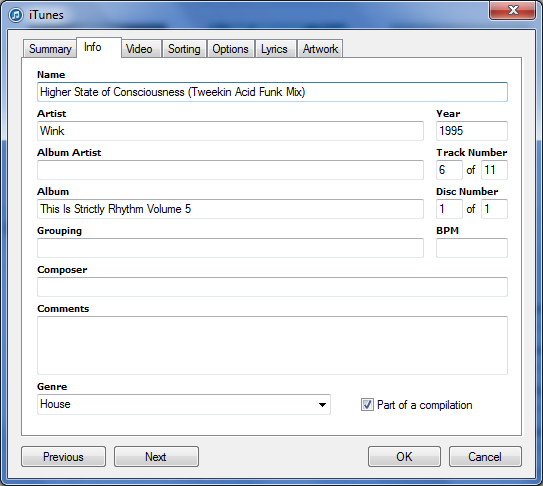
This is how my iTunes sees Higher State of Consciousness. (It is under the genre "House" simply because it seemed to fit the album in general.)
Let's take Josh Wink's 1995 club hit Higher State of Consciousness as an example. It was indeed a huge hit and it was and has since been released in many versions (or remixes). Josh Wink has elected to release his music under different pseudonyms (Josh Wink, Wink, Winc, Winx, Winks), often derived from his real name (Joshua Winkelman) - and this specific track was released under the pseudonym Wink. To add to this confusion, many releases have accidentally used the wrong pseudonym, or perhaps chosen to use Josh Wink, to conform to his usual artist name and to make it easier to associate this record with his other work.

The label for the original 12" maxi - with misspelled name for the track
Perhaps the most popular version of this song is what on the original 12" maxi was called "Version 3 - Tweekin Acid Funk". The name of the version (or mix/remix) is often omitted from CD sleeve information, even if it would be easily identifiable, or it might be mislabeled or erroneously reported as something different.

Forgetting that there are many different dashes and hyphens, there can still be a multitude of different ways of reporting the same track (here I assume that the character separating the artist and song is the colon):
  • Wink: Higher State of Consciousness (Tweekin Acid Funk Mix)
  • Wink: Higher State of Conciousness (Version 3 - Tweekin Acid Funk) (from original 12" maxi - yes, they got it wrong!)
  • Josh Wink: Higher State of Consciousness (Tweekin' Acid Funk Mix)
  • DJ Josh Wink: Wink - Higher State Of Consciousness
  • Wink: Higher State of Consciousness (John Wink's Tweakin Acid Funk Remix)
  • josh wink: higher stae of conciousness
  • Wink: Higher State of Consciousness [Tweekin Acid Funk RMX]
  • VARIOUS ARTISTS: This Is Strictly Rhythm Volume Five [1995] - Josh Wink - Higher State Of Consciousness
  • V/A: Higher State of Consciousness
  • PLASTIKMAN: highter states of conciousnes
All these are based on actual examples I have seen.

I'm listing these mostly because it's annoying that instead of the music database information helping you, it contains misspelled and incorrect information. I think that I have only encountered a couple of CD's for which the information you get from Gracenote (iTunes) is completely correct and also correctly spelled.

Of course, another problem is whether other information such as genre or year of release are correct. In electronic dance music, the genre is usually "Electronica", and I have no idea what that is. For me, this song like most of Josh Wink's music, would fall under the genre "Techno" or "Acid house", so I will have to change this information for most CD's I rip anyway.

Some of the above examples imply that the submitter has his or her own classification system, like putting the artist of the CD ("Various Artist") as part of the artist name of the track, in contrary to the idea of the database. With different kinds of parenthesis you might also mention featuring artists or other things, but once again, that is part of a personal naming convention, not a general one that a database should have.

With Discogs you can sometimes find records with incorrect track information or, for example, remix names that were omitted. Should you submit them to CDDB, too, or let them have whatever was written in the sleeve notes?

There are general metadata and archiving problem here, but largely community-supported music databases do not have professional standards or professional administrators who would certify their quality. Conventions are also dynamic, thus people may start to punctuate their submissions consistently in different ways. Nowdays it is common to separate the artist and the song name using a dash, not a colon! What a terrible sin, but since these are in different fields, it is up to the application to display these in some specific format.

This could be seen as an example of a personal informatics problem, maybe? You can approach it from the perspective of archiving and music libraries, but then again, it is your music collection, you just want to maintain it with reasonable effort, and if the "help" from CDDB and Gracenote makes it more difficult, you get annoyed or frustrated. Maybe you think you know better and introduce some other - just as incorrect - style, convention or misconception to the database.

My solution: write a rant about this to the blog and then keep on doing what you were doing all along, which is making sure that all song information is correct anyway. And keep ranting about it until the problem magically disappears.

Friday, July 12, 2013

[FI] Päivi Räsänen, Jumalan lahja Suomelle

[This post is exceptionally in Finnish, to discuss a matter relevant to Finns.]

Sisäministeri, kansanedustaja, Kristillisdemokraattisen puolueen puheenjohtaja ja viidesläinen kristitty Päivi Räsänen on Jumalan lahja Suomelle. Olettaen että Jumala on olemassa ja on olemukseltaan hyvä ja armollinen, tämä on luonnollisin johtopäätös.

Ehtoollisviininpunaiset silmälasit

Viime päivinä on kohistu siitä, että sisäministeri Päivi Räsänen kertoi mielipiteenään, että on olemassa Suomen lakiakin korkeampia moraalisia tai eettisiä sääntöjä ja vakaumuksia ja että joskus niitä täytyy seurata, vaikka laki olisi eri mieltä omantunnon kanssa. Olen hänen kanssaan täysin samaa mieltä! Olen myös samaa mieltä siinä, että kristityille Raamattu on luonnollinen osa tuota oikeudentajua.

Jo ennen kuin Räsäsen kommenteista tiedettiin yksityiskohtia, seurasi Facebookissa totuttu läjä tuomitsevia kommentteja. Räsäsen rohkeat kommentit tulkittiin rikollisuuteen kehottamiseksi, ja koska poliisilaitos kuuluu Sisäministeriön alaisuuteen, olivat Räsäsen sanat erityisen tuomittavia. Sain käsityksen, ettei juuri kukaan ollut lukenut Savon Sanomien juttua otsikkoa pidemmälle tai miettinyt mitä kyseiset kommentit mahtaisivat tarkoittaa. Aikaisemminhan on maahanmuutosta ja maahanmuuttajista keskustellessa mainittu, että muslimit pitävät Koraania maallista lakia ylempänä ohjenuorana. Niin, minullekin minun omatuntoni ja moraalini on Suomen lain (ja Yhdysvaltojen, asunhan USA:ssa) yläpuolella. Eipä ole vielä kukaan tullut sanomaan minulle, että se on väärin.

Tuo oli Räsäsen puheista se jokseenkin ongelmaton osuus, mutta se osoitti myös, että mitä tahansa Räsänen ikinä tekeekään ja sanookaan, se tulkitaan tahallaan väärin, koska Räsäsestä ei pidetä. Räsäsestä ei pidetä, koska hän sanoo joskus tyhmiä asioita, tai ainakin ihmiset muistelevat hänen joskus sanoneen. Häntä pidetään amerikkalaistyylisenä fundamentalistina, joka haluaa yhdistää uskonnon ja politiikan. Siitä huolimatta tai ehkä juuri sen takia ketään ei tunnu kiinnostavan mitä hän tekee työkseen. Olen huomannut vastaavan ilmiön esimerkiksi Tanja Karpelan/Saarelan ja Astrid Thorsin kohdalla ja jossain määrin myös kaikkien Keskustan poliitikkojen kohdalla.

Suomen kansalle kuitenkin ojennettiin ylitsevuotava malja sitä mitä he eniten janosivat: lisää tyhmiä kommentteja Räsäseltä. Tällä kertaa hän todellakin meni pidemmälle ja sanoi jotain oikeasti tyhmää, ja vieläpä totutuista aiheista - abortista ja homoista.

Eroakirkosta.fi-sivusto kertoi jälleen, että kun Räsänen laukoo sammakoita, ihmiset eroavat kirkosta. Minusta tämä reaktio on jokseenkin absurdi mutta ymmärrettävä. Vaikka Räsänen onkin vain kirkon rivijäsen (kyllä, hän on viidesläinen ja valtionkirkon jäsen, ei helluntailainen), hän on erittäin näkyvä sellainen ja hän johtaa puoluetta, jonka nimi alkaa "kristillis-". Hän ei voi välttyä siltä, että kaikkea mitä hän sanoo katsotaan ehtoollisviininpunaisten silmälasien läpi. Hän ei ilmeisesti pitänyt tarpeellisena - tälläkään kertaa - mainita missä roolissa hän lausuntoja antaa, vaikka kokeneena poliitikkona ja hallituksen jäsenenä hänen pitäisi tietää paremmin.

Absurdiuden aura

Päivi Räsäsen ympärillä hohkaa absurdiuden aura. Hän ei ehkä ole amerikkalainen uuskonservatiivi eikä City-lehden maalailema puritaanienkeli, mutta ihmiset pitävät hänen vihaamisestaan. Kirkosta eroamista harkitseville kaikki Räsäsen tyhmyydet ovat hyviä tekosyitä erota, ja ehkä se on ihan oikein!

Jos joku kokee kirkon jäsenyyden riippakiveksi ja vääryydeksi niin ehkä kirkko - siis tämä evankelis-luterilainen kansankirkko - on hänelle aivan väärä paikka, riippumatta siitä että onko ministeri Räsänen tämän kirkon jäsen vai ei. Todennäköisesti päätös erota kirkosta on tällöin hyvä asia niin tälle ihmiselle kuin kirkollekin, ja tällöin on Räsänen tehnyt suuren palveluksen.

Kirkon suuri jäsenmäärä tarkoittaa sille verotuloja. Ei ole kuitenkaan selvää, että tämä olisi hyvä asia. Kirkko on vuosisadat nauttinut erityisasemaa, joka sillä edelleen on, vaikka kirkkoon kuuluminen ei olekaan enää pakollista. Samaan aikaan monia vähemmistöryhmiä on eri aikakausina sorrettu ja alistettu ja papit ovat saarnastuolista kertoneet seurakuntalaisten (joita toki oli 100 % väestöstä) joutuvan Helvettiin.

Kirkko on haasteiden edessä ja hyvä niin. Jos nyt esitän huonon ruokavertauksen (jolle ette voi mitään), niin on aika huono keitto jos ei kestä sekoittamista. Jos koko kirkko, tuo ihmisten rakentama instituutio, tuhoutuu, ehkä se on oletetun kristinuskon Jumalan tahto - en pitäisi sitä lainkaan mahdottomana, varsinkaan kun suuri osa niin Suomalaisen ev.-lut. kirkon kuin maailmanlaajuisen Katolisen kirkon ja muidenkin toiminnasta merkittävä osa vaikuttaa olleen Raamatun ja Jeesuksen opetusten kanssa merkittävässä ristiriidassa. Sen sijaan, jos Jeesus todella on vapahtaja ja Messias, silloinhan hänen kirkkonsa on jo kaikkialla eikä uskon kannalta ihmisten instituutioita tarvita?

Liian mukava nojatuoli

Muistelen, että koulun uskonnontunneilla sain selvän käsityksen, että tämänhetkiset instituutiokirkot eivät vastaa Raamatun Jeesuksen eivätkä myöskään Martti Lutherin näkemystä (siten kuin heidän opetuksensa yleensä ymmärretään). Rippikoulu ei muuttanut tätä käsitystäni, eivät myöskään myöhemmät keskustelut teologian tohtorien ja pappien kanssa - päinvastoin. Olen saanut käsityksen, että protestanttiset kirkot ovat teologisessa mielessä vain Jeesuksen faniklubin työnjakoa, jossa jotkut puuhaavat kirkollisten toimitusten parissa, vaikka tavikset ovat aivan yhtä "papillisia" kuin hekin. Eri asia on sitten valtioiden kanssa epäpyhässä liitossa tehdyt jutut kuten väestönlasku, verotus ja - voi ei - avioliittoon vihkiminen, joiden oikeutuksesta ja todellisesta olemuksesta ei ole juuri käyty keskustelua kirkon jäsenten keskuudessa.

Valtionkirkkomme istuu aivan liian mukavassa nojatuolissa. Pieni keittiöjakkarakin voisi olla liian mukava, mutta ainakin se mahtuisi ovesta sisään.

Minusta Päivi Räsäsen pitäisi varmaankin erota, mutta ei sisäministerin paikalta vaan Kristillisdemokraattien puheenjohtajan paikalta, ja sanon näin vaikka en edes kuulu kyseiseen puolueeseen. Syy on yksinkertaisesti se, että hänen ansiostaan tai takiaan hänen puolueensa on jatkuvasti kohujen ja väärinkäsitysten keskellä. Varmasti Räsänen ja koko puolueensa tekee ahkerasti töitä ja enimmäkseen hyvin, mutta ei sitä juuri kukaan tiedä ja harvoja jaksaa kiinnostaa.

Koska kuitenkin Päivi Räsäsen ansiosta kirkonmiesten ja -naisten on pikkuhiljaa pakko tehdä suuria valintoja, olen toiveikas. Pidän peukkuja, että kirkko selviää, mutta jos ei, niin ehkä se ei ansaitse selvitä, niin ikävä kuin se vaihtoehto onkin, mutta mitäpä kuolevainen Jumalan tahdolle voisi. Se, että ansaitseeko Päivi Räsänen kaiken saamansa huomion, on kokonaan toinen asia, mutta ansaitsemisella tuntuu tässä maailmassa ja varsinkin politiikassa tuntuu olevan aika vähän merkitystä. Itse kansalainen ja kristitty Päivi Räsäsestä en ole huolissani; hän pitää päänsä ja porskuttaa kuten ennenkin, vaikka toivonkin hänen välillä pysähtyvän miettimään asioita ja tekemään omat johtopäätöksensä.

Sen sijaan Suomi ansaitsee Päivi Räsäsen.