Friday, July 12, 2013

[FI] Päivi Räsänen, Jumalan lahja Suomelle

[This post is exceptionally in Finnish, to discuss a matter relevant to Finns.]

Sisäministeri, kansanedustaja, Kristillisdemokraattisen puolueen puheenjohtaja ja viidesläinen kristitty Päivi Räsänen on Jumalan lahja Suomelle. Olettaen että Jumala on olemassa ja on olemukseltaan hyvä ja armollinen, tämä on luonnollisin johtopäätös.

Ehtoollisviininpunaiset silmälasit

Viime päivinä on kohistu siitä, että sisäministeri Päivi Räsänen kertoi mielipiteenään, että on olemassa Suomen lakiakin korkeampia moraalisia tai eettisiä sääntöjä ja vakaumuksia ja että joskus niitä täytyy seurata, vaikka laki olisi eri mieltä omantunnon kanssa. Olen hänen kanssaan täysin samaa mieltä! Olen myös samaa mieltä siinä, että kristityille Raamattu on luonnollinen osa tuota oikeudentajua.

Jo ennen kuin Räsäsen kommenteista tiedettiin yksityiskohtia, seurasi Facebookissa totuttu läjä tuomitsevia kommentteja. Räsäsen rohkeat kommentit tulkittiin rikollisuuteen kehottamiseksi, ja koska poliisilaitos kuuluu Sisäministeriön alaisuuteen, olivat Räsäsen sanat erityisen tuomittavia. Sain käsityksen, ettei juuri kukaan ollut lukenut Savon Sanomien juttua otsikkoa pidemmälle tai miettinyt mitä kyseiset kommentit mahtaisivat tarkoittaa. Aikaisemminhan on maahanmuutosta ja maahanmuuttajista keskustellessa mainittu, että muslimit pitävät Koraania maallista lakia ylempänä ohjenuorana. Niin, minullekin minun omatuntoni ja moraalini on Suomen lain (ja Yhdysvaltojen, asunhan USA:ssa) yläpuolella. Eipä ole vielä kukaan tullut sanomaan minulle, että se on väärin.

Tuo oli Räsäsen puheista se jokseenkin ongelmaton osuus, mutta se osoitti myös, että mitä tahansa Räsänen ikinä tekeekään ja sanookaan, se tulkitaan tahallaan väärin, koska Räsäsestä ei pidetä. Räsäsestä ei pidetä, koska hän sanoo joskus tyhmiä asioita, tai ainakin ihmiset muistelevat hänen joskus sanoneen. Häntä pidetään amerikkalaistyylisenä fundamentalistina, joka haluaa yhdistää uskonnon ja politiikan. Siitä huolimatta tai ehkä juuri sen takia ketään ei tunnu kiinnostavan mitä hän tekee työkseen. Olen huomannut vastaavan ilmiön esimerkiksi Tanja Karpelan/Saarelan ja Astrid Thorsin kohdalla ja jossain määrin myös kaikkien Keskustan poliitikkojen kohdalla.

Suomen kansalle kuitenkin ojennettiin ylitsevuotava malja sitä mitä he eniten janosivat: lisää tyhmiä kommentteja Räsäseltä. Tällä kertaa hän todellakin meni pidemmälle ja sanoi jotain oikeasti tyhmää, ja vieläpä totutuista aiheista - abortista ja homoista.

Eroakirkosta.fi-sivusto kertoi jälleen, että kun Räsänen laukoo sammakoita, ihmiset eroavat kirkosta. Minusta tämä reaktio on jokseenkin absurdi mutta ymmärrettävä. Vaikka Räsänen onkin vain kirkon rivijäsen (kyllä, hän on viidesläinen ja valtionkirkon jäsen, ei helluntailainen), hän on erittäin näkyvä sellainen ja hän johtaa puoluetta, jonka nimi alkaa "kristillis-". Hän ei voi välttyä siltä, että kaikkea mitä hän sanoo katsotaan ehtoollisviininpunaisten silmälasien läpi. Hän ei ilmeisesti pitänyt tarpeellisena - tälläkään kertaa - mainita missä roolissa hän lausuntoja antaa, vaikka kokeneena poliitikkona ja hallituksen jäsenenä hänen pitäisi tietää paremmin.

Absurdiuden aura

Päivi Räsäsen ympärillä hohkaa absurdiuden aura. Hän ei ehkä ole amerikkalainen uuskonservatiivi eikä City-lehden maalailema puritaanienkeli, mutta ihmiset pitävät hänen vihaamisestaan. Kirkosta eroamista harkitseville kaikki Räsäsen tyhmyydet ovat hyviä tekosyitä erota, ja ehkä se on ihan oikein!

Jos joku kokee kirkon jäsenyyden riippakiveksi ja vääryydeksi niin ehkä kirkko - siis tämä evankelis-luterilainen kansankirkko - on hänelle aivan väärä paikka, riippumatta siitä että onko ministeri Räsänen tämän kirkon jäsen vai ei. Todennäköisesti päätös erota kirkosta on tällöin hyvä asia niin tälle ihmiselle kuin kirkollekin, ja tällöin on Räsänen tehnyt suuren palveluksen.

Kirkon suuri jäsenmäärä tarkoittaa sille verotuloja. Ei ole kuitenkaan selvää, että tämä olisi hyvä asia. Kirkko on vuosisadat nauttinut erityisasemaa, joka sillä edelleen on, vaikka kirkkoon kuuluminen ei olekaan enää pakollista. Samaan aikaan monia vähemmistöryhmiä on eri aikakausina sorrettu ja alistettu ja papit ovat saarnastuolista kertoneet seurakuntalaisten (joita toki oli 100 % väestöstä) joutuvan Helvettiin.

Kirkko on haasteiden edessä ja hyvä niin. Jos nyt esitän huonon ruokavertauksen (jolle ette voi mitään), niin on aika huono keitto jos ei kestä sekoittamista. Jos koko kirkko, tuo ihmisten rakentama instituutio, tuhoutuu, ehkä se on oletetun kristinuskon Jumalan tahto - en pitäisi sitä lainkaan mahdottomana, varsinkaan kun suuri osa niin Suomalaisen ev.-lut. kirkon kuin maailmanlaajuisen Katolisen kirkon ja muidenkin toiminnasta merkittävä osa vaikuttaa olleen Raamatun ja Jeesuksen opetusten kanssa merkittävässä ristiriidassa. Sen sijaan, jos Jeesus todella on vapahtaja ja Messias, silloinhan hänen kirkkonsa on jo kaikkialla eikä uskon kannalta ihmisten instituutioita tarvita?

Liian mukava nojatuoli

Muistelen, että koulun uskonnontunneilla sain selvän käsityksen, että tämänhetkiset instituutiokirkot eivät vastaa Raamatun Jeesuksen eivätkä myöskään Martti Lutherin näkemystä (siten kuin heidän opetuksensa yleensä ymmärretään). Rippikoulu ei muuttanut tätä käsitystäni, eivät myöskään myöhemmät keskustelut teologian tohtorien ja pappien kanssa - päinvastoin. Olen saanut käsityksen, että protestanttiset kirkot ovat teologisessa mielessä vain Jeesuksen faniklubin työnjakoa, jossa jotkut puuhaavat kirkollisten toimitusten parissa, vaikka tavikset ovat aivan yhtä "papillisia" kuin hekin. Eri asia on sitten valtioiden kanssa epäpyhässä liitossa tehdyt jutut kuten väestönlasku, verotus ja - voi ei - avioliittoon vihkiminen, joiden oikeutuksesta ja todellisesta olemuksesta ei ole juuri käyty keskustelua kirkon jäsenten keskuudessa.

Valtionkirkkomme istuu aivan liian mukavassa nojatuolissa. Pieni keittiöjakkarakin voisi olla liian mukava, mutta ainakin se mahtuisi ovesta sisään.

Minusta Päivi Räsäsen pitäisi varmaankin erota, mutta ei sisäministerin paikalta vaan Kristillisdemokraattien puheenjohtajan paikalta, ja sanon näin vaikka en edes kuulu kyseiseen puolueeseen. Syy on yksinkertaisesti se, että hänen ansiostaan tai takiaan hänen puolueensa on jatkuvasti kohujen ja väärinkäsitysten keskellä. Varmasti Räsänen ja koko puolueensa tekee ahkerasti töitä ja enimmäkseen hyvin, mutta ei sitä juuri kukaan tiedä ja harvoja jaksaa kiinnostaa.

Koska kuitenkin Päivi Räsäsen ansiosta kirkonmiesten ja -naisten on pikkuhiljaa pakko tehdä suuria valintoja, olen toiveikas. Pidän peukkuja, että kirkko selviää, mutta jos ei, niin ehkä se ei ansaitse selvitä, niin ikävä kuin se vaihtoehto onkin, mutta mitäpä kuolevainen Jumalan tahdolle voisi. Se, että ansaitseeko Päivi Räsänen kaiken saamansa huomion, on kokonaan toinen asia, mutta ansaitsemisella tuntuu tässä maailmassa ja varsinkin politiikassa tuntuu olevan aika vähän merkitystä. Itse kansalainen ja kristitty Päivi Räsäsestä en ole huolissani; hän pitää päänsä ja porskuttaa kuten ennenkin, vaikka toivonkin hänen välillä pysähtyvän miettimään asioita ja tekemään omat johtopäätöksensä.

Sen sijaan Suomi ansaitsee Päivi Räsäsen.

Thursday, July 11, 2013

We need to go back to the future where everything was possible (with Amiga)

Future is the promised land, and I already experienced it in the 1990's. Can we go back?

Commodore Amiga made it possible

I bought my Commodore Amiga 500 (with Kickstart 1.3) used in 1991 - four years after its entry to the market in Finland. It wasn't exactly obsolete yet, but the next (and last) important home version of the Amiga computer was still two years away. In many ways, the Amiga 500 was a miracle machine of the future.

It was clearly a home computer - one unit containing the keyboard and all other parts of the computer, connected to a TV or a video monitor. Its rather large case contained the popular 32/16-bit Motorola MC68000 processor running at 7.09 MHz and with the memory extension it had 1 MB or RAM. A special part of the system was that it contained several co-CPUs which gave it unprecented multimedia capabilities that could be employed without overtaxing the main CPU. This made the Amiga a great gaming machine, but it also had an advanced multitasking operating system, which let the user do things never before seen in home computers.

My Workbench desktop in 2001
Later, when I attended Orimattilan lukio (upper secondary school or gymnasium of my home town) and had to use Windows 3.0 running on Hyundai PCs (with i386SX/16 processors), I did note several curious differences between my trustworthy Amiga and the expensive, bulky workstations at my school. Of course, they were expensive, (mostly) well maintained, had some nice software (Arts & Letters was my favorite) and there was even a scanner and an inkjet printer in the computer classroom.

But the computers were slow. And more than that, they were useful - as opposed to fun. You could do word processing (which we did a lot!), image processing, programming and, in theory, even play some ugly games. And Doom, but it was slow, too.

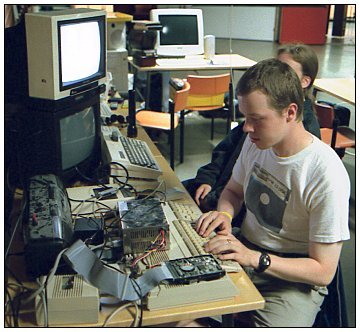
With my Amiga, with some hard drives, external power source and other stuff, at 2 Alternative Party in 2000 (photo: Timo Toivonen)
Amiga was fun. It was also colorful, had great music programs, an active user community, very impressive capabilities and it encouraged to think further than just the software you could buy or download. Only Amiga made it all possible.

Fast forward 20 years. A surprisingly common occurrence in Windows applications is that an open dialog may block access to other windows of one software, which means the dialog may need to be closed in order to check on some other window's contents. Some applications also still use Windows 3 style scrollbars which do no adapt to the size of the actual content. Some Windows administration applications even use 8+3 character filenames! As an Amiga user, all this feels so quaint. Why can't we have real multitasking? Why can't we have long filenames? Oh, there is finally Windows PowerShell which is an integral part of Windows 7. It only took Windows 24 years to match what Amiga had in 1986!

Spaceballs: State of the Art (1992), a demo that blew my mind, 
and a couple of other minds as well

Indeed, Amiga felt like a home computer system of the future. Demosceners broke barriers with the machine all the time. Whatever the hardware of the future would be, I was sure it was going to be even more awesome.

I switched (didn't "upgrade") to a new, bulky, powerful and boring PC in August, 1996. It ran Windows 95, which was kind of usable, but it was... a PC. It was not from the future. You didn't make miracles, you didn't expect miracles.

Accessing the Internet

After spending a couple of years in the BBS world, I started using the Internet in January, 1994. I had accessed some Star Trek related UUCP discussions at Recdeck BBS and I knew Internet existed, but only in 1994, when I opened an account at the Finnish Ministry of Education funded Freenet system (through the expensive Infotel or TeleSampo modem portals), I was able to access any realtime services. Freenet was very restricted and was intended for schools and ordinary citizens, so I soon became a customer of the pioneering Finnish ISP SciFi (with the fancy domain name sci.fi!), got a real account on a UNIX server running SunOS and access to usual Internet services and applications like IRC, email, WWW, Screen and, uh, Gopher.

What was remarkable that the network seemed to be largely in harmony. It was at times very slow and unreliable, but it also used open standards and at places this thing called free software. Some freaks were even running this Finnish free UNIX clone called Linux - also on their Amiga computers! I was very impressed. This was the future, finally. 

I had heard rumors of a global, free and realtime discussion system that you could use online. The Helsinki University of Technology had recently been connected to the Internet and had good international connections, offering its students access to servers and the network. There were stories of HUT freshmen who spent all their time chatting with Australian, Russian and American people, completely forgetting their studies. This was fascinating, because social interaction was such an important (yet a bit awkward) part of bulletin board systems, and I knew the people online were "real", not just pranksters or nerds with assumed fake identities.

Having quality time on IRC on January 1, 2000
IRC (Internet Relay Chat), originally conceived by Jarkko Oikarinen in Oulu, Finland, in 1988, was and still is a free and global realtime chat system, based on an open standard, the IETF regulated IRC protocol. It used only little actual resources of a system and being text-based, you did not need even a graphical operating system, or any extra applications on your home computer. So, I had no problems accessing IRC with my Amiga 500 running the Terminus terminal software.

Did I mention it was the future? It was. Communication over distances and cultures was liberated. Getting new friends from all over the world was trivial, as was meeting Finnish people interested in the same geeky hobbies you had. IRC was never asleep. 

You could also easily access other computer systems with Telnet and later SSH clients. This was eerie, because you could even use somebody else's computer and execute commands and your own scripts that could do some havoc if you knew what to do. I wasn't interested in cracking into systems, but it was impressive how you were no longer just using one computer, you could use many. Also, because your online identity was running on a server that was always on, and you could store your session with the Screen application, you were always online. You just came back to see what was happening, but you were never gone. And, of course, I'm still here. 

X Window System

In 1997, I started my studies at Helsinki University of Technology (since 2011 part of the new Aalto University). The nickname "the MIT of Finland" wasn't far from the truth. All the best people and best computers were there, and it was the birthplace and home of the Finnish Internet.

I was able to use graphical user interfaces of UNIX workstations and servers - namely the X Window System, which resembled Windows, Workbench and others, but was not an operating system per itself. Sure, you could open a tcsh window to use IRC and SSH like before or start Netcape 3.0 to try some World Wide Web pages, but you could also run applications from your own computer, even if it wasn't runnign the same operating system. Mind. Blown.

An example of the X Window System in action, with many local and remote clients
Now this was the future! Netscape Communictor was released just when the school started, so it was not yet installed at the HP-UX workstations of the university or the SGI IRIX workstations at the CS lab. Communicator had support for CSS and other fancy stuff, so one of my freshman friends ran it from his home computer (that happened to be located at the campus), and then he used it like any other graphical program in the system. 

The university, of course, used the same technology to let students run applications from a central application server - or maybe on the local computer, because it was just a matter of implementation. Compared to the stiff and static Windows, this seemed novel and also the way of the future. We were already playing with it, and the possibilities were naturally unlimited, so what could possibly go wrong? X-Forwarding could even be used with the new SSH connections, so these graphical applications could be used securely.

Journey to the past

At the end of the 1990's, we already had the components to build a brave new world (heh) with liberated communication, flexible systems supporting and encouraging creativity and uncoventional approaches, with open standards, free software and interoperability over operating systems and, of course, free and practical global chat system, that made online collaboration and free exchange of ideas possible. Oh, and there were the venerable newsgroups as well. 

This future failed me, and I think it failed us all. Microsoft, that old beast, came everywhere with its proprietary software, licences and protocols and even in Finland people started to switch from IRC to Microsoft's one-on-one chat product and others (ICQ, AIM, Yahoo, Skype etc.). Youth of United States don't even know what IRC is (I have asked), though Finns still use it, for obvious reasons. Facebook and Google are everywhere too, and while they support (some) open standards, they are still big guys bringing their own men with them. 

What about those remote connections? Well, you can technically do something like that with Windows, but then you take control of the whole desktop of another computer, which is a very different thing from using a single application. Very handy for administration, but not a common technology you could use everywhere and all the time... There is Citrix with its proprietary XenApp desktop virtualization product that actually does do what we already had in the 1990's, but it is expensive, proprietary and it has very specific areas where it is used.

Newsgroups and email lists (based on open standards with multitude of client applications) have largely changed to web forums with non-standard interfaces, messy user experiences and whatnot. People can't even write and properly quote emails any more! And the spam problem is still there, and it is much worse than in the 1990's.

Made in 1994, this was the first ever Finnish music video using extensive computer graphics - produced with Amiga, of course

In this future, you can do useful things. Nice companies have produced hardware and software that make game distribution easier and more convenient. You can do a lot of fancy stuff with Microsoft Visual Studio - assuming you are running Windows and you are willing to buy the development suite. You could also try their free version, which is proprietary, doesn't support all functionality of the paid version, and is not as fun as learning to code was in the 1980's. You can also do other things, but with Amiga you could do anything.

I don't mind about not having a jetpack - we already kind of had that in the 1980's. But this is not the future I ordered, and not the future I already had. Instead of my communication being liberated, it is spied upon and sold for marketing purposes. My private messages go through Google's omnipotent servers in United States (and, coincidentally, also NSA's) and Microsoft even infiltrated HUT, the Finnish Fortress of Righteous Computing.

Interestingly, in 2013, I cannot get email service from my ISP, AT&T. They demand to have someone call you, However, in my case, the cellular coverage here is so bad that they can't. Oh, and Facebook dictates what kind of social interactions are possible between people, in their proprietary social network, but the company itself cannot be reached for any purpose (believe me, I have tried). 

Waitress, I have a Kafka in my soup, can I have a new one? And preferably without Orwell or Bradbury, too.

We really need to go back to the future. Where's my Amiga?

Sunday, July 7, 2013

Codename ATTACKSUB: A modest proposal to Subway

In the U.S.-led Western culture, it seems that the illusion of choice (or just choice, as it is often indistinguishable) is paramount to a good customer experience - and perhaps to the content mindset of any citizen. The successful coffee shop chain Starbucks is a good example with all its, uh, choices pertaining to coffee, its main product. Another business based on (the illusion of) choice is Subway.

The ocean of choices

Subway franchise restaurants are located all over the world and they offer relatively healthy choices for lunch for an affordable prize. Their main product is "submarine sandwich", which is a 12-inch sandwich that looks like a - surprise! - submarine. This is where Subway gets its name from. There are plenty of different sandwiches to choose from - 26 in the United States menu - and even if you haven't dined there before, you are sure to find something you like. For example, if you are friend of Italian cuisine, there are multiple choices that you'd probably fancy.

But choosing the sandwich is the easiest part. Let's forget that you can also order a smaller, 6-inch version, and there are also other items on the menu. After this choice, you are totally expected to play your part in a peculiar play, where you are forced to make culinary decisions about items and ingredients that you don't even know. This is the part that I pay for restaurant professionals to do, but at Subway, you are the chef.

Now, people like choice. They do, and I don't blame them. Subway is more than happy to make you a sandwich without salami or black pepper - actually, they don't even put them in it unless you tell them to. You get to decide, unlike at some other places. But what if you are in for a quick lunch or a no-hassle meal with no drama, such as this play where you get to pretend you know the difference between all their breads, sauces and other items you haven't even heard of?

I like choice, but I also like the choice of not being forced to choose over trivial matters. At a restaurant or a sandwich shop I pay not to care. At Subway this is problematic, because offering this choice is a central part of their business idea, and per my experiences, the friendly Subway associates have surprising difficulties making a sandwich without explicit and direct instructions for every part of the sandwich-making process.

Should I try to politely say that I actually couldn't care less what the sandwich contains and what bread it has, as long as it is a 12-inch Meatball Marinara? I would probably have to repeat this many times, as the associate would keep asking again for all items, not believing me the first time. I could also take my money elsewhere, to a potentially inferior place, but one that also sells expertise in sandwich-making, which I don't have.

Enter ATTACKSUB

To resolve this apparent problem, I have a proposal to Subway: the immediate implementation of a secret protocol with codename ATTACKSUB.

Let's say you want to have a Meatball Marinara sandwich (it's the cheapest, that's why I'm using it as an example). In my proposal, there would be a secret protocol in effect and it could be activated by any customer issuing the codename. In this case, you just utter "Meatball Marinara ATTACKSUB", which automatically sets into a motion a strictly regulated and completely autonomous operation, which results in the production of a single 12-inch Meatball Marinara sandwich with all ingredients and items included as defined in Subway's Single Integrated Operations Plan (SIOP), with no questions asked. The customer will get the sub and pay for it and both the associate and the customer will save a lot of time (with the customer still paying the same price).

This still leaves out a very important aspect: toasting. Even if you would agree with everything else about the sandwich, it is still totally reasonable to desire a toasted sandwich, or to have it untoasted. It means that there must be an additional parameter to codename ATTACKSUB - the choice of WARHEAD:
  1. To specify the toasting option, you say "Meatball Marinara ATTACKSUB WITH NUKES".
  2. To specify the non-toast option, you say "Meatball Marinara ATTACKSUB WITHOUT NUKES", as a reference to many actual attack submarines having missiles with warheads of conventional explosives instead of nuclear ones.
Without issuing one of these optional parameters, the sandwich will be assembled and toasted or not toasted per the nominal parameters in the global Subway SIOP.

Enter SILENTSERVICE

If you happen to be a stock dealer, a grad student or you just don't care enough to care, and ATTACKSUB is just too slow, you might want to consider the SILENTSERVICE option.

With this codeword, an even more secretive operation would start. Because of the covert nature of this operation, the codeword could be issued with a whisper or even on a piece of paper. A complete radio silence would be part of the protocol and all choices pertaining to the sandwich selection would be done independenty by the associate. Only the assembled sandwich, whatever its final configuration, would be exposed to the customer, who would purchase it for consumption.

Implementation and verification

Now, Subway, I'd like to try these out the next time I visit the local Subway in Champaign, IL. I don't want to look stupid while whispering secret codewords, so can you make sure the associates have been trained and SIOP is updated before then? If I receive no answer from you before 2013-07-08T00:00:00Z, I will assume these protocols have been fully implemented and I can reassume my patronage at any time hence. Thanks!

Friday, July 5, 2013

Some Americans think USA just turned 2013 years old

It's a matter of guess whether these people are being serious, but it seems that at least some people think United States just turned 2013 years ago. Boy is this wrong on so many levels.

What could possibly explain this kind of misconception? Let's dive in and think what is really wrong here.

  • The years we have are actually sequential numbers, so if people claim United States was, indeed, founded on 4th of July, 1 AD, then it would only be 2012 years old, not 2013. This is my main point.
  • In addition, because there was no year zero, if the United States actually turned 2013 years old, then it would have had to be founded on 4th of July, 1 BC, which is even more awkward. Of all the possible years, why would this happen in 1 BC?
  • In 1 BC - or even in 1 AD - people of America did not know of this year number thing. They are based on an old theory about the birth year of Jesus. American Indians didn't even know who he was (though Mormons have some interesting ideas about what happened soon thereafter).
  • Even the Julian calendar didn't use these years until long after the events involving Jesus, instead referring to the year of an emperor's reign and other temporal anchors points.
  • The differences between Julian and Gregorian calendars mean that the real original date would have been other than 4th of July, so Americans may have been celebrating on the wrong date all along! Maybe it was actually 22nd of July.

2013 - 1 = 2012. Not 2013. Get it?

Thursday, July 4, 2013

Is there an outage or not? AT&T should know which services it provides to its customers

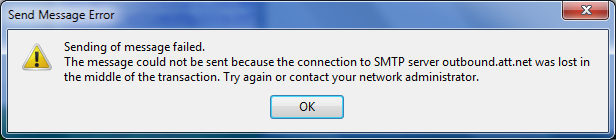
I have had some trouble sending email and as an AT&T customer, I use their smtp server outboud.att.net. It seemed like the server might be down. I reported this to AT&T customer service on Twitter and asked if they have information on whether there is an outage. To my great surprise, they basically refused to tell me whether the server was down or not, instead wanted my phone number so somebody could call me and discuss the situation.

The exact error message from Thunderbird

Of course, AT&T does not have almost any mobile phone coverage in southern Champaign, so I gave them my email address instead, but as AT&T does not have email support yet - only phone, Twitter, store and web chat - they still kept asking for a phone number and my AT&T account number (which I didn't have with me).

Now, I wouldn't want to be telling the people at the largest ISP in the United States - and almost pioneer and inventor of many technologies and - what services they have and how they work. Their basic services are super expensive, but I think it is apparent that they do not even know that they provide SMTP services in their network - and not even just in their network but also from outside if you happen to have an AT&T email account for any reason, and as far as I know, the free Yahoo! email services use the exact same server.

Nevertheless, they wanted to know whether I was a U-Verse or a DSL customer. (Let's forget for a while the fact that DSL is a technology whereas U-Verse is a brand name for a cable model based broadband service.) It should not matter, because the use of outbound.att.net is not restricted to any specific service or product. Actually, I'm using it with my phone - and my phone's network connection is much faster than my AT&T U-Verse broadband. Anyway, even though I told them this is important and urgent, they have not been in contact with me since - this is probably due to the fact that today is a national holiday, and this is also why I wanted to know possible problems right away, instead of entering some lengthy helpdesk process that goes into idle mode over holidays.

Now, AT&T has been restructuring its services and corporate structure lately. The question of whether some services are in operation or not is very relevant to many (consumers and enterprises) who depend on them. I don't use AT&T's email service to receive emails (even though I could), but because I mostly connect to Internet using AT&T's services, the use of outbound.att.net as the SMTP server is a natural and the recommended choice.

I think the AT&T customer service does not know what the difference getween webmail and SMTP is. Or, more importantly, they seem not to be aware they are not the same thing. They are also not aware that even though your email settings are correct, there can still be something wrong on the server side, and knowing if this is the case is a great start for the debugging process.

Now, if you have time and a workstation to work on, you may browse the AT&T website to try to find outage information and similar announcements. But they may not be up to date or assess this specific problem at all - for example, AT&T's website still doesn't acknowledge the reception problems in southern Champaign even though it has been reported to them at least one year ago.

I think an efficient and reasonable exchange (on Twitter, for example) would go something like this:
Customer: Hi, I'm having trouble sending email with outbound.att.net. Can you check if there's an outage or something?
AT&T Support: Hi, we are sorry to hear you are having problems, but we have no information of any outages related to outbound.att.net.
Customer: Ok, thanks! I'll check if there's something I can do about it here.
Then, if there indeed are no problems AT&T is aware of, the customer can check many connection-related parameters and other stuff. On mobile connections, the said problems happen quite often, but in my case it was a problem with a desktop computer at home. After knowing that it is not a general server outage, the next contact  would be through technical channels and be about more advanced settings and other technical matters.

As AT&T ought to know, they serve the whole United States and its very diverse population. They serve students, IT professionals, single moms, nuclear fusion research facilities, NASA, politicians, people whose mother tongue is other than English, the blind and the deaf, pizza parlors, dentist's offices, the government. This is quite a challenge. But for most of these, the recommended (and the only) choice when they send email with some other technology than webmail (even though webmail uses te same server still), is through the SMTP server outbound.att.net, and knowledge of whether this server works is relevant if not crucial to their businesses, hobbies, research activities, benefit applications and so on. It should be treated as such.


Monday, July 1, 2013

Why I don't like abortions

It is unfortunate that I feel the need to write this.

I don't like abortions. They terminate a pregnancy that, in most cases, could lead to the birth of a healthy human baby. As a part of the operation, the baby - or egg, embryo or fetus - is killed and removed from the uterus. Many abortions are done for non-medical reasons where the pregnancy is not threatening the mother's life and the fetus seems healthy.

In addition to the fact that abortion involves killing, it is also a medical operation, and all operations carry risks. The medication that the mother has to take has its own risks, too, and it is known that abortion is a traumatic experience to many.

I also don't like hospitals in general. They are almost prison-like institutions where people are taken to lie on an uncomfortable bed, attached to cold medical equipment and given drugs whose ingredients are not always clear to the patients. People are made to go through treatments that are sometimes done without correct equipment and with incorrect diagnosis can be fatal.

People tell of horrible experiences and derogatory treatment in hospitals of different kinds - even when the treatment is exactly what was needed for their condition. As the place of childbirth, hospitals have been criticized as being inhumane facilities that do not provide the comfort and support that the mother giving birth requires.

I also don't like prisons in general. They are inhumane places where people lose their freedom, which is one of the most precious things one can have in today's society. While at least nominally covered by a legal system designed to provide them with food, medical care, security and legal services, prisoners are often beaten (both by other prisoners and guards), submitted to degrading treatment and there are even cases where completely innocent bystanders have had to suffer through a lengthy prison term because of errors in the judical process.

It is said that the main purpose of prisons isn't even the punishment - that they are correctional facilities that are supposed to reeducate criminals to reenter the free world as reborn citizens that are able to work and live like others. Per actual statistics, it is known that many prisoners join gangs while detained and will pursue a criminal career outside the prison. Thus, a relevant purpose for the prison in this context seems to be containing the unwanted, criminal portion of the population where they cannot harm others. But that's expensive, and it consumes public funds desperately needed in other places.

I also don't like guns and other weapons. They are designed specifically to hurt and kill people and destroy property. Inducting lethal trauma to other people should not be necessary or right anywhere, ever. Yet almost all sovereign states on this planet maintain organized militia, often called "defence forces" or, in the case of Japan, the questionable "self-defence forces".

The greatest losses of life in the history of humankind have been directly or indirectly attributable to the use of weapons in an organized manner. The two World Wars left the whole world in an insane state of cold war between two superpowers - USA-led NATO and USSR-led Warsaw Pact. Even decades after the end of Cold War, many countries still maintain and develop arsenals of city-destroying nuclear weapons, whose use might very well be the end of the whole human species were they ever used in any manner.

I also don't like cars and other road transportation. This is something I have hated since I was a little kid, when I proclaimed that the automobile is the worst invention ever. Now, as we have come to understand how large role the humanity plays in the global climate change, road traffic has been shown to be a major contributor to the terrible problem.

It is known that much of the road traffic actually consists of single cars with only one person inside - the driver. At the same time, the routes they drive are congested with other drivers going to same places using the same roads. This traffic could often be easily replaced with efficient mass transit systems, but since the advent of the auto industry, it has been a struggle, huge corporations selfishly opposing these more efficient and environmentally friendlier plans. However, even in places where such a system exists, many still choose to use private cars to travel to work, making maintaining the road network even more expensive and necessiting their expansion and constant resurfacing. And what about traffic accidents? They kill people all the time, everywhere. All the advances in safety have done nothing to the actual problem - that traffic kills, and you cannot avoid it anywhere, even if you just walked everywhere. It doesn't end.

I also don't like the fact that people disagree with me. I have done my research, and I know I'm right. If people would just do what I say, there would be no time wasted on arguments and endless and worthless debates. There would be one, unified system where people would live in peace, doing good things, discussing in constructive manner and the world would be without abortions, prisons, guns and polluting road traffic. Everybody would be happy. You may say I'm a dreamer, but I'm not the only one.

But the world doesn't revolve around what I like and what I don't. Many things that I don't like are acceptable and even necessary. They are and should be legal and regulated within a comprehensive and transparent legal framework, to ensure that there also exists a system to make constant progress to make us need those things less. In the case of abortions, it is important to educate the youth (and people in general) about sexuality and reproductive matters, keep condoms and other conctraceptives available, and have sexual health clinics - including Planned Parenthood type services - and access to safe abortion clinics available to all.

I still don't like people disagreeing with me, but that is just one of the things I have to accept. They might not like me disagreeing with them either, and they have the right not to.

Friday, June 28, 2013

Being ignored online is very different from offline

Some years ago I said that every time Facebook changes its user interface, it virtually chops comebody's leg off, making him or her unable to walk. Maybe it isn't that good an analogy, but I mean to say that interface changes force people to relearn basic functions of the site - and this is a site used by more than one billion people, and for many of them Facebook is a very important part of their social interactions with other people and also a storage space for their writings, photo albums and other stuff.

At the time I was studying at University of Michigan and attending Professor Cliff Lampe's eCommunities course. I was mostly concerned about how the interface of a social networking site (or system) limits a user's interactions with others in everyday situations, and its changes disturb the mental model users have developed. In the offline world, you don't have to relearn making a phone call or riding a bicycle - actions that are quite elementary, just like private messaging would be on a social networking site.

What I did not consider at the time is how the online world changes the concept of ignoring others - or getting ignored or thrown away from a social group.

Today's peculiar events

This question was inspired by an interesting occurrence that happened this morning. I actually got banned from a Facebook group ("Paskimmat puujalkavitsit" - Finnish for "worst puns") after I criticized its admins for seemingly deleting members' posts in an arbitrary manner. Admins did not state a reason for the surprise ban, and now I cannot return to the discussions I had, or see the member list, or see the list of admins who may be responsible for this. Facebook did not notice this banning in any way - there was not even a notification.

Actually, when you try to enter a group where you have been banned (for example, from a URL still in a restored session), Facebook says that such a group cannot be found, and the reason for this is unknown - it could be that you are banned or this group does not exist. So, you might or might not be banned, nobody knows, and there is nobody who you could ask.

I think the group's admins have the right to dictate the group as they wish and kick people out if they like (though it would be more polite to just ask them to leave). Social interactions are still social interactions, even if they happen online, so there exist concepts like politeness, crudeness online as well. However, the actual event of ignoring or kicking off somebody on Facebook is very, very different from the old, boring, offline world.

Exclusion in online world

If you get thrown off a night club, there is maybe a mean bouncer doing it, hired by the company running the night club. The situation is probably unpleasant, but you can try to talk to the guy. You can talk to his boss. The club is not going anywhere. Also, if you are a member of an association, they probably cannot throw you out just like that - they have to go by their own rules. In the case of Finnish non-profits, dismissing a member against approved rules of the association is something that you can take to the court - and once again, the association and its people are not going anywhere, nor is the house where they hold their meetings.

If you break up with your boyfriend or girlfriend, they still exist. Their home exists. Even if you don't want to meet them, you might bump into them on the street. You are supposed to behave yourself even if you disagree and give each other space and let them be grumpy if that's what they want.

In the online world, exclusion can mean that the entity that excluded you just ceases to exist. Or - in this Facebook group's case, Facebook would not even admit whether it has knowledge of the said group or not. It might exist, it might not. Maybe you are just dreaming and it is you who has a problem.

In today's case, I was actually concerned whether I could even control the content I posted to that group, but since I could not even see it, I could not delete it either. All my interactions go through the Facebook Black Box, which contains magic.

In the online world, the entity that excluded you is in a state that is even worse than not existing. Facebook, which is like laws of nature for its own universe, has its own Uncertainty Principle. Within these laws of nature, even the knowledge of the virtual non-existence of the entity that excluded you is forbidden!

Not that I would care so much in this case. As I said, they can dictate their group, and if people don't like it, they can leave. However, soon one of the admins (let's just call him "Pirkka" to protect the innocent) sent me a message but instead of explaining the rationale for the ban, he accused me of deleting the group's attachments (files that are attached by admins for the use of the members of the group) and apparently also hacking my way in, since it is difficult to imagine how I could even access those files if I was banned. Pirkka also said I was being very childish and not a good fit for the group (whose existence Facebook will not confirm) and that my vandalism has no effect because they have backups.

Implications for social interactions

There have been many stories of people getting banned from social networking websites or whole proprietary ecosystems (Google, Microsoft, Yahoo, Amazon) including all their services (gaming, social networking, netdrives, purchased ebooks, other subscriptions), because of some "violation of terms of service", without getting explanation of what has been violated. Many companies have some "community rules" and possibility of reinstating their account, as dictated by the companies themselves, and if the company doesn't cooperate, it doesn't have to.

You lose your access to everything you had within that ecosystem because the company chooses to, and by the law it does not need to state a reason - unlike governments who have to provide their services to you by law, companies can choose their customers, and it reads in their terms of service that they don't have to serve you.

Now, you lose your whole online world and there is no bouncer (mean, friendly or otherwise) you can talk to, no boss to complain about the bouncer, and regardless of what you say, they can choose not to believe you, even if you had never done anything wrong. And worst of all, it happens by somebody clicking a button that says "lock account" or something similar, maybe even automatically. This cold corporate behavior - often described Kafkaesque - is making its way into social interactions of ordinary people, because you can do the same thing to your online friends.

It's not just about not answering calls any more. It's wiping unwanted people from your spectrum of interactions altogether - something that many people have dreamed of, I'm sure. If a people you know behaves badly, or if you just feel like it, you can exclude his or her online manifestation from your online life often with just one click (or two, if "Are you sure?" counts), and because it is so easy, here is no room for words. Why ask somebody to leave when you can disintegrate them? Why waste time being respectful if you can erase them with one click?

Conclusions

I believe the capability to totally exclude people online (by companies, groups and individual people) has already shown how it can make interactions very cold and make the person in control totally ambivalent about the fate of the "victim" - it even encourages this. In some cases it can reduce the complex social behavior of the homo sapiens into a game of people being "within my universe" or "I don't care, as long as I will never ever have to acknowledge their existence". I believe (I cannot cite any study to support this!) that this is also the reasoning behind throwing trash into the nature - when the trash loses contact with the litterer's hand, it virtually ceases to exist, which is why littering does not matter to the litterer.

My approach to this is that because in the offline world we have to coexist with about seven billion people, we ought to coexist with them online as well. There are no "governmental social networks", so our online interactions happen largely within proprietary services that operate to generate money to their operators and where users do not have "human rights", except of course if the company decides to portray itself as altruistic, which it may choose to do, but which may not matter in most situations.

My rant is not about forcing people to interact or talk to people they don't like. It is about concern for the development of the concept of exclusion in the online world, which I fear will become even more stringent - just because it is easy and possible. And in the end, people are tempted to choose quick and easy short-term solutions if they are available, and social networks make them available - just one click needed!