Sunday, March 16, 2014

Introducing mating rituals to bookstores

Bars and night clubs are known for their role in human mating rituals. In addition to just going out with friends and maybe dancing and drinking, people do and are even expected to look for company, either long-term or just one-night stands. While many young adults enjoy this, there are many who do not, and they may even prefer reading books, and going to bookstores instead of bars. Nice, huh?
One proposal to extend mating rituals to bookstores
This is, of course, a fine opportunity for me to rant about extending mating rituals to improper places.

The image above is from Facebook page Word Porn. I doubt it is the original author of this idea, but it doesn't mention any source. It has been shared all over the social media for a while, and this specific image has about 130,000 likes and 80,000 shares, two days of its original posting on this page.

The good: There's nothing wrong in going to bookstores instead of bars, and a bookstore isn't a bad place to meet people, either. It would be nice if people would understand this, and perhaps book fans (geeks? nerds? outcasts?!) should find it easier to find new people, even mates.

Mates... like in a mating ritual? That's right. The idea proposes extending the heteronormative mating rituals to bookstores. It specifically refers to certain expectations placed upon people in bars. I have been told by several people (both women and men) and witnessed it myself, that men offering to buy drinks for women is often perceived as a mating ritual, and it is a way for a man to show he is interested, has money and maybe has knowledge of different alcoholic drinks. It is also a good way to get the woman intoxicated - and as part of this ritual (or just a social ritual?), many men expect women to have sex with them after having received so many free drinks.

It doesn't always play like this, but there are norms and expectations, just like in this idea. At the same time, bars are social spaces for having fun with friends (and others), dancing, drinking and so on. Bookstores are retail stores selling books (though they can still be very nice places, and maybe you can read there as well!).

In any retail store (books, groceries, hardware), it would be very awkward if there was an expectation for me to buy something for strangers, or for others to buy something for me. I wasn't really aware that there was this kind of expectation at bars, either, but apparently some people think there is.

There's also the issue of books being very expensive in contrast to alcoholic drinks...

Sunday, February 16, 2014

Lennon and other dreamers of 'Imagine'

John Lennon's 1971 hit single 'Imagine' has inspired people for decades. It is a song about a dream that humankind should live at peace, without divisive barriers. Lennon lists three major barriers: religion, nationalism and possessions. In the lyrics, he envisions 'brotherhood of man' with 'nothing to kill or die for'.

'Imagine' is a song and in general, lyrics to songs should not be taken too seriously. It's poetry, and as a dreamer, Lennon wanted to convey his feelings that there should be peace instead of war and divisiveness. Still, he said he advocated socialism and atheism (albeit not in forms that, for example, Soviet Union represented), and there have been varying interpretations of what he actually meant or how literally the lyrics should be taken, or whether they are just a dream with no real connections or something we should actually strive for.

Stanley's comic

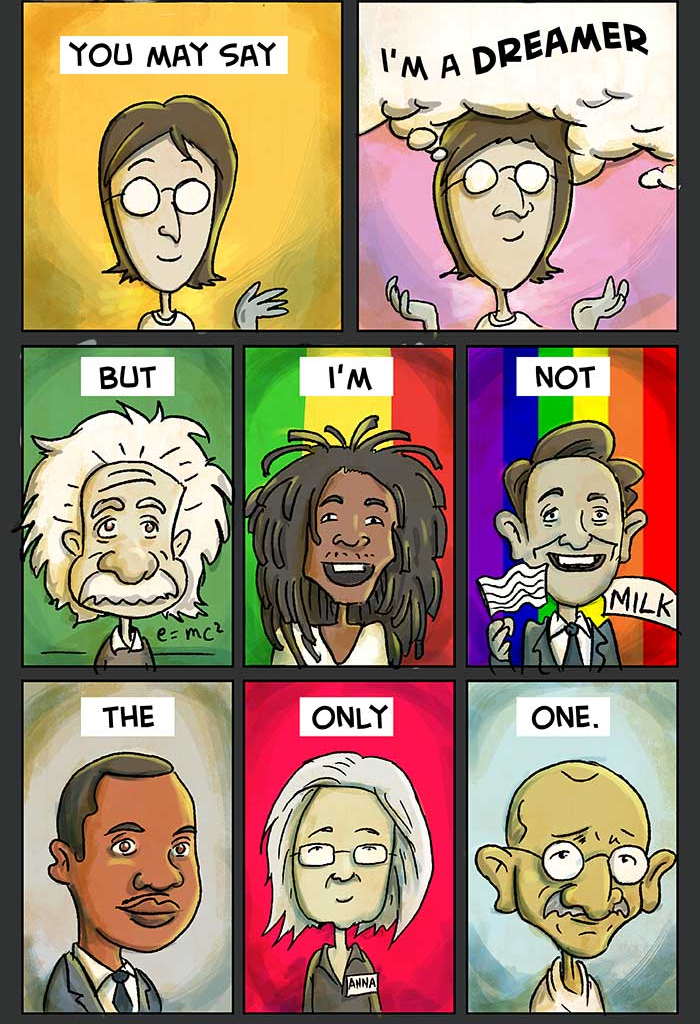
In 2013, artist Pablo Stanley produced a comic version of the song, which can also be purchased as a poster, and he included six examples of other 'dreamers'. On his website, he also has a small disclaimer about how he is aware of some unamicable qualities of Lennon and how the examples do not actually fit Lennon's ideal.

Excerpt from Stanley's comic
Albert Einstein - despite being a pacifist - advocated research of nuclear weapons and his letter to U.S. president Franklin D. Roosevelt was a key influence that led to the Manhattan Project. His groundbreaking work in physics made the nuclear bomb possible, and the next 50 years of Cold War were marked with constant fear of global annihilation by (accidental) nuclear war.

Bob Marley was a legendary guitarist who was known for his Rastafarian faith. He spoke of how important religion is in his life and how he sees Haile Selassie, Emperor of Ethiopia, as messiah. His music is known for its religious themes.

Harvey Milk, before his career as a city administrator and an activist, was a professional soldier and an officer in the United States Navy during the Korean War. There have even been calls to name a U.S. warship as USS Harvey Milk in his honor.

Martin Luther King was a Baptist priest and a religious scholar (he held a PhD in systematic theology from Boston University). In his own words, he based his activism on teachings of Jesus Christ.

Anna Politkovskaya was a journalist and human rights activist who - like Milk, King and Gandhi in this list - was murdered. She wasn't known for opposing possessions or nationalism per se (but was a known critic or Russian political leadership), and was apparently Orthodox Christian, like a major part of Russians are.

Mahatma Gandhi was the father of the independent India and a legendary nationalist who advocated non-violent resistance against colonial oppressors. Still, he worked as an army recruiter during WWI. He was also known for his religious views - he was Hindu and was inspired by Jain, Christian and Muslim ideals.

Analysis

I think Stanley's comic was pretty good and he chose very distinguished individuals as his 'dreamers'. But would they be Lennon's co-dreamers? I think not. Much of these people's work and ideals go against Lennon's ideals. However, they all worked for a better world and - in Lennon's words just as Gandhi's - a 'brotherhood of man'.

In Stanley's comic, religious officials stay as religious officials, after settling their differences. There's a Muslim girl playing football. Perhaps Stanley doesn't take Lennon's song too literally - perhaps he goes against Lennon's ideals, as he was pretty radical.

Still, Lennon quite clearly says that in his dream world, there's nothing to kill or die for. To me, this sounds like an utopia where there are no important things to struggle for. Things are given for granted and people are not even willing to defend or challenge them.

You could take 'religion' as everything related to belief in supernatural, omnipotent and otherworldly entities and deities, and claim that it is all bad. Quite often this is how it is understood. However, religion itself could be seen, even by believers, as a man-made institution that often controls, subjugates and abuses its members and puts them against other people, and there exist fine examples of this type of religions. Is this what Lennon meant? Interestingly, Greg Graffin of the punk rock band Bad Religion has spoken about how their band's message is not anti-theist per se, but against institutions that divide and take away freedom, regardless of whether they are religious or not. In this sense, the 'anti-religious' sentiment of Imagine makes sense.

For Lennon, it seems countries are nationalist, artificial, political entities that justify violence. It would be interesting to see Lennon and Gandhi debate this. A national identity is important to people. Gaining independence is often a way out of oppression and violence, and it is a result of nationalism - the Finnish independence in 1917 is one example, the Indian independence in 1948 another. Can countries exist if there is 'brotherhood of man'?

Lennon composed this song using his super duper expensive Steinway & Sons piano, in his lavish house. Maybe he dreamed that these possessions would not matter. What would people play with, compose with, work with, build with, without possessions? Should there also be no ambition?

Interestingly, much of this dream of his resembles the Christian concept of Heaven.

Real dreamers

Stanley's examples of dreamers, as stated above, were very good. These three Americans, one Jamaican, one Russian and one Indian made the world a better place and advanced 'brotherhood of man', but I think not in the ways Lennon envisioned in his song, and direct analogies are naïve. Lennon describes a dream world but uses too specific examples of its features, and it throws me out of it, and distances me from it. There are and will be possessions, countries and religions, and I am not dreaming of a world without them, and neither did those six fine individuals.

Of these, Mahatma Gandhi is probably the closest of Lennon's ideal. He understood religious and ethnic groups, discussed with people and brought understanding and was prepared to take extreme non-violent actions - and died for his country. He built a nation.

There are numerous other individuals that would be in a list of real dreamers, to continue Stanley's list. Billionaires, soldiers, politicians, priests, and others who have made a contribution to advance peace and understanding. Mother Theresa, Abraham Lincoln, Muhammad Ali, Nelson Mandela, Aung San Suu Kyi, Andrei Sakharov, Tenzin Gyatso (14th Dalai Lama), Malala Yousafzai, maybe even Bill Gates (even though I don't like Microsoft, Gates himself deserves praise for many things). I don't recognize them from Lennon's 'Imagine'.

Of course, these 'dreamers' are not a matter of imagination - they have lived, worked, and some still work in an imperfect world, as imperfect people, but not towards a utopia because the brotherhood of man cannot be one.

Friday, January 24, 2014

Americans for prison rape

A Canadian teenager was arrested in United States due to alleged (but disputed) driving under influence and speeding. The teenager spent one night in county jail in Florida. Meanwhile, social media was ripe with comments and jokes about how this teenager ought to be raped while detained - by a black man.

This teenager was, of course, the 19-year-old singer and pop star Justin Bieber.

I blurred the face of the inmate - he is not accused of raping Justin Bieber
On Thursday evening (Jan 23, 2014), the Wisconsin radio station 95.7 The Rock posted this image on their Facebook and Twitter profiles. It shows Bieber's official mugshot combined with an unknown inmate's picture, with caption humorously suggesting that Bieber is going to get raped by this fierce-looking black inmate.

The picture has been "liked" by roughly 400,000 people and shared close to 150,000 times on Facebook. In the comments section thousands of individuals expressed happiness about how gangs of black men will now rape the pop star and how he deserves it. Many of the commenters also uploaded manipulated images featuring black men raping Justin Bieber.

Assorted comments

There are about 17,000 comments to this image. Here's a very small selection of them.

  • Matteo Paola: "I still wish that  upon him. He is one of the worst human beings ever. And he gets away with it all because of his stupid idiotic fanbase."
  • Jeremy Sxe Jagoda: "who cares its still funny"
  • Fernando Chali posted an image showing Justin Bieber pregnant after said prison rape.
  • Rhys Chalmers posted a picture suggesting that the rapist will not use lubricant, thus causing more pain.
  • Jordan McElhinney, among others, posted pictures suggesting that big black men tell Bieber to drop the soap before raping him.
  • Eru Electroboy: "respect this comment, hes gona get raped in jail"

Several people also suggested that Bieber deserves to get sexually abused because a girl committed suicide after Bieber had taunted her publicly. This story is, of course, a hoax.

Several commenters also said that others should not call for raping and mutilating other people just because they don't like them. Brian Klipp answered  "Found the butthurt Biebs fan" - and many others said "Welcome to the Internet", suggesting that on the Internet it is customary and permissible to say anything. Sorry guys, that is 4chan, not the whole Internet.

You are on Facebook, showing your real names and photos of you smiling with your kids, with your professors and friends, saying how happy you are that another person gets raped in prison. By a black man.

Rape shame

Of course, we know that rape is mostly not about sexual intercourse - it is about shame, humiliation, degradation. That is why it was so common during the French revolution in 1792 and Soviet occupation of Berlin in 1945, for example. Even though Bieber is a popular recording artists, his music and image irritate many so much that they want him to suffer the ultimate humiliation. Which, to many, is being raped by a black man in prison.

Now, in many cultures, homosexual intercourse is a shame by itself. A true man will only show his worth by having sex with women, and others are "faggots". Even worse is being raped, because then a man is lowered into a "bitch". This is precisely the situation where so many individuals want Justin Bieber to be.

Feminist activists often mention "rape culture" - idea that quiet acceptance of sexual abuse, humiliation and harassment is integrated to the society so much that we don't even recognize when we support abuse of women. While I don't agree with the prevalence of this type of "culture", the idea still makes sense on some level. However, I do not often see people openly claiming that some certain woman (celebrity or not) should be raped, to "teach her a lesson" or to just to humiliate her. I didn't see it even when Paris Hilton or Britney Spears were jailed, even though they were also disliked by many. Yet now I can see thousands of people publicly fantasizing about sexually abusing Justin Bieber. Is this rape culture? Or just light-hearted Internet humor?

Black man, the rapist

People openly fantasize about what kind of sexual violence they would like Justin Bieber to experience while detained. All of these fantasies have one thing in common: the rapist being a black man.

So, it's not just that people claim they want Justin Bieber to get raped, the idea is that the rapist is the worst of all - a big, mean, dumb black man, who is apparently the lowest of all lowly creatures. Somebody who has no value, and will probably be executed soon anyway. He probably doesn't even have a name, or if he does, it's "Bubba".

I don't exactly like calling all stupidity "racist" but this consistent use of black men as stereotypical prison rapists is getting a little racist.

It's humor, right? The idea that a rich pop star would be raped by another man is funny because it plays with taboos and shame. It is so funny that almost half a million people have "liked" this joke - probably more than any other picture I have ever seen on Facebook. It must be the funniest joke ever! If the rapist was a white guy, or a female guard, it wouldn't be that funny any more.

Sexual abuse in prisons

According to Just Detention International, estimated 200,000 inmates are sexually abused every year in United States alone while in detention. Only a very small minority of the cases is reported to authorities, and of them only a small number leads to disciplinary action.

From their website: "For its victims, prisoner rape is a nightmare that does not end. Most survivors are sexually abused again and again. Abusive staff and inmates target people they see as most vulnerable, including lesbian, gay, bisexual, and transgender detainees and those who survived sexual abuse prior to being detained."

Prisoners, those lowly rats. Criminals who deserve to be humiliated for their crimes and never forgiven?

Sometimes there is news about prisoners complaining about abusive guards, lack of protection and violations of their legally stipulated rights. In the social media you see commentary saying that they deserve whatever they get in prison because they are criminals and this is their punishment. In the case of people convicted of violent crimes, especially sexual and especially committed against children, there are even calls for lynching. I've seen people say guards should be encouraged to beat up, mutilate, rape and even kill these prisoners.

Oh, and suspects are the same thing. Some years ago there was a Finnish Facebook group distributing personal information of people who are or have been suspected or convicted of rape or violent crimes against children. This group was public and there were hundreds of ordinary-looking citizens there. The group had many photos of (alleged) rapists and scans of court documents. The comments in the photos were very much like what the Justin Bieber picture had - people fantasizing about what kind of sexual violence the alleged criminal should experience while detained. Some commenters said they would personally want to commit these acts of abuse, as a revenge and humiliation that the (alleged) criminal deserves, and invited others to join their manhunt to kill these people. These were ordinary mothers and fathers, posting their comments with their real names for the world to see.

Thanks, Justin

Thanks to Justin Bieber we have once again witnessed the rage of the Internets. Bieber is, of course, a celebrity and icon instead of a person to Internet commenters - just like a black man in prison uniform is a symbol of crime and sexual violence to these commenters. Combining these is almost innocent - and natural, and if you don't understand this, then you are a butthurt Bieber fan, like Brian Klipp said.

If these are normal and natural expressions of (justified?) rage, then perhaps calls for lynching and killing alleged rapists and other criminals are, too. You can always say that it was a joke - on the Internet - and you didn't really want to kill that guy, even though you said you wanted, and you offered your help, with your own name, to kill somebody, and even described how you would do it.

Just yesterday I saw a Finnish far-right political activist post an image of two female politicians of the Left Alliance on Facebook, with the comment "leftist lesbians should be shot". That was, of course, just a funny joke, suggesting that he does not approve of their political views, right? Just as innocent as saying that because you do not like the music he makes, Justin Bieber should be raped. By a black man.

Friday, January 17, 2014

Ronald McNair, astronaut

It was announced today that several old, previously unpublished photos of the space shuttle Challenger disaster had been found and put online. I have always been interested in spaceflight and astronomy and STS-51-L - among other fateful flights - remains in my mind as a great engineering failure and terrible loss of brave astronauts and scientists, and a reminder of how modern technology sometimes fails us. Inspired by the surfaced photos, I took a new look at the Wikipedia article about the disaster.

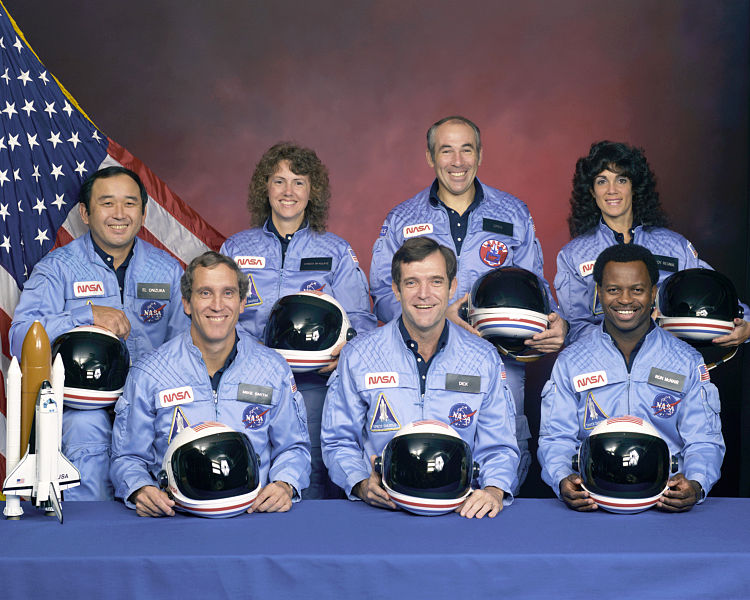
The Challenger accident happened when I was only 8 years old. I remember looking at the famous group photo of the crew and thinking that they looked very "American": of the seven crew members only three were white men - there were also two women, one Japanese-American and one African-American man. Also, one of the women was not a career astronaut but a school teacher. In this sense, the crew looked very much like the United States I knew. I also thought Judith Resnik's large hairdo was very typical for Americans in the 1980s!

The crew of STS-51-L in November, 1985
Ellison Onizuka (in the photo the first from the left in the second row) was the first Asian American in space (he had flown to space before), and apparently also the first Buddhist. Christa McAuliffe was also probably the first astronaut of Lebanese roots.

Ronald McNair was the second African American in space (he had flown before, too), if Arnaldo Tamayo Méndez of Cuba doesn't count. He would probably have been the third, if Robert Lawrence had not been killed in an aviation accident in 1967.

It turns out that my university (University of Illinois) has a minority student scholar program named after Ronald McNair. I did notice the familiar name when I visited the Turner Student Services Building the first time two years ago, but the people at the program office I talked to were not sure if it had been named after the astronaut or somebody else.

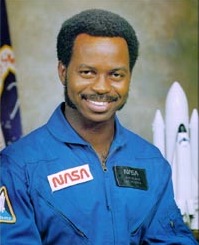
Dr. Ronald E. McNair, NASA astronaut
When I was a kid, I remember thinking that McNair looked very "American". In 1986, I had not yet met any non-white people but I recognized many African American politicians, athletes, actors and musicians. McNair's wide smile somehow reminded me of some people I knew, but I didn't research the crew's biographies much further. I did remember the smile, though.

Today, I read out the Wikipedia article about him and it looks like that he died younger than I am now - he was only 35 at the time of the Challenger disaster. He had received a PhD degree from MIT when he was 26, becoming a known expert in laser physics. By the time of his death, he already received three honorary doctorates. He was also the first astronaut of the Bahá'í faith, and quite possibly the first saxophonist in space. Jean-Michel Jarre's The Last Rendez-Vous (Ron's Piece) is dedicated to him - McNair was expected to record the solo for this track in space, and later perform it live at Jarre's concert in Houston in April, 1986.


In United States, there seems to be an obsession to name everything after famous people (military heroes, politicians, rich donors, astronauts). Often it feels unnecessary, sometimes even ridiculous, but sometimes it makes you think about and reflect on stories behind renowned, accomplished and exceptional individuals.

It's interesting to think that in 1986 I noticed McNair not because he seemed different but because in the diverse crew of STS-51-L, he did not seem different. The days of all-male, all-white and all-military crews of Gemini and Apollo programs were long gone - it was now time for all-American crews.

The shuttle flights resumed in 1989 and increasing international cooperation was notable in flight crews - astronauts from Canada, Germany, Russia, Japan and other countries flew on Shuttle flights before the program ended in 2011 - including the first (enrolled) member of an aboriginal tribe in space, John Herrington (of Chickasaw First Nation).

Sure, my observations of the STS-51-L crew in 1986 were somewhat naíve but I'm only happy that my belief (or hope) in space belonging to a more diverse group of travellers than just American and Soviet/Russian fighter pilots did become true.

Thursday, December 19, 2013

Why alternative treatments are not accepted by science

It is public knowledge that alternative treatments such as homeopathy and acupuncture (and many others) are not accepted by the scientific community as having effectiveness distinguishable from placebo. It is said that these treatments do not fulfill the criteria for medicine - which is often along the lines of double-blind clinical trials (or other trials of similar level of rigor).

This is easy to say - you just check what the dictionary says about science and check what kind of results previous research has yielded, and hope that the scientific method had worked and researchers and peer reviewers haven't been too dishonest.

But what kind of explanations and ideas do practitioners of alternative treatments have about this? After all, they think their treatments work - their customers' experiences usually support this - and many would like to have their discipline recognized better, even as part of the contemporary medicine, taught at universities.
Fourteen meridians in a Chinese acupuncture chart from the 1340s (source: Wikipedia)

Can the effectiveness be confirmed?

From books, interviews and generally on the Internet I have heard and read many opinions about the position of acupuncture and homeopathy in regards to what they call "school medicine". I'm sharing some of them here.

"Can be confirmed" / "Has been confirmed"

These are based on the idea, that the treatment "works" in the traditional sense and its effect can be confirmed and the treatment could probably be part of contemporary medicine.
  1. Effectiveness could be confirmed, but global conspiracy of Big Pharma corporations is controlling the industry and will not allow alternative practitioners to compete with their lucrative business. They are twisting and possibly sabotaging results of academic studies.
  2. Effectiveness could be confirmed, but due to the bad reputation  and "unscientific" background of the treatments, serious researchers will not attempt it, fearing that they lose their reputation.
  3. Effectiveness could be confirmed, but due to so many hoaxers and unreliable practitioners, it is next to impossible to produce reliable studies on the treatments.
  4. Effectiveness could be confirmed, but the process of doing so is very long and difficult, and it will take time before we can have conclusive results.
  5. Effectiveness has already been confirmed, but the scientific community (or Big Pharma) maintains the illusion that it has not.
  6. Effectiveness has already been confirmed: the placebo effect is the real effect, it has just been misunderstood.

"Cannot be confirmed"

Explanations in this category are based on the idea that for some reason, alternative treatments are fundamentally incompatible with what is usually called contemporary medicine or empirical science.
  1. Cannot be confirmed, because they are based on unknown interactions and laws of nature.
  2. Cannot be confirmed, because they are not based on laws of nature but a spiritual and/or unphysical connection of some kind, and by definition that is outside the reach of science.
  3. Cannot be confirmed, because they treat causes of conditions, not symptoms, and are thus outside the scope of contemporary medicine (which only deals with symptoms).
  4. Cannot be confirmed, because they are tailored for each person, and treatments of different people cannot be compared in a study.
  5. Cannot be confirmed, because they do not have a common methodology which could be evaluated.
  6. Cannot be confirmed, because they are only effective in a delicate, deep practitioner-patient relationship, which makes usual double blind and randomized controlled trials impossible.
  7. Cannot be confirmed, because medicine has distanced itself from natural treatment and spirituality so much that it is simply unable to detect the effectiveness.

"Confirmation is irrelevant"

There are some who abandon the whole idea of a treatment having an effect in the traditional sense.
  1. It is irrelevant whether it can be confirmed, because customers' (patients') own assessment of their own condition is the only possible criteria of effectiveness.
Regardless of the actual effectiveness of acupuncture, homeopathy and others, I think it would be constructive to think about these explanations instead. Some of them are actually not that implausible.

It is my understanding that patients of alternative treatments practitioners are generally (very) happy with their care. They have appointments with a private practitioner who has plenty of time to discuss with the customer, ask about background of the condition, and propose different options, unlike your usual doctor at the health center who will spend the 20 minutes by picking a diagnosis from the ICD-10 manual (or ICD-9 if you are American, I'm sorry) and write a prescription of antibiotics. Thus, general happiness about the experience should not be seen as any kind of evidence about effectiveness of the treatment, even if the harsh public health experience might act as a "nocebo" - making the drug's effect lesser.

Alternative or not?

Assuming that some alternative treatments actually work - and it is apparent that most do not - it would be incredibly useful to find out which ones have potential to be studied more and possibly be introduced to the realm of contemporary medicine. However, it has been noted that there are many ways of doing acupuncture, some of them not using needles at all, so studying one practitioner might not give any insight into how others do it. Homeopathy, on the other hand, is manifested by diluted "drugs" that have consistently been shown to contain no active ingredients (which is not in contrary to the principles of homeopathy), and would be easier to study, however in homeopathy as well it has been stressed that the treatment cannot be distanced from the delicate practitioner-patient dynamic.

Meanwhile, some ordinary health products have been misleadingly labelled as homeopathic to make them more attractive to consumers - these may be a case of products that can be shown to be effective, but as they are not true homeopathic products, they do not add to the knowledge of alternative treatments.

Homeopathy has been studied at various universities (including my alma mater, University of Michigan, which even had a dedicated department for it). Many trained physicians still allege that homeopathy is about medicine in traditional sense, and can be empirically studied and its effectiveness confirmed, thus making it a "non-alternative treatment". At the same time, explanations for how homeopathy might function have been proposed (memory of water), but even if homeopathy was effective (which I doubt), its underlying mechanism would still be unknown. Some also claim that the effectiveness of homeopathy has already been confirmed many times over, but for some reason the credible results are not taken seriously.

Supporters of alternative treatments do not always seem to grasp the breadth of ideas - among the practitioners and supporters - about what the real problem is. For some, whether acupuncture of homeopathy works is just a matter of empirical science. For others, it is a spiritual matter. Thus, homeopathy, acupuncture and others thus present themselves as ambiguous, fuzzy ooze around certain misguided concepts, which explains much of the trouble they have with contemporary medicine.

Sunday, December 8, 2013

Day of Infamy - Roosevelt's humble call to arms?

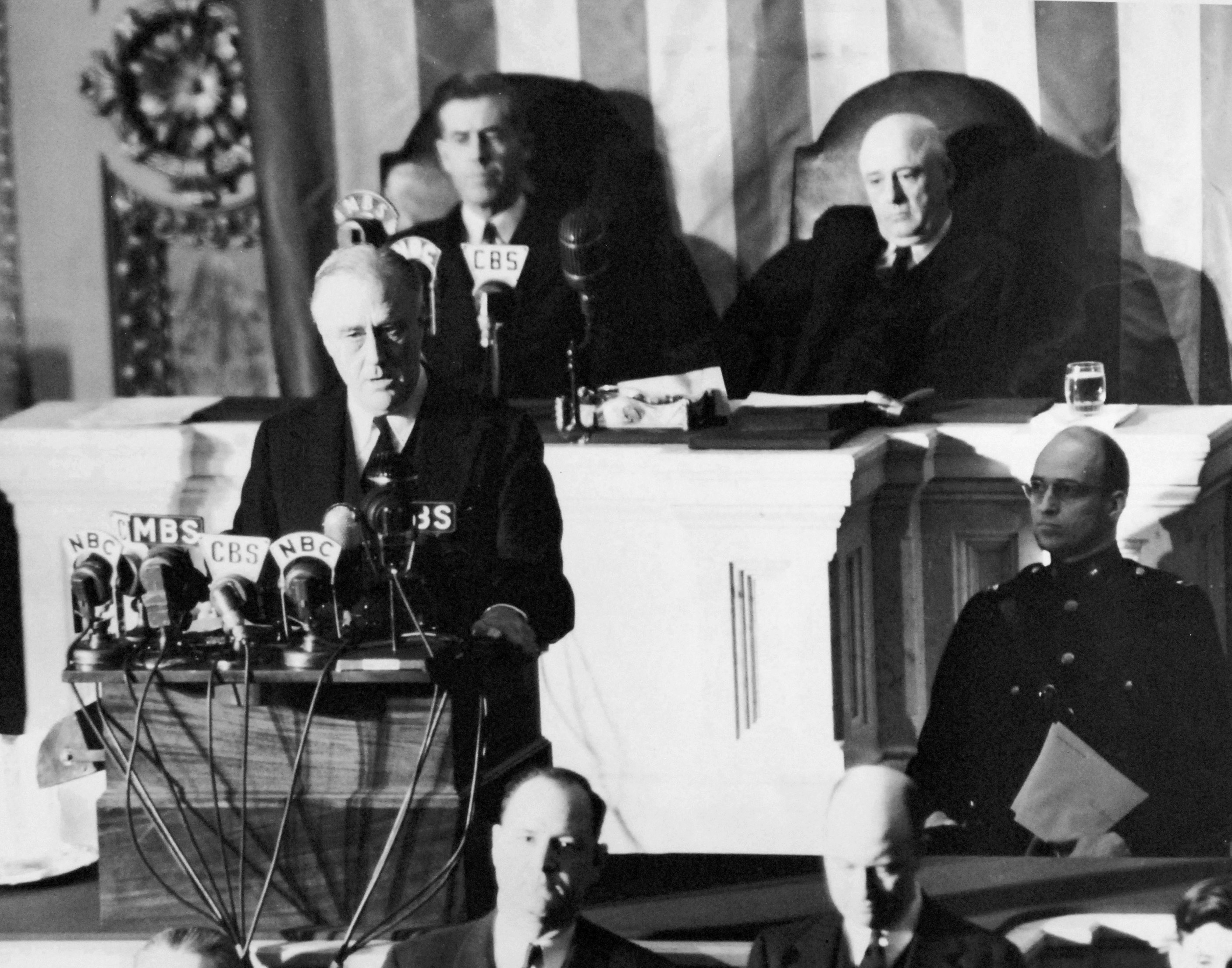
On December 7, 1941 - 72 years ago - the U.S. president Franklin D. Roosevelt gave one of his most famous speeches, calling that day the "Day of Infamy", and calling all Americans to arms against Japan and its allies - namely Germany. Allies of United States had already been engaged in the war for two years at that time.

As bad as the movie was, Pearl Harbor (2001) reminded the world about Japan's attack on Pearl Harbor, naval warfare mastermind Isoroku Yamamoto's involvement in the attack, and the U.S. response, especially the Doolittle Raid. With some misguided casting and lack of realism, it still featured important parts of the action and showed the attack through the eyes of many people present there, including seamen, pilots and nurses.It also featured Roosevelt giving his famous speech.

FDR delivering the speech to U.S. Congress

If the shoe fits, wear it

I always thought Roosevelt's wording was very fitting and the speech was an inspiring call to arms (even if I never actually read the whole text). After years of non-interventionist (or even isolationist) politics, leaving its European allies without direct military support, United States was forced to join the global war, and that day - Day of Infamy - showed Americans how unprepared United States was.

Indeed, it was infamy that United States has been caught "pants down". Its naval base in Hawaii had been attacked, after the remarkable failure of U.S. intelligence left it with no warning of the impending attack. It showed how future of naval warfare was aircraft carriers with their unique and flexible power projection capabilities, not battleships that were the mainstay of U.S. fleets. At the same time, the Mitsubishi A6M Zero fighter was to earn its reputation as the most capable naval fighter in the world.

Admiral Isoru Yamamoto, bringer of infamy
From this infamy, United States would rise to a formidable opponent in the war and end up beating up Japan in the Pacific theatre, innovating in naval and other warfare and, in the end, making the only two nuclear attacks in history, threatening to destroy Tokyo next. It had gone through the dramatic circle and avenged Pearl Harbor, and naturally also fought alongside its allies in Europe and elsewhere.

Only a couple of years ago, I realized I had misinterpreted Roosevelt's words.

The other interpretation

As depicted in the film Pearl Harbor - and numerous other films and reenactments - Japanese admirals had masterminded a daring attack to Pearl Harbor Naval Base, using aircraft carriers and naval fighters to bring destruction to the U.S. Pacific fleet. It missed the U.S. aircraft carriers, which - very wisely - the planners considered the main target, because unlike Americans, they realized their potential. However, the strike itself was very successful.

To recap, Imperial Japanese Navy launched a direct attack on United States Navy's base in Hawaii. Japan attempted to abide by the Hague Convention of 1907, by announcing its intentions - declaring war - before the attack, but due to delay caused by translation of the declaration from Japanese to English, war was declared a bit after the launch of the strike.

Apparently Roosevelt - and Americans still this day - thought it was an improper way to start a war. USA and Japan had been engaged in negotiations that were hoped to alleviate any need for war, and it seemed those negotiations had been a sham to make U.S. leadership uncertain about its true intentions, and as a continuation of that, an attack withoug declaring a war first was infamous.

Infamy in another context
Even though on many fronts there were formal declarations of war in WWII - for example, the United Kingdom declaring war on Gemany in September, 1939 - often hostilities were started without warning. Germany's attack on Poland in September, 1939 was one example, Soviet Union's attack on Finland in November of that year (a surprise, after months of negotiations) was another. Unlike many others, Japan made it clear that this was about a war between sovereign nations, and its armed forces engaged the other nation's armed forces, by striking a military target, and apparently honestly tried to make a declaration of war just as international agreements stipulated.

Deception is used in diplomacy and international relations - but to call Japanese tactics "infamy" is blatant exaggeration. Indeed, Japan had malicious intent and it threatened the whole Pacific region and was friends with Germany, but in the context of Second World War, its strike on a U.S. naval base was an exceptionally honest way of starting a war, as awkward as it sounds.


Michael Bay's Pearl Harbor, the awkward reference frame of this post
During the course of WWII, whole cities - with their populations - were effectively wiped off the map, including Coventry, Dresden, Rotterdam, Hiroshima and Nagasaki. The scope of destruction a war can bring was redefined. Was the attack on Pearl Harbor more "wrong" than other military actions of WWII? Was the diplomatic deception more "wrong" than other similar tactics around that time? Was the response less infamous?

I still think the interpretation of "Day of Infamy" meaning "United States got caught pants down by Japan, and it is embarrassing" is more fitting in the context of WWII. However, it should not take away from the remembrance of December 7, 1941, which marked the start of war between USA and Japan, and as such is a day to be remembered, as yet another realization of war being inevitable, and the start of the last war between these countries.

Thursday, December 5, 2013

Private cars vs. public transportation, an epic battle

Ground rule: use public transportation if you can. It is good for the environment and good for the city (if you are in a city) and it increases your sex appeal. However, the whole picture is much more complex than that. City planners and bus manufacturers try to appeal to the public by launching publicity campaigns like this one from the Polish bus manufacturer Solaris Bus & Coach SA:


This photo is from their Facebook page. The photo caption reads (from Google Translate):
So many cars disappear from the streets of our cities, when their owners will fill one bus. Public transportation! This number of cars would be unnecessary, if Their owners changed to a bus. Public transport!
It looks like the bus in the photo is Solaris Urbino 18 Hybrid, which is one of the manufacturer's newest products, and is a very modern hybrid vehicle. Based on the product brochure, it the densest configuration, it can carry 161(!) passengers, which is quite impressive. It looks like there are about thirty rows of private cars, five cars in a row, so let's make a wild guess and assume that there are 161 private cars on the left side of the picture. The point is clear: many private cars actually carry only one passenger, the driver, and when you fully utilize a bus, you can carry lots of people.

The good bus

How many of the 161 passengers - who now have abandoned their cars and only commute by bus - can actually have a seat? Answer: 51. Assuming that all passengers are average-sized and able-bodied, 110 of them will have to stand for the whole journey, and they cannot take any wheelchairs or a baby strollers.

It is true that number of vehicles on the right (1) is less than the number of vehicles on the left (161). The bus full of people would be much more efficient on transporting the people than the cars are, which is the point of mass transportation in general.

These publicity campaigns consistently compare the "best case" scenario for buses and "worst case" for cars, and this may lead to unrealistic expectations. In the scenario of the image, the bus will be as full as it can legally be. It probably won't be comfortable, fast or maybe not even safer than private car (there are no safety belts or air bags on buses, except for the driver). Because it is full, stops will be long and cumbersome, some people might even have to step out to let other passengers out, and then board again. The bus will also use slower and smaller roads to pick up passengers, and will usually not take the passengers to their ultimate destination - they will have to switch to another bus or walk (or use other form of transportation).

The mass transportation model works well in crowded cities for commuting, but actual occupancy rates are often much lower. According to UK Department for Transport's report, the estimated average occupancy rate (vehicle miles divided by passenger miles) of buses in London was 19.3, which is good - but only 9.1 outside of London (11.1 for the whole Great Britain). It also mentions that the current trend is that the rate for outside London is falling, potentially making mass transportation less effective and more challenging to maintain.

The bad private cars

According to University of Michigan Center for Sustainable Systems' report, average occupancy rate of all U.S. vehicles was 1.55 in 2011. The average rate varies by trip purpose - for leisure it is close to 2, for commuting it is often close to 1, and sometimes the car can also be full(!).

1.55 passengers is 31 % of a passenger vehicles maximum capacity (assumed five). 11.1 passengers is only 15.9 % of maximum capacity of a traditional city bus (40 seats and 30 standing, rough estimate). 

With these figures, you only need two or three cars to match the average occupancy rate of a bus, and with a car you can travel from point to point with greater flexibility. Fuel efficiency for new cars is more than 25 miles per gallon (sorry for using non-standard units!) and for an ordinary U.S. city bus, according to National Renewal Energy Laboratory's study, was roughly 4.0 mpg (Appendix C). 

With 11 passengers, this would equal to 44.0 passenger miles per gallon (we're talking approximations here, in reality of course fuel economy changes with the load), which is only slightly better than for a modern passenger vehicle with only 1 occupant! A full passenger vehicle would clock near 150 passenger miles per gallon (assuming no extra hurdles, heavy traffic, stops etc.) - and even with average 1.55 passengers it would still clock an impressive 38.75 pmpg.

Conclusions

Based on these numbers, driving a passenger car alone is approximately as fuel efficient as it is to travel on a bus, and with at least two passenger, it is significantly more efficient. At the same time, it is much more comfortable, flexible, faster and safer, and it allows you to transport groceries, strollers and other items.

However, this is not the complete picture either, for many reasons.

While that 4.0 mpg for a city bus is measured based on actual vehicle miles and fuel consumption, directly comparing it to passenger car fuel deficiency is difficult. Cars are used for much more than commuting, and often buses simply do not go where drivers would like to go. Often bus trip involves somebody driving a private car to pick up a passenger, because the nearest bus stop is too far away (or in a dangerous place) to walk. With newer buses (and hybrid and electric engines) efficiency can be improved - and bus is not the only form of mass transportation in many cities.

Good city and transport planning can improve public transport by planning the city around it and making it easy to catch a bus or train and switch between them. However, it may create dense suburbs without which heavy rail transport might not be worth building there.

And, perhaps most importantly, the average occupancy rate can be vastly improved. If people really would ride the bus when it is practically possible, there could be less traffic on the roads, less pollution and better fuel economy (per passenger) for buses. Owners (and drivers) of private cars are not (all) stupid. Many of them would ride the bus, subway, train or tram if it was feasible, but it is not because of bad route planning. I was unfortunate to experience this myself in 2009 when I started in a new job which was located only about 5 km from my home - but travel time there by bus was almost 40 minutes, and involved one or two switches. I bought a car (Citroën C1, 64.0 mpg) and haven't regretted that decision one second. (I still walked there sometimes.)

Frank Palmer of Daily Kos wrote about the "mpg fallacy" - and made some of the same points I make here. 

We will not and practically cannot achieve the utopian future where private cars have been exchanged for mass transportation - at least not in near future, and meanwhile, a more complete picture of different forms of commuting and transportation should be discussed in public. Mass transit is good, but by average not nearly as good as it is claimed to be. Sadly.

P.S. The modern hybrid bus in the image would achieve around 1000 pmpg.