Thursday, December 4, 2025
Still about the Kobayashi Maru test...
Still about the Kobayashi Maru test, masterfully expored in Star Trek II. It deepens our image of James T. Kirk - he really does not want to lose. However, even though he ultimately did beat the test, before that, he failed it more times than anyone else, ever. He took it multiple times, researching it, attempting different tactics, and finally found a combination of parameters and approaches that solved the problem.
Even though in popular culture Kirk has the reputation of a maverick, risk taker, who uses intuition to beat any challenge, in Trek canon Kirk was an academically accomplished student who studied harder than anyone else, said to be a nerd who lived in the library or similar. His "original" solution to Kobayashi Maru was due to academic rigor, just like his later tactical successes.
When sitting in the captain's chair on the Enterprise, he was sitting on a stack of manuals, textbooks, and biographies of historical commanders. He didn't impose them on others, and didn't remind others of Starfleet regulations, even though he was the one who knew them (and maybe even ultimately wrote them?).
In Star Trek II, Kirk is a faculty member at Starfleet Academy, teaching command-branch specializing cadets like Saavik. The test is only required for command-branch cadets at the end of their studies. But what the audience doesn't know and it is not explained that there was (by canon) a 12-year gap between the events of the first two movies. Kirk had retired from Starfleet, contemplated marriage with Antonia, but just recently returned to a teaching job at the Academy.
Part of the tension of the first movie was that Kirk hadn't even been on a starship since Enterprise returned from its five-year mission two years earlier. But in II, he had already been retired for years. We see him in action, and he feels old. That's natural for someone who just came back from retirement, but this setting is not apparent from the movie.
It also explains the tone of Kirk's birthday party. He is, indeed, back at Starfleet, but disillusioned. Is this why he came back? Should he have stayed away? After all, he was just about to get married (though we only learn about this in Generations) but chose Starfleet instead.
So in the first movie, Kirk is a jerk and he imposes himself over others for selfish reasons. In the second one, he is not sure what he wants or even whether it was the right choice to come back. At 50 years of age, it is also fitting to see his home, like a captain's cabin containing souvenirs from around the world, but him not knowing what they mean to him any more.
Now, of course, Strange New Worlds has reframed TOS. It is no longer about a lone starship, one of many, venturing into the unknown, commanded by a brilliant semi-celebrity captain, but about the most famous ship, not only wihin Starfleet, but within the whole UFP, for no apparent reason. No big deal for Kirk, then. Even if he had failed, there were no stakes, as Enterprise had already established its iconic status before he started.

Friday, September 23, 2022
Information architecture, UX design, and a delicious meal
Designing a good user experience for an information system (or, generally, a technical system with an user interface) isn't trivial. Just like a culinary professional crafting good meals, a UX designer has to know what they are doing. There are schools for these fields, theories, articles, journals. People have tons of expectations for what they receive from them.
For a long time, experts created computer systems for other experts. Now, most of the world's population use the Internet at least occasionally - and it is associated with the expectation that they are able to (or expected to) do certain things online - like banking, government services - in addition to using social networks like Facebook.
Scenario
Imagine you were a chef creating a very nice meal in the kitchen, not knowing who would get to eat it. You have done your schooling, you know the French names for all the ingredients you use, you know all the relevant culinary trends, and generally know how to craft a healthy, good-looking, nutritious meal. You know your friends and colleagues consider you a true professional and would gladly eat anything you cook.
Say you produce such a meal at a restaurant. On a table there's a plate of food, with a glass of red wine. A fork and a knife and a napkin. It looks good.
A person comes via the open door.
They walk to the table. They don't sit, but they look at the plate for a while. Then they pick two potatoes from the plate and eat them immediately. They also drink all the wine. Before leaving without paying, they also steal the fork and the knife. They walk rapidly to the door, but as it is now closed (not locked), they panic, and proceed to break the window to exit the restaurant (hurting themself in the process).
This wasn't the result you expected; everybody knows how to behave at a restaurant and how to eat food, right?
Unpacking
Let's say you get the chance to talk to the person and find out what happened.
Turns out that they saw the chair. However, it was red, and they had never seen a red chair before, and assumed that it was either not a chair or somehow defective or otherwise "strange" with bad vibes. As they were not experts in furniture - and they emphasized they were not a nerd - they didn't want to try their luck by sitting on it.
They were initially suspicious because the plate was not white, but gray, and they were not sure what it meant - because it must have meant something. But since it still looked like a plate and it contained food, they decided to proceed to eating.
There was a nice steak on the plate, but they were not aware that meat could be edible, so they ignored it. There were also carrots, but they were of the baby variety, so their size did not match the expectations they had for a carrot, so just to be sure they ignored them, too.
The two potatoes (the third was under the steak so they didn't see it) looked exactly like the potatoes they were used to, and they expected food to be available, so they consumed the potatoes immediately. It wasn't much food, but it was free and easy to eat, so they were quite satisfied.
They claim they drank the wine because they thought it was juice. But that's a lie - they knew it contained alcohol and that was the real reason.
However, next to the plate there was a knife. They knew knifes are weapons, so they took the knife for later use. They didn't recognize the fork, but as it was made of the same material as the knife, they assumed it was a weapon, too, and took it as well.
They didn't know they were in a restaurant, so they didn't pay. They just heard there was food available, and while they had heard of restaurants before, they had never been in one.
Because the door was now closed, they assumed they were trapped. They assumed there was a reason the door wasn't open any more and they felt powerless. As a result, they broke the window as a last resort.
The challenge with the average user (who is definitely not a "nerd")*
Facebook, Gmail, and an online bank are examples of complex systems that people use every day with lots of expectations about what they will get and encounter. The systems must ensure that the use happens in a safe and secure manner in addition to the system being easy to use (which is part of the "safe and secure" thing by design).
However, these systems are not built for experts - the expectation is that anyone can use them without specifically studying how to use them. By "anyone", I mean also the average user who we cannot expect to know what a computer is, what an operating system is, what a window is (and how they work in, say, Windows), what an application is, what a web browser is, what Internet is, what Web is, what "secure" means, what a search engine is, what a web page and a web site are. They also don't necessarily even want to know (because they are not "nerds" - they consider it impossible or even undesirable to know these things).
What a challenge. A UX designer has to design a system using different technical concepts but there can be very few expectations for the average user (who doesn't even consider themself to be "using" anything) to have any knowledge of the concepts that were used to create the system. At the same time, the services must be delivered in a certain manner - equally, safely, securely, efficiently - while providing a satisfactory user experience (to satisfy the user's goals).
The solution is absolutely not only serving potatoes at a restaurant. The solution is also not mandating a culinary course on all customers.
In some ways, we have already lost the game. In the restaurant example the customer actually did leave satisfied and happy (minus the incident with the broken window), even if you were perplexed and surprised as the chef. They might have enjoyed the steak (if they eat meat in the first place) and the chair was probably pretty comfortable as well, even though it was red. The knife was a familiar object to them, even if in another context. There's a lot to build on! Sometimes the user doesn't know what they want from a system but are willing to try different things. Also, by knowing better what the expectations are, they can be guided to the expected outcome. After all, the average user is not your friend or colleague but someone who doesn't know you and doesn't care much about the beautiful system you designed.
There's also the useful concept of interaction cost - the sum of efforts for a user to reach their goal in a user interface, including physical actions and cognitive load. You probably have an idea of what the expected result is, but the path to it may be too costly compared to other paths that you didn't think of, for a variety of reasons. It's not just about how to place interface elements visually but also about how to display information within the interface!
Final thoughts: In the context of user experience design, I think people (users) are quite selfish with their goals. Also indifferent, disinterested and easily distracted. We expect them to be interested in things they don't care about and also we don't understand their expectations and ultimate motivations. Even the words "user" and "system" can be misleading - they paint a picture of a well-defined technical system that users navigate through, with a huge contrast to how users... I mean interaction participants, see it.
* I have encountered lots of people who specifically and emphathetically say they are not "nerds", therefore they claim they are unable to understand anything related to information technology.
Friday, June 1, 2018
Sabrina Salerno, the feminist
People who lived in the 1980s in Europe probably remember Sabrina Salerno, who was a prominent pop singer with the breakthrough hit 'Boys' in 1987. The music video for that song was allegedly banned on MTV because of the very famous nipple slip in the video clip that was originally made as a segment for an Italian TV show. She was criticized by feminists as being a sex object, using sex and provocative appearances to further her singing career and not offering much else to the world of music. She was compared with other "sexy" female pop singers of the time, including but not limited to Samantha Fox, who, like Sabrina, had been a well-known topless model.
After two successful studio albums of the Italo disco genre, it seemed that Sabrina had disappeared. She did continue her singing and acting career in Italy, though, and frequently gives interviews. She also appeared on the music video for a folk cover of 'Boys' by the Finnish singer Sansa in 2011.
We didn't hear much about feminism in the 1980s. We didn't care much about what Sabrina or any other pop star actually said in interviews. Everybody knew she had breasts and that her style was not especially... modest. Some had even seen her music videos (I hadn't, as we only had two TV channels at the time). She seemed to have gigs in Finland, my home country, every year.
On the surface level, for many, she seemed like the worst example of a sexy pop star chained by her producers and managers to perform suggestive songs about sex. For me, the Italo disco beats in Sabrina's hits such as 'My Chico' convinced me that there is actually some "adult music" (as in not children's music) that is worth listening to and later this evolved fascination about electronic music in general and techno music specifically.
But who was (or is) Sabrina and what did she actually say?
Thanks to the Internet and YouTube, there's a lot of material to work with. Having studied at an international school, she had no trouble giving comments in English or appearing at music and talk shows around the world. It is actually striking to see this 19-year-old woman casually discussing her music and views, exhibiting total self-confidence, challenging the interviewer, questioning the interviewer's questions.
In this 1988 interview with MTV, she says she admires Madonna due to her strong personality and the control she has over her career. She stresses that she does not try to be sexy - she tries to be Sabrina, it is up to others to decide whether they think she's sexy or not.
In another interview with Super Channel, Sabrina says "I'm not an object, I'm a subject". She asks why athletes such as football players are respected and understood but as a pop singer she has to explain why she trains dancing and singing and has to take care of her body.
In 1989 she had an interview with the Swedish show Bullen, in which she says she has never fallen in love and discusses how she cares too much about her career to settle down and start a family. She also says having been abandoned by her parents and living alone since the age of 16, she has grown independent and worked hard to prove herself.
In other interviews she has discussed the conservative Italian family-centered society and its expectations for young women. She says her "sexy" appearance is body positivity - she says she feels she is beautiful and has the right to show it and is perplexed why anybody questions her right to do it.
On her second studio album, 'Super Sabrina', she collaborated with the producer trio Stock-Aitken-Waterman ald also with the disco legend Giorgio Moroder. She co-wrote the hit 'My Chico' and shared that she aimed to perform more music written by herself. She also wanted to evolve and not continue the same disco/pop career as before, which led to conflicts with her producers and mangers.
I understand that the "sexy" image (expectation) of female pop singers can be problematic. However, Madonna, among others, has used the image while building her career, and is nowadays seen as, in many ways, an exemplary strong and independent woman, even as an "almost sacred feminist icon".
While Madonna and Samantha Fox seemed sophisticated and their videos polished, Sabrina seemed more provocative and uninhibited, openly asking why she should hide what she is or thinks.
She asked for respect for her rights and work as a singer and as a woman and as a teenager questioned the subjugated role of women in the society. She said she wanted to do good and change the society by being herself. And she said all this before even turning 21.
Sabrina's feminism (if you want to call it that, and she did not use the word) isn't always what you would expect from something described as feminism. Maybe she doesn't look like a feminist. But arent't the themes what feminism is about, especially as seen through the progressive lense of the 2010s society? Or, at least, shouldn't her career and comments be at least considered as expressions of feminist ideals, to some extent, just like feminists from so many different backgrounds can have completely valid ideas and approaches?
Did you remember what Sabrina said?
After two successful studio albums of the Italo disco genre, it seemed that Sabrina had disappeared. She did continue her singing and acting career in Italy, though, and frequently gives interviews. She also appeared on the music video for a folk cover of 'Boys' by the Finnish singer Sansa in 2011.
We didn't hear much about feminism in the 1980s. We didn't care much about what Sabrina or any other pop star actually said in interviews. Everybody knew she had breasts and that her style was not especially... modest. Some had even seen her music videos (I hadn't, as we only had two TV channels at the time). She seemed to have gigs in Finland, my home country, every year.
On the surface level, for many, she seemed like the worst example of a sexy pop star chained by her producers and managers to perform suggestive songs about sex. For me, the Italo disco beats in Sabrina's hits such as 'My Chico' convinced me that there is actually some "adult music" (as in not children's music) that is worth listening to and later this evolved fascination about electronic music in general and techno music specifically.
But who was (or is) Sabrina and what did she actually say?
Thanks to the Internet and YouTube, there's a lot of material to work with. Having studied at an international school, she had no trouble giving comments in English or appearing at music and talk shows around the world. It is actually striking to see this 19-year-old woman casually discussing her music and views, exhibiting total self-confidence, challenging the interviewer, questioning the interviewer's questions.
In this 1988 interview with MTV, she says she admires Madonna due to her strong personality and the control she has over her career. She stresses that she does not try to be sexy - she tries to be Sabrina, it is up to others to decide whether they think she's sexy or not.
In another interview with Super Channel, Sabrina says "I'm not an object, I'm a subject". She asks why athletes such as football players are respected and understood but as a pop singer she has to explain why she trains dancing and singing and has to take care of her body.
In 1989 she had an interview with the Swedish show Bullen, in which she says she has never fallen in love and discusses how she cares too much about her career to settle down and start a family. She also says having been abandoned by her parents and living alone since the age of 16, she has grown independent and worked hard to prove herself.
In other interviews she has discussed the conservative Italian family-centered society and its expectations for young women. She says her "sexy" appearance is body positivity - she says she feels she is beautiful and has the right to show it and is perplexed why anybody questions her right to do it.
On her second studio album, 'Super Sabrina', she collaborated with the producer trio Stock-Aitken-Waterman ald also with the disco legend Giorgio Moroder. She co-wrote the hit 'My Chico' and shared that she aimed to perform more music written by herself. She also wanted to evolve and not continue the same disco/pop career as before, which led to conflicts with her producers and mangers.
I understand that the "sexy" image (expectation) of female pop singers can be problematic. However, Madonna, among others, has used the image while building her career, and is nowadays seen as, in many ways, an exemplary strong and independent woman, even as an "almost sacred feminist icon".
While Madonna and Samantha Fox seemed sophisticated and their videos polished, Sabrina seemed more provocative and uninhibited, openly asking why she should hide what she is or thinks.
She asked for respect for her rights and work as a singer and as a woman and as a teenager questioned the subjugated role of women in the society. She said she wanted to do good and change the society by being herself. And she said all this before even turning 21.
Sabrina's feminism (if you want to call it that, and she did not use the word) isn't always what you would expect from something described as feminism. Maybe she doesn't look like a feminist. But arent't the themes what feminism is about, especially as seen through the progressive lense of the 2010s society? Or, at least, shouldn't her career and comments be at least considered as expressions of feminist ideals, to some extent, just like feminists from so many different backgrounds can have completely valid ideas and approaches?
Did you remember what Sabrina said?
Wednesday, May 30, 2018
What would a Warplanes film be like?
I saw a poster for the film Planes, part of the popular Cars franchise. I noticed that some of the characters are military jets (Super Hornets). I started to wonder what a film called Warplanes (that would happen in the same universe) would be like.
Warplanes would follow a miscellaneous cast of American warplanes at a major air force base. There would be the young and fast F-22 planes that everyone admires and the F-35s who are in their teens, trying to prove themselves. Looking upon them are the older F-15s and F-16s, many of them combat veterans. Their "cousins", Ray-Ban-wearing F/A-18s, who sometimes come to visit for joint dissimilar air combat training, have traveled around the world, bombed exotic places, and starred in famous films. (Nobody remembers the F-14s any more.)
Overseeing these "kids" are of course older, bigger planes: the clumsy but gentle transport C-5 and the little bit more agile C-17. Their friends include the radar plane E-3 and the best friend forever KC-135 and its bigger brother KC-10. (Obviously all of these would have cute names in the actual film.)
Many older planes would actually be sad and bored. Once lauded as technological marvels, carrying expensive and advanced nuclear weapons, are now mostly used for training purposes or sitting in the desert, some having had their wings chopped off due to the START treaty. The B-52 and B-1 especially would still like to see some action, to prove that there still is a reason for them to exist. There's a generational gap between them and the F-22s and F-35s, even though they are supposed to work together.
But one day, a plane they have heard of but never seen, the shadowy but respected E-4 Nightwatch, delivers a message from the trusty and wise VC-25 Air Force One which has sadly been shot down: they have a new mission, and they have to work together to complete it! There's no time for anyone to sit in the desert any more!
The F-22s are excited to be moved to forward-operating bases assisted by their friends, KC-135s. Striking from multiple directions and with their Super Hornet buddies and allied Eurofighters, they target the bad guys' air defences to pave the way for the nuclear-armed B-52 bombers, escorted by the enthusiastic F-35s and F-16s. The Falcons and Raptors notice the tears in the corners of the old Stratofortresses' cockpit windows - the old guys are really touched by finally getting into action. They still know their tricks! They launch their nuclear-tipped ALCMs toward enemy targets, knowing they have fulfilled their duty, perhaps even fate. Some of them even drop old-fashioned B61 gravity bombs toward Russian cities and other civilian targets. They are heroes! One B-52, just before being shot down, is even informed of having been awarded a medal for outstanding combat service!
In the sequel, the surviving Warplanes head back home, after saving the world from the bad guys who wanted to destroy their freedom and independence. Since all KC-135s were destroyed in air or on the ground, not all make it back - some have to ditch in the sea, some even meeting their allied Warships and brand new P-8 maritime reconnaissance planes. But the ones who make it back see that the enemy counterattack has destroyed almost the whole United States, including their own home air force base. Landing at civilian airports and facing innocent humans demanding answers for why they caused the country to turn into apocalyptic wasteland, they face completely new problems. People want to strip them of their radiation-hardened parts to build shelters, repair hospitals and build radios to coordinate rescue operations. Will our friends survive? Is this the end for the friendly machines designed as deliverers of mass destruction?
(There are no further sequels.)
Wednesday, March 28, 2018
Vulcans in Star Trek: Jewish or secretly gay?
It is commonly thought (and partially revealed by scriptwriters) that Vulcans are based on ugly stereotypes of Jewish culture (intelligent, controlling, scheming, with secret bloody rituals). Leonard Nimoy also developed the Vulcan greeting based on a Jewish blessing he witnessed at a synagogue. Likewise, Klingons were modeled after stereotypes about feudal Japan (with Viking influences), Romulans after Ancient Rome etc. But wouldn't it be more or at least substantially allegorical to think of Vulcans as closeted homosexuals?
In TOS, Vulcans are depicted as competent, rational, a bit weird and funny-looking, reserved, and having lots of secrets. Literally. In classic episodes "Balance of Terror" and "Amok Time", it is revealed that the Vulcans actually maintain a careful facade to conceal their true identity. They are actually emotional, fierce, even violent people who hide behind ancient rituals and purity pledges (Kolinahr) to appear relatively normal to others.
In "Amok Time" and TNG's "Sarek", it is revealed that being a member of the Vulcan society imposes a heavy toll: finding a mate is not through love but an arranged child marriage confirmed by a ritual, failure to find a mate results in mental illness and even death, as does continued suppression of emotions without release. In "Sarek", this is made explicit by Sarek's breakdown after decades of harboring forbidden emotions that he forcefully releases to Picard via mind meld. In "Star Trek III: The Search for Spock", Saavik offers herself to Spock as a mate to save his life.
Obviously, in "Star Trek V: The Final Frontier", we meet a Vulcan who does not believe in Surak's restricting ideals. He is openly emotional which finally betrays him. Spock keeps his brother's existence secret even to his closest friends due to embarrassment - Sybok is out of the closet, while Spock is confined to it and desperately committed to staying there, as indoctrinated in his childhood by his powerful father.
We also know that Spock is also half Vulcan. This creates an identity crisis that he tries to fix by committing to a reparatory therapy known as Kolinahr ("Star Trek: The Motion Picture"). But as he is to make the final purity pledge, he realizes that this path is not entirely correct - there is something in the universe that calls upon him and wants to be intimate with him (which happens later in the film by mind meld).
I did a bit of Google research and while there are tons of references and allegories to sexuality in Star Trek, I did not actually easily find mentions of Vulcan life as an allegory of closeted lgbti+ people. One of the reasons for Star Trek's success is that the aliens and future concepts we encounter are relatable because they are based on human concepts. Even when not made explicit, the patterns are familiar, therefore I am surprised that I haven't encountered this connection before. Not saying it is any more correct than the Jewish connection that the scriptwriters have acknowledged, but it is also not surprising if these connections seem fitting.
What do you think?
Metamathematics and the associated shame
I was 35 when I found metamathematics.
It's something I'd been secretly interested in all my life but I didn't have a word for it. After going to bed, in darkness, I would take out my mobile phone, browse Wikipedia or Encyclopedia of Mathematics and read about hyperbolic geometry, minimal universal Turing machines, cellular automata, Entscheidungsproblem and other things. I thought I was the only one. There was no one in my family I could talk to about it. Only later, at a liberal American university, far away from home, I realized that metamathematics is nothing to be ashamed of, and you can do it just for fun, either alone or with somebody you trust. There are even online groups and fun events you can go with others who share the same interest.
I also believe that metamathematics is only natural in the wider development of mathematics and should be recognized as foundational instead of hushed away as insignificant fringe research area. Also, you don't have to read everything that has been written about it or to know everybody in the scene, you can get intimate with the Busy Beaver game within the confines of your home.
It's also important and encouraging that while Gauss was hesitant to come out with his blasphemous ideas with hyperbolic geometry, others like Hilbert, Church, and Turing proudly stepped into spotlight. I'm not into hero worship but these pioneers - with sometimes tragic lives - are revered for a reason.
(This is my first new blog post in four years!)
It's something I'd been secretly interested in all my life but I didn't have a word for it. After going to bed, in darkness, I would take out my mobile phone, browse Wikipedia or Encyclopedia of Mathematics and read about hyperbolic geometry, minimal universal Turing machines, cellular automata, Entscheidungsproblem and other things. I thought I was the only one. There was no one in my family I could talk to about it. Only later, at a liberal American university, far away from home, I realized that metamathematics is nothing to be ashamed of, and you can do it just for fun, either alone or with somebody you trust. There are even online groups and fun events you can go with others who share the same interest.
I also believe that metamathematics is only natural in the wider development of mathematics and should be recognized as foundational instead of hushed away as insignificant fringe research area. Also, you don't have to read everything that has been written about it or to know everybody in the scene, you can get intimate with the Busy Beaver game within the confines of your home.
It's also important and encouraging that while Gauss was hesitant to come out with his blasphemous ideas with hyperbolic geometry, others like Hilbert, Church, and Turing proudly stepped into spotlight. I'm not into hero worship but these pioneers - with sometimes tragic lives - are revered for a reason.
(This is my first new blog post in four years!)
Saturday, April 5, 2014
Bigot steps down
I heard that Mozilla's new CEO (Brendan Eich) was a right-wing anti-gay Republican fundamentalist Christian bigot and because he hates equality and human rights, he must be fired. Yesterday, he was.
I read Mozilla Executive Chairwoman (why not 'chairperson'?) Mitchell Baker's announcement about Eich stepping down. I was puzzled and confused - based on this announcement, it sounds like somebody has been revealed as pedophile or something really horrible. The announcement was full of what I perceived as empty rhetoric about core values, understanding the community and so on. What was going on? Why did the CEO resign? What is the anger she talks about? Had they really unearthed something much more sinister than the claimed donation to a campaign?
Turns out, they hadn't.
In 2008, California ballot referendum commonly called Prop 8 was held. seeking to define marriage as an institution of a man and a woman, blocking same-sex unions in the state. Of the over 17 million voters, 52 % were in favor and the proposition was passed, only to be overturned by a federal court soon thereafter. The full list of over 110,000 individual donors to the opponents and proponents of Prop 8 is public information. Of these, 35,000 people donated in favor of Prop 8, and one of them was Brendan Eich.
Even though the referendum was six years ago and Eich's donation was public information, the real storm started only recently, in addition to the usual Twitter storm, OkCupid asked its users to boycott Mozilla Firefox. Apparently that rage - justified or not - was enough for Mozilla and Eich to arrive to certain conclusions.
Apparently Eich's conduct was spotless, according to the Mozilla chairwoman. Eich explicitely vowed to uphold Mozilla's values of inclusiveness and not let his personal opinions affect his job. He has not and did not elaborate on his political, religious or other stances. This was specifically for the fact that we know he was for Prop 8.
He donated one thousand dollars to the campaign. Other donors include hundreds of employees from several universities and big technology companies such as Boeing and Microsoft. The proposition was passed, and it was backed by national organizations and top politicians such as John McCain, who was also a presidential candidate that year. In my opinion, his conduct was not very exceptional in United States, though I am very surprised that if he really was in favor of Prop 8, why he didn't donate more, 50,000 dollars for example.
I didn't like Prop 8 and I like the American approach to same-sex marriage: it is a constitutional issue about equality. European countries are taking a much more complicated road, and it also means there are lots of different opinions and changes are opposed for many procedural reasons as well.
Among the millions of voters, we know how these 110,000 people (probably) voted, and we can use this against them, and kick them out of their jobs because they were on the wrong side in this part of political process, right? Or, perhaps, Eich was in such a special position that his political views six years ago were a good enough justification to end his brief CEO tenure, and this is implied but not explicitely said in the announcement.
Eich seems to have given categorical responses. He is the CEO and vows to uphold Mozilla's values (he was one of the founders, after all), and his personal opinions are not relevant. I think they shouldn't be, especially as the only thing we know about them is a single donation. However, this need not matter in a storm. For the rest of the world, he's not CEO but the King of Mozilla whose personal (real or assumed) traits represent success and failure in what he represents. LZ Granderson wrote about this for CNN.
However, the biggest failure of all, in my opinion, was the announcement. If this was indeed such a big issue, this public apology whould have been much more explicit. What is she apologizing for? How was Eich's conduct wrong? They also mention freedom of speech. How is that related? Eich didn't even say anything, just wrote one check to a campaign. She repeats how Mozilla respects everybody's religious, political and other views, but they just fired their CEO over one political donation. Why does she not say what is allowed, what should have happened, what went wrong? Why does she call this a freedom of speech issue? She says "you" are angry. Well, not everybody are. The free software community is global and apparently not everyone agreed with the rage. She says she understands it, but I don't, because I don't think she tells us what it is.
She says Eich had to go because Mozilla is committed to the certain values - that Eich vowed to uphold. If he did, as nobody has said he didn't, why did he have to go?
There are probably answers, and Eich was, in the end, probably the wrong choice, and much (but not all) of the rage was unfair and unwarranted. But why are there questions? I care a lot about equality and good conduct of companies, and to defend those, Mozilla should have made a strong and clear statement about the facts. Now they are only catering to similar-minded folks who got what they wanted, perhaps hoping that big corporation PR maneuvers let them evade tough questions.
I read Mozilla Executive Chairwoman (why not 'chairperson'?) Mitchell Baker's announcement about Eich stepping down. I was puzzled and confused - based on this announcement, it sounds like somebody has been revealed as pedophile or something really horrible. The announcement was full of what I perceived as empty rhetoric about core values, understanding the community and so on. What was going on? Why did the CEO resign? What is the anger she talks about? Had they really unearthed something much more sinister than the claimed donation to a campaign?
Turns out, they hadn't.
 |
| Netscape Navigator 2.0 - the first browser that contained Eich's JavaScript interpreter |
What happened
Two weeks ago, Mozilla Corporation hired their CTO Brendan Eich as their new CEO. Mozilla Corporation is the corporate arm of Mozilla Organization which also operates Mozilla Foundation, so it is not a typical Silicon Valley company. Eich was one of the founders of Mozilla Organization, inventor of JavaScript and was one of 25 people Mozilla vetted for the job.In 2008, California ballot referendum commonly called Prop 8 was held. seeking to define marriage as an institution of a man and a woman, blocking same-sex unions in the state. Of the over 17 million voters, 52 % were in favor and the proposition was passed, only to be overturned by a federal court soon thereafter. The full list of over 110,000 individual donors to the opponents and proponents of Prop 8 is public information. Of these, 35,000 people donated in favor of Prop 8, and one of them was Brendan Eich.
Even though the referendum was six years ago and Eich's donation was public information, the real storm started only recently, in addition to the usual Twitter storm, OkCupid asked its users to boycott Mozilla Firefox. Apparently that rage - justified or not - was enough for Mozilla and Eich to arrive to certain conclusions.
Context
This happened in United States, where CEO (or anyone else, it seems) can be fired for any reason, any time. Mozilla and Eich certainly thought it is best for Mozilla if he resigns, and that part is very much business as usual in USA. However, there are many details about this storm that are very problematic.Apparently Eich's conduct was spotless, according to the Mozilla chairwoman. Eich explicitely vowed to uphold Mozilla's values of inclusiveness and not let his personal opinions affect his job. He has not and did not elaborate on his political, religious or other stances. This was specifically for the fact that we know he was for Prop 8.
He donated one thousand dollars to the campaign. Other donors include hundreds of employees from several universities and big technology companies such as Boeing and Microsoft. The proposition was passed, and it was backed by national organizations and top politicians such as John McCain, who was also a presidential candidate that year. In my opinion, his conduct was not very exceptional in United States, though I am very surprised that if he really was in favor of Prop 8, why he didn't donate more, 50,000 dollars for example.
I didn't like Prop 8 and I like the American approach to same-sex marriage: it is a constitutional issue about equality. European countries are taking a much more complicated road, and it also means there are lots of different opinions and changes are opposed for many procedural reasons as well.
Among the millions of voters, we know how these 110,000 people (probably) voted, and we can use this against them, and kick them out of their jobs because they were on the wrong side in this part of political process, right? Or, perhaps, Eich was in such a special position that his political views six years ago were a good enough justification to end his brief CEO tenure, and this is implied but not explicitely said in the announcement.
Failures
Mozilla should have realized that it is risky to to give a promotion from CTO to CEO to a guy who is in a public list of donations to a controversial campaign (even if it was supported by a majority of Californian voters). They also shouldn't (and didn't) hire other people who might have been pereceived as somehow improper or inadequate, even if they were otherwise perfect for the job, because that's how business is in America. I fear this might be why there have been so few female CEOs in tech companies. Or female presidents. A risky choice.Eich seems to have given categorical responses. He is the CEO and vows to uphold Mozilla's values (he was one of the founders, after all), and his personal opinions are not relevant. I think they shouldn't be, especially as the only thing we know about them is a single donation. However, this need not matter in a storm. For the rest of the world, he's not CEO but the King of Mozilla whose personal (real or assumed) traits represent success and failure in what he represents. LZ Granderson wrote about this for CNN.
However, the biggest failure of all, in my opinion, was the announcement. If this was indeed such a big issue, this public apology whould have been much more explicit. What is she apologizing for? How was Eich's conduct wrong? They also mention freedom of speech. How is that related? Eich didn't even say anything, just wrote one check to a campaign. She repeats how Mozilla respects everybody's religious, political and other views, but they just fired their CEO over one political donation. Why does she not say what is allowed, what should have happened, what went wrong? Why does she call this a freedom of speech issue? She says "you" are angry. Well, not everybody are. The free software community is global and apparently not everyone agreed with the rage. She says she understands it, but I don't, because I don't think she tells us what it is.
She says Eich had to go because Mozilla is committed to the certain values - that Eich vowed to uphold. If he did, as nobody has said he didn't, why did he have to go?
There are probably answers, and Eich was, in the end, probably the wrong choice, and much (but not all) of the rage was unfair and unwarranted. But why are there questions? I care a lot about equality and good conduct of companies, and to defend those, Mozilla should have made a strong and clear statement about the facts. Now they are only catering to similar-minded folks who got what they wanted, perhaps hoping that big corporation PR maneuvers let them evade tough questions.
Tuesday, March 18, 2014
Why and how to lose weight - and why not
Obesity is a real problem in most of the Western world. At the same time, "healthy", "nutritional" and "weight-loss" products are an enormous business and magazines are full of stories about how and why to lose weight. I try to ignore them, but once I tried to lose weight, too. I don't claim my experience is generalizable, but then again, why would other people's stories be?
You might think that personal health is such an important issue that magazines would double check all claims they publish. However, much of what is reported about weight loss is actually just myths, and even if it wasn't, personal motivations, results and methods vary a lot and too often this is forgotten.
In online discussions and elsewhere, people claimed the following:
Reality of "fatties"
Just today, it emerged that some guy had written an "inspirational" post about a "Fatty" he saw in the park running. He thought it was rockin' that this "Fatty" ran and tried to lose some fat, even if it was really difficult, and how awesome it was that "Fatty" was "paying off the debt of another midnight snack, another dessert, another beer". The runner had a very different story to tell. This is yet another example of generalization related to weight loss and exercise and yet another story of arrogance and unfounded assumptions. Mr. Posnanski explained well his motivations well, but whatever his motivations for running were, why make stupid guesses?You might think that personal health is such an important issue that magazines would double check all claims they publish. However, much of what is reported about weight loss is actually just myths, and even if it wasn't, personal motivations, results and methods vary a lot and too often this is forgotten.
My experience
I have almost always been above average in size. I remember two times when I lost weight, though neither time it was my intention. In the spring of 1998, I was a poor student and basically ate too modestly. I weighed 72 kg in May - I had been over 10 kg heavier one year before. In January, 2003, I lost lots of weight. I was very busy with organizing an event and I have only vague memories of the whole month - except that I was also really short of money and didn't get much sleep. I recall losing 15 kg (from 114 to 99 kg) but I think I should blame the scale for that - it sounds implausible that I would have really lost 15 kg in one month. Later I gained weight and achieved 125 kg by the spring of 2008.In online discussions and elsewhere, people claimed the following:
- It is physically impossible not to enjoy exercise because of endorphins associated with it.
- Losing weight is really hard.
- Wii Fit is a toy and can't help you lose weight.
- If you lose weight even a bit, you will notice it immediately.
- If you lose weight, you will sleep better.
- If you lose weight, you will feel much better and happier and gain self-confidence.
- If you lose weight, everybody will notice it.
- If you lose weight, everything you do will feel different, lighter, better.
- If you lose weight even a bit, your general health will improve significantly.
- Obesity means very bad blood levels.
- Eating more healthily is really good because vegetarian food is so much better.
- Eating less means that you feel better because you don't feel full all the time.
- If you stop exercising, you will gain all the weight back (and then some more).
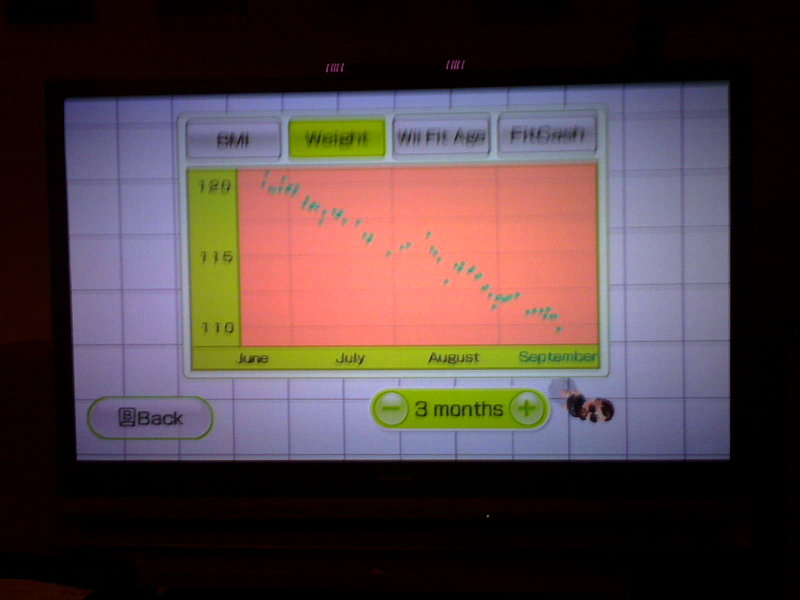
Sure, it makes sense to lose weight because there are also real health benefits. Still, the real reason why I finally tried to lose weight was none of these - it was mostly because I didn't have any reason not to, and didn't feel any pressure. In June 2008, I bought the Wii Fit game for Nintendo Wii and set a random goal of -15 kg in three months.
 |
| The first goal achieved |
By September, I had gone from 124 to 109 kg. I also ate less and more healthily, and at the office cafeteria I mostly had salad lunches. Wii Fit was a nice game and I played it almost every evening for one hour. I didn't consider it as exercise - it was a game, after all. I got scores and improved on them, and noticed that I was actually pretty good at some of the moves. Apparently I had quite a good coordination skill and balance, even if I wasn't that fit. I decided to set another goal, to lose another 15 kg by January.
By January, I had lost another 15 kg and was now 94 kg - about 25 % less than half a year before. The weight had gone down completely consistently at around 1 kg per week and even Christmas didn't make make a dent to the downward graph. Then I stopped.
Reflection
Per my experience, how many of the claims about weight loss were correct? Zero.
I didn't and still don't enjoy the physical feeling of exercise, regardless of the type. The physical part always feels bad, even when (very rarely) the experience otherwise would be satisfying. I only like "exercise" when it is primarily about something else, like playing a video game or going to places (cycling). Maybe it isn't fun, and never will be, but it can be tolerable.
During those six months, I had to tighten my belt by seven notches (and also make two new notches), so my waist really got smaller. This meant that I had to buy new clothes, and new clothes cost money. Aside from that, I didn't really notice anything different, and I don't think many other people noticed either. I wasn't any happier, didn't sleep better, didn't enjoy food any more. Salads were bland (though not that bad). My health didn't improve at all - I was already very healthy. Even my blood levels didn't improve. I can't say I expected any of those improvements, but any of them would have been nice.
Did something go wrong? Weren't those claims supposed to motivate and inspire me to lose weight? Perhaps I just didn't care about those claims and that is precisely why finally ended up trying to lose weight - and managed to do it. No amount of fat-shaming would have made me to even try. Still, it seems that dubious claims about obesity and weight loss are everywhere, and are touted by both the media and individuals. These claims (whether true or not - but often not) aren't making the situation better for those who might benefit from weight loss. Don't lose weight because of dubious claims but regardless of them (if you feel like it).
I'm sure that in my case there were some benefits as well, but not in the form of happier life or daily compliments on my "new" slimmer look. Regarding the weight coming back: even though I didn't play Wii Fit or eat that healthily after January, 2009, the fat didn't return. In August, 2010, just before I moved to USA, I weighed about 99 kg, which is 5 kg more than 1.5 years earlier.
Sunday, March 16, 2014
Introducing mating rituals to bookstores
Bars and night clubs are known for their role in human mating rituals. In addition to just going out with friends and maybe dancing and drinking, people do and are even expected to look for company, either long-term or just one-night stands. While many young adults enjoy this, there are many who do not, and they may even prefer reading books, and going to bookstores instead of bars. Nice, huh?
This is, of course, a fine opportunity for me to rant about extending mating rituals to improper places.
The image above is from Facebook page Word Porn. I doubt it is the original author of this idea, but it doesn't mention any source. It has been shared all over the social media for a while, and this specific image has about 130,000 likes and 80,000 shares, two days of its original posting on this page.
The good: There's nothing wrong in going to bookstores instead of bars, and a bookstore isn't a bad place to meet people, either. It would be nice if people would understand this, and perhaps book fans (geeks? nerds? outcasts?!) should find it easier to find new people, even mates.
Mates... like in a mating ritual? That's right. The idea proposes extending the heteronormative mating rituals to bookstores. It specifically refers to certain expectations placed upon people in bars. I have been told by several people (both women and men) and witnessed it myself, that men offering to buy drinks for women is often perceived as a mating ritual, and it is a way for a man to show he is interested, has money and maybe has knowledge of different alcoholic drinks. It is also a good way to get the woman intoxicated - and as part of this ritual (or just a social ritual?), many men expect women to have sex with them after having received so many free drinks.
It doesn't always play like this, but there are norms and expectations, just like in this idea. At the same time, bars are social spaces for having fun with friends (and others), dancing, drinking and so on. Bookstores are retail stores selling books (though they can still be very nice places, and maybe you can read there as well!).
In any retail store (books, groceries, hardware), it would be very awkward if there was an expectation for me to buy something for strangers, or for others to buy something for me. I wasn't really aware that there was this kind of expectation at bars, either, but apparently some people think there is.
There's also the issue of books being very expensive in contrast to alcoholic drinks...
 |
| One proposal to extend mating rituals to bookstores |
The image above is from Facebook page Word Porn. I doubt it is the original author of this idea, but it doesn't mention any source. It has been shared all over the social media for a while, and this specific image has about 130,000 likes and 80,000 shares, two days of its original posting on this page.
The good: There's nothing wrong in going to bookstores instead of bars, and a bookstore isn't a bad place to meet people, either. It would be nice if people would understand this, and perhaps book fans (geeks? nerds? outcasts?!) should find it easier to find new people, even mates.
Mates... like in a mating ritual? That's right. The idea proposes extending the heteronormative mating rituals to bookstores. It specifically refers to certain expectations placed upon people in bars. I have been told by several people (both women and men) and witnessed it myself, that men offering to buy drinks for women is often perceived as a mating ritual, and it is a way for a man to show he is interested, has money and maybe has knowledge of different alcoholic drinks. It is also a good way to get the woman intoxicated - and as part of this ritual (or just a social ritual?), many men expect women to have sex with them after having received so many free drinks.
It doesn't always play like this, but there are norms and expectations, just like in this idea. At the same time, bars are social spaces for having fun with friends (and others), dancing, drinking and so on. Bookstores are retail stores selling books (though they can still be very nice places, and maybe you can read there as well!).
In any retail store (books, groceries, hardware), it would be very awkward if there was an expectation for me to buy something for strangers, or for others to buy something for me. I wasn't really aware that there was this kind of expectation at bars, either, but apparently some people think there is.
There's also the issue of books being very expensive in contrast to alcoholic drinks...
Sunday, February 16, 2014
Lennon and other dreamers of 'Imagine'
John Lennon's 1971 hit single 'Imagine' has inspired people for decades. It is a song about a dream that humankind should live at peace, without divisive barriers. Lennon lists three major barriers: religion, nationalism and possessions. In the lyrics, he envisions 'brotherhood of man' with 'nothing to kill or die for'.
'Imagine' is a song and in general, lyrics to songs should not be taken too seriously. It's poetry, and as a dreamer, Lennon wanted to convey his feelings that there should be peace instead of war and divisiveness. Still, he said he advocated socialism and atheism (albeit not in forms that, for example, Soviet Union represented), and there have been varying interpretations of what he actually meant or how literally the lyrics should be taken, or whether they are just a dream with no real connections or something we should actually strive for.
Albert Einstein - despite being a pacifist - advocated research of nuclear weapons and his letter to U.S. president Franklin D. Roosevelt was a key influence that led to the Manhattan Project. His groundbreaking work in physics made the nuclear bomb possible, and the next 50 years of Cold War were marked with constant fear of global annihilation by (accidental) nuclear war.
Bob Marley was a legendary guitarist who was known for his Rastafarian faith. He spoke of how important religion is in his life and how he sees Haile Selassie, Emperor of Ethiopia, as messiah. His music is known for its religious themes.
Harvey Milk, before his career as a city administrator and an activist, was a professional soldier and an officer in the United States Navy during the Korean War. There have even been calls to name a U.S. warship as USS Harvey Milk in his honor.
Martin Luther King was a Baptist priest and a religious scholar (he held a PhD in systematic theology from Boston University). In his own words, he based his activism on teachings of Jesus Christ.
Anna Politkovskaya was a journalist and human rights activist who - like Milk, King and Gandhi in this list - was murdered. She wasn't known for opposing possessions or nationalism per se (but was a known critic or Russian political leadership), and was apparently Orthodox Christian, like a major part of Russians are.
Mahatma Gandhi was the father of the independent India and a legendary nationalist who advocated non-violent resistance against colonial oppressors. Still, he worked as an army recruiter during WWI. He was also known for his religious views - he was Hindu and was inspired by Jain, Christian and Muslim ideals.
In Stanley's comic, religious officials stay as religious officials, after settling their differences. There's a Muslim girl playing football. Perhaps Stanley doesn't take Lennon's song too literally - perhaps he goes against Lennon's ideals, as he was pretty radical.
Still, Lennon quite clearly says that in his dream world, there's nothing to kill or die for. To me, this sounds like an utopia where there are no important things to struggle for. Things are given for granted and people are not even willing to defend or challenge them.
You could take 'religion' as everything related to belief in supernatural, omnipotent and otherworldly entities and deities, and claim that it is all bad. Quite often this is how it is understood. However, religion itself could be seen, even by believers, as a man-made institution that often controls, subjugates and abuses its members and puts them against other people, and there exist fine examples of this type of religions. Is this what Lennon meant? Interestingly, Greg Graffin of the punk rock band Bad Religion has spoken about how their band's message is not anti-theist per se, but against institutions that divide and take away freedom, regardless of whether they are religious or not. In this sense, the 'anti-religious' sentiment of Imagine makes sense.
For Lennon, it seems countries are nationalist, artificial, political entities that justify violence. It would be interesting to see Lennon and Gandhi debate this. A national identity is important to people. Gaining independence is often a way out of oppression and violence, and it is a result of nationalism - the Finnish independence in 1917 is one example, the Indian independence in 1948 another. Can countries exist if there is 'brotherhood of man'?
Lennon composed this song using his super duper expensive Steinway & Sons piano, in his lavish house. Maybe he dreamed that these possessions would not matter. What would people play with, compose with, work with, build with, without possessions? Should there also be no ambition?
Interestingly, much of this dream of his resembles the Christian concept of Heaven.
Of these, Mahatma Gandhi is probably the closest of Lennon's ideal. He understood religious and ethnic groups, discussed with people and brought understanding and was prepared to take extreme non-violent actions - and died for his country. He built a nation.
There are numerous other individuals that would be in a list of real dreamers, to continue Stanley's list. Billionaires, soldiers, politicians, priests, and others who have made a contribution to advance peace and understanding. Mother Theresa, Abraham Lincoln, Muhammad Ali, Nelson Mandela, Aung San Suu Kyi, Andrei Sakharov, Tenzin Gyatso (14th Dalai Lama), Malala Yousafzai, maybe even Bill Gates (even though I don't like Microsoft, Gates himself deserves praise for many things). I don't recognize them from Lennon's 'Imagine'.
Of course, these 'dreamers' are not a matter of imagination - they have lived, worked, and some still work in an imperfect world, as imperfect people, but not towards a utopia because the brotherhood of man cannot be one.
'Imagine' is a song and in general, lyrics to songs should not be taken too seriously. It's poetry, and as a dreamer, Lennon wanted to convey his feelings that there should be peace instead of war and divisiveness. Still, he said he advocated socialism and atheism (albeit not in forms that, for example, Soviet Union represented), and there have been varying interpretations of what he actually meant or how literally the lyrics should be taken, or whether they are just a dream with no real connections or something we should actually strive for.
Stanley's comic
In 2013, artist Pablo Stanley produced a comic version of the song, which can also be purchased as a poster, and he included six examples of other 'dreamers'. On his website, he also has a small disclaimer about how he is aware of some unamicable qualities of Lennon and how the examples do not actually fit Lennon's ideal.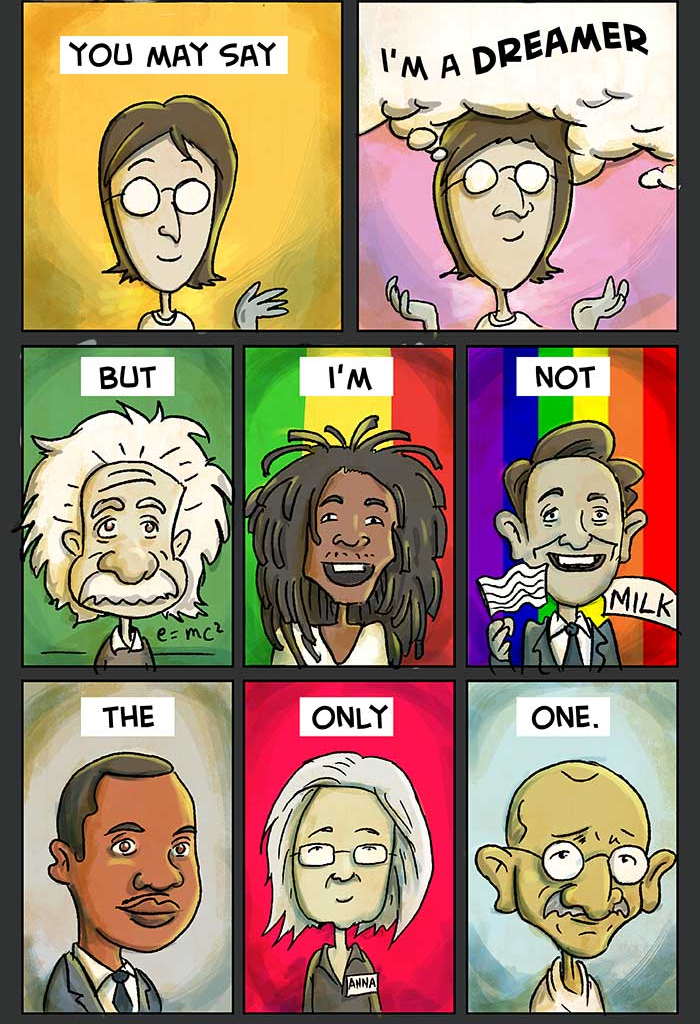 |
| Excerpt from Stanley's comic |
Bob Marley was a legendary guitarist who was known for his Rastafarian faith. He spoke of how important religion is in his life and how he sees Haile Selassie, Emperor of Ethiopia, as messiah. His music is known for its religious themes.
Harvey Milk, before his career as a city administrator and an activist, was a professional soldier and an officer in the United States Navy during the Korean War. There have even been calls to name a U.S. warship as USS Harvey Milk in his honor.
Martin Luther King was a Baptist priest and a religious scholar (he held a PhD in systematic theology from Boston University). In his own words, he based his activism on teachings of Jesus Christ.
Anna Politkovskaya was a journalist and human rights activist who - like Milk, King and Gandhi in this list - was murdered. She wasn't known for opposing possessions or nationalism per se (but was a known critic or Russian political leadership), and was apparently Orthodox Christian, like a major part of Russians are.
Mahatma Gandhi was the father of the independent India and a legendary nationalist who advocated non-violent resistance against colonial oppressors. Still, he worked as an army recruiter during WWI. He was also known for his religious views - he was Hindu and was inspired by Jain, Christian and Muslim ideals.
Analysis
I think Stanley's comic was pretty good and he chose very distinguished individuals as his 'dreamers'. But would they be Lennon's co-dreamers? I think not. Much of these people's work and ideals go against Lennon's ideals. However, they all worked for a better world and - in Lennon's words just as Gandhi's - a 'brotherhood of man'.In Stanley's comic, religious officials stay as religious officials, after settling their differences. There's a Muslim girl playing football. Perhaps Stanley doesn't take Lennon's song too literally - perhaps he goes against Lennon's ideals, as he was pretty radical.
Still, Lennon quite clearly says that in his dream world, there's nothing to kill or die for. To me, this sounds like an utopia where there are no important things to struggle for. Things are given for granted and people are not even willing to defend or challenge them.
You could take 'religion' as everything related to belief in supernatural, omnipotent and otherworldly entities and deities, and claim that it is all bad. Quite often this is how it is understood. However, religion itself could be seen, even by believers, as a man-made institution that often controls, subjugates and abuses its members and puts them against other people, and there exist fine examples of this type of religions. Is this what Lennon meant? Interestingly, Greg Graffin of the punk rock band Bad Religion has spoken about how their band's message is not anti-theist per se, but against institutions that divide and take away freedom, regardless of whether they are religious or not. In this sense, the 'anti-religious' sentiment of Imagine makes sense.
For Lennon, it seems countries are nationalist, artificial, political entities that justify violence. It would be interesting to see Lennon and Gandhi debate this. A national identity is important to people. Gaining independence is often a way out of oppression and violence, and it is a result of nationalism - the Finnish independence in 1917 is one example, the Indian independence in 1948 another. Can countries exist if there is 'brotherhood of man'?
Lennon composed this song using his super duper expensive Steinway & Sons piano, in his lavish house. Maybe he dreamed that these possessions would not matter. What would people play with, compose with, work with, build with, without possessions? Should there also be no ambition?
Interestingly, much of this dream of his resembles the Christian concept of Heaven.
Real dreamers
Stanley's examples of dreamers, as stated above, were very good. These three Americans, one Jamaican, one Russian and one Indian made the world a better place and advanced 'brotherhood of man', but I think not in the ways Lennon envisioned in his song, and direct analogies are naïve. Lennon describes a dream world but uses too specific examples of its features, and it throws me out of it, and distances me from it. There are and will be possessions, countries and religions, and I am not dreaming of a world without them, and neither did those six fine individuals.Of these, Mahatma Gandhi is probably the closest of Lennon's ideal. He understood religious and ethnic groups, discussed with people and brought understanding and was prepared to take extreme non-violent actions - and died for his country. He built a nation.
There are numerous other individuals that would be in a list of real dreamers, to continue Stanley's list. Billionaires, soldiers, politicians, priests, and others who have made a contribution to advance peace and understanding. Mother Theresa, Abraham Lincoln, Muhammad Ali, Nelson Mandela, Aung San Suu Kyi, Andrei Sakharov, Tenzin Gyatso (14th Dalai Lama), Malala Yousafzai, maybe even Bill Gates (even though I don't like Microsoft, Gates himself deserves praise for many things). I don't recognize them from Lennon's 'Imagine'.
Of course, these 'dreamers' are not a matter of imagination - they have lived, worked, and some still work in an imperfect world, as imperfect people, but not towards a utopia because the brotherhood of man cannot be one.
Friday, January 24, 2014
Americans for prison rape
A Canadian teenager was arrested in United States due to alleged (but disputed) driving under influence and speeding. The teenager spent one night in county jail in Florida. Meanwhile, social media was ripe with comments and jokes about how this teenager ought to be raped while detained - by a black man.
This teenager was, of course, the 19-year-old singer and pop star Justin Bieber.
On Thursday evening (Jan 23, 2014), the Wisconsin radio station 95.7 The Rock posted this image on their Facebook and Twitter profiles. It shows Bieber's official mugshot combined with an unknown inmate's picture, with caption humorously suggesting that Bieber is going to get raped by this fierce-looking black inmate.
The picture has been "liked" by roughly 400,000 people and shared close to 150,000 times on Facebook. In the comments section thousands of individuals expressed happiness about how gangs of black men will now rape the pop star and how he deserves it. Many of the commenters also uploaded manipulated images featuring black men raping Justin Bieber.
Several people also suggested that Bieber deserves to get sexually abused because a girl committed suicide after Bieber had taunted her publicly. This story is, of course, a hoax.
Several commenters also said that others should not call for raping and mutilating other people just because they don't like them. Brian Klipp answered "Found the butthurt Biebs fan" - and many others said "Welcome to the Internet", suggesting that on the Internet it is customary and permissible to say anything. Sorry guys, that is 4chan, not the whole Internet.
You are on Facebook, showing your real names and photos of you smiling with your kids, with your professors and friends, saying how happy you are that another person gets raped in prison. By a black man.
Now, in many cultures, homosexual intercourse is a shame by itself. A true man will only show his worth by having sex with women, and others are "faggots". Even worse is being raped, because then a man is lowered into a "bitch". This is precisely the situation where so many individuals want Justin Bieber to be.
Feminist activists often mention "rape culture" - idea that quiet acceptance of sexual abuse, humiliation and harassment is integrated to the society so much that we don't even recognize when we support abuse of women. While I don't agree with the prevalence of this type of "culture", the idea still makes sense on some level. However, I do not often see people openly claiming that some certain woman (celebrity or not) should be raped, to "teach her a lesson" or to just to humiliate her. I didn't see it even when Paris Hilton or Britney Spears were jailed, even though they were also disliked by many. Yet now I can see thousands of people publicly fantasizing about sexually abusing Justin Bieber. Is this rape culture? Or just light-hearted Internet humor?
So, it's not just that people claim they want Justin Bieber to get raped, the idea is that the rapist is the worst of all - a big, mean, dumb black man, who is apparently the lowest of all lowly creatures. Somebody who has no value, and will probably be executed soon anyway. He probably doesn't even have a name, or if he does, it's "Bubba".
I don't exactly like calling all stupidity "racist" but this consistent use of black men as stereotypical prison rapists is getting a little racist.
It's humor, right? The idea that a rich pop star would be raped by another man is funny because it plays with taboos and shame. It is so funny that almost half a million people have "liked" this joke - probably more than any other picture I have ever seen on Facebook. It must be the funniest joke ever! If the rapist was a white guy, or a female guard, it wouldn't be that funny any more.
From their website: "For its victims, prisoner rape is a nightmare that does not end. Most survivors are sexually abused again and again. Abusive staff and inmates target people they see as most vulnerable, including lesbian, gay, bisexual, and transgender detainees and those who survived sexual abuse prior to being detained."
Prisoners, those lowly rats. Criminals who deserve to be humiliated for their crimes and never forgiven?
Sometimes there is news about prisoners complaining about abusive guards, lack of protection and violations of their legally stipulated rights. In the social media you see commentary saying that they deserve whatever they get in prison because they are criminals and this is their punishment. In the case of people convicted of violent crimes, especially sexual and especially committed against children, there are even calls for lynching. I've seen people say guards should be encouraged to beat up, mutilate, rape and even kill these prisoners.
Oh, and suspects are the same thing. Some years ago there was a Finnish Facebook group distributing personal information of people who are or have been suspected or convicted of rape or violent crimes against children. This group was public and there were hundreds of ordinary-looking citizens there. The group had many photos of (alleged) rapists and scans of court documents. The comments in the photos were very much like what the Justin Bieber picture had - people fantasizing about what kind of sexual violence the alleged criminal should experience while detained. Some commenters said they would personally want to commit these acts of abuse, as a revenge and humiliation that the (alleged) criminal deserves, and invited others to join their manhunt to kill these people. These were ordinary mothers and fathers, posting their comments with their real names for the world to see.
If these are normal and natural expressions of (justified?) rage, then perhaps calls for lynching and killing alleged rapists and other criminals are, too. You can always say that it was a joke - on the Internet - and you didn't really want to kill that guy, even though you said you wanted, and you offered your help, with your own name, to kill somebody, and even described how you would do it.
Just yesterday I saw a Finnish far-right political activist post an image of two female politicians of the Left Alliance on Facebook, with the comment "leftist lesbians should be shot". That was, of course, just a funny joke, suggesting that he does not approve of their political views, right? Just as innocent as saying that because you do not like the music he makes, Justin Bieber should be raped. By a black man.
This teenager was, of course, the 19-year-old singer and pop star Justin Bieber.
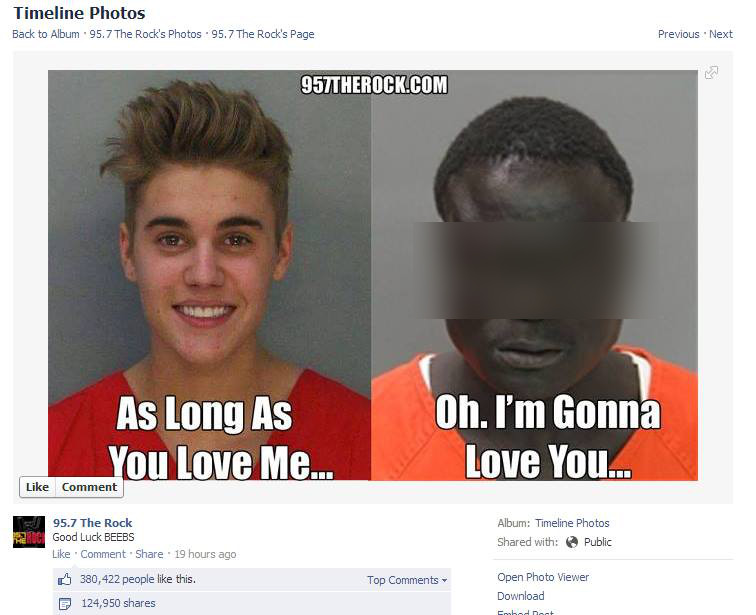 |
| I blurred the face of the inmate - he is not accused of raping Justin Bieber |
The picture has been "liked" by roughly 400,000 people and shared close to 150,000 times on Facebook. In the comments section thousands of individuals expressed happiness about how gangs of black men will now rape the pop star and how he deserves it. Many of the commenters also uploaded manipulated images featuring black men raping Justin Bieber.
Assorted comments
There are about 17,000 comments to this image. Here's a very small selection of them.- Matteo Paola: "I still wish that upon him. He is one of the worst human beings ever. And he gets away with it all because of his stupid idiotic fanbase."
- Jeremy Sxe Jagoda: "who cares its still funny"
- Fernando Chali posted an image showing Justin Bieber pregnant after said prison rape.
- Rhys Chalmers posted a picture suggesting that the rapist will not use lubricant, thus causing more pain.
- Jordan McElhinney, among others, posted pictures suggesting that big black men tell Bieber to drop the soap before raping him.
- Eru Electroboy: "respect this comment, hes gona get raped in jail"
Several people also suggested that Bieber deserves to get sexually abused because a girl committed suicide after Bieber had taunted her publicly. This story is, of course, a hoax.
Several commenters also said that others should not call for raping and mutilating other people just because they don't like them. Brian Klipp answered "Found the butthurt Biebs fan" - and many others said "Welcome to the Internet", suggesting that on the Internet it is customary and permissible to say anything. Sorry guys, that is 4chan, not the whole Internet.
You are on Facebook, showing your real names and photos of you smiling with your kids, with your professors and friends, saying how happy you are that another person gets raped in prison. By a black man.
Rape shame
Of course, we know that rape is mostly not about sexual intercourse - it is about shame, humiliation, degradation. That is why it was so common during the French revolution in 1792 and Soviet occupation of Berlin in 1945, for example. Even though Bieber is a popular recording artists, his music and image irritate many so much that they want him to suffer the ultimate humiliation. Which, to many, is being raped by a black man in prison.Now, in many cultures, homosexual intercourse is a shame by itself. A true man will only show his worth by having sex with women, and others are "faggots". Even worse is being raped, because then a man is lowered into a "bitch". This is precisely the situation where so many individuals want Justin Bieber to be.
Feminist activists often mention "rape culture" - idea that quiet acceptance of sexual abuse, humiliation and harassment is integrated to the society so much that we don't even recognize when we support abuse of women. While I don't agree with the prevalence of this type of "culture", the idea still makes sense on some level. However, I do not often see people openly claiming that some certain woman (celebrity or not) should be raped, to "teach her a lesson" or to just to humiliate her. I didn't see it even when Paris Hilton or Britney Spears were jailed, even though they were also disliked by many. Yet now I can see thousands of people publicly fantasizing about sexually abusing Justin Bieber. Is this rape culture? Or just light-hearted Internet humor?
Black man, the rapist
People openly fantasize about what kind of sexual violence they would like Justin Bieber to experience while detained. All of these fantasies have one thing in common: the rapist being a black man.So, it's not just that people claim they want Justin Bieber to get raped, the idea is that the rapist is the worst of all - a big, mean, dumb black man, who is apparently the lowest of all lowly creatures. Somebody who has no value, and will probably be executed soon anyway. He probably doesn't even have a name, or if he does, it's "Bubba".
I don't exactly like calling all stupidity "racist" but this consistent use of black men as stereotypical prison rapists is getting a little racist.
It's humor, right? The idea that a rich pop star would be raped by another man is funny because it plays with taboos and shame. It is so funny that almost half a million people have "liked" this joke - probably more than any other picture I have ever seen on Facebook. It must be the funniest joke ever! If the rapist was a white guy, or a female guard, it wouldn't be that funny any more.
Sexual abuse in prisons
According to Just Detention International, estimated 200,000 inmates are sexually abused every year in United States alone while in detention. Only a very small minority of the cases is reported to authorities, and of them only a small number leads to disciplinary action.From their website: "For its victims, prisoner rape is a nightmare that does not end. Most survivors are sexually abused again and again. Abusive staff and inmates target people they see as most vulnerable, including lesbian, gay, bisexual, and transgender detainees and those who survived sexual abuse prior to being detained."
Prisoners, those lowly rats. Criminals who deserve to be humiliated for their crimes and never forgiven?
Sometimes there is news about prisoners complaining about abusive guards, lack of protection and violations of their legally stipulated rights. In the social media you see commentary saying that they deserve whatever they get in prison because they are criminals and this is their punishment. In the case of people convicted of violent crimes, especially sexual and especially committed against children, there are even calls for lynching. I've seen people say guards should be encouraged to beat up, mutilate, rape and even kill these prisoners.
Oh, and suspects are the same thing. Some years ago there was a Finnish Facebook group distributing personal information of people who are or have been suspected or convicted of rape or violent crimes against children. This group was public and there were hundreds of ordinary-looking citizens there. The group had many photos of (alleged) rapists and scans of court documents. The comments in the photos were very much like what the Justin Bieber picture had - people fantasizing about what kind of sexual violence the alleged criminal should experience while detained. Some commenters said they would personally want to commit these acts of abuse, as a revenge and humiliation that the (alleged) criminal deserves, and invited others to join their manhunt to kill these people. These were ordinary mothers and fathers, posting their comments with their real names for the world to see.
Thanks, Justin
Thanks to Justin Bieber we have once again witnessed the rage of the Internets. Bieber is, of course, a celebrity and icon instead of a person to Internet commenters - just like a black man in prison uniform is a symbol of crime and sexual violence to these commenters. Combining these is almost innocent - and natural, and if you don't understand this, then you are a butthurt Bieber fan, like Brian Klipp said.If these are normal and natural expressions of (justified?) rage, then perhaps calls for lynching and killing alleged rapists and other criminals are, too. You can always say that it was a joke - on the Internet - and you didn't really want to kill that guy, even though you said you wanted, and you offered your help, with your own name, to kill somebody, and even described how you would do it.
Just yesterday I saw a Finnish far-right political activist post an image of two female politicians of the Left Alliance on Facebook, with the comment "leftist lesbians should be shot". That was, of course, just a funny joke, suggesting that he does not approve of their political views, right? Just as innocent as saying that because you do not like the music he makes, Justin Bieber should be raped. By a black man.
Friday, January 17, 2014
Ronald McNair, astronaut
It was announced today that several old, previously unpublished photos of the space shuttle Challenger disaster had been found and put online. I have always been interested in spaceflight and astronomy and STS-51-L - among other fateful flights - remains in my mind as a great engineering failure and terrible loss of brave astronauts and scientists, and a reminder of how modern technology sometimes fails us. Inspired by the surfaced photos, I took a new look at the Wikipedia article about the disaster.
The Challenger accident happened when I was only 8 years old. I remember looking at the famous group photo of the crew and thinking that they looked very "American": of the seven crew members only three were white men - there were also two women, one Japanese-American and one African-American man. Also, one of the women was not a career astronaut but a school teacher. In this sense, the crew looked very much like the United States I knew. I also thought Judith Resnik's large hairdo was very typical for Americans in the 1980s!
Ellison Onizuka (in the photo the first from the left in the second row) was the first Asian American in space (he had flown to space before), and apparently also the first Buddhist. Christa McAuliffe was also probably the first astronaut of Lebanese roots.
Ronald McNair was the second African American in space (he had flown before, too), if Arnaldo Tamayo Méndez of Cuba doesn't count. He would probably have been the third, if Robert Lawrence had not been killed in an aviation accident in 1967.
It turns out that my university (University of Illinois) has a minority student scholar program named after Ronald McNair. I did notice the familiar name when I visited the Turner Student Services Building the first time two years ago, but the people at the program office I talked to were not sure if it had been named after the astronaut or somebody else.
When I was a kid, I remember thinking that McNair looked very "American". In 1986, I had not yet met any non-white people but I recognized many African American politicians, athletes, actors and musicians. McNair's wide smile somehow reminded me of some people I knew, but I didn't research the crew's biographies much further. I did remember the smile, though.
Today, I read out the Wikipedia article about him and it looks like that he died younger than I am now - he was only 35 at the time of the Challenger disaster. He had received a PhD degree from MIT when he was 26, becoming a known expert in laser physics. By the time of his death, he already received three honorary doctorates. He was also the first astronaut of the Bahá'í faith, and quite possibly the first saxophonist in space. Jean-Michel Jarre's The Last Rendez-Vous (Ron's Piece) is dedicated to him - McNair was expected to record the solo for this track in space, and later perform it live at Jarre's concert in Houston in April, 1986.
In United States, there seems to be an obsession to name everything after famous people (military heroes, politicians, rich donors, astronauts). Often it feels unnecessary, sometimes even ridiculous, but sometimes it makes you think about and reflect on stories behind renowned, accomplished and exceptional individuals.
It's interesting to think that in 1986 I noticed McNair not because he seemed different but because in the diverse crew of STS-51-L, he did not seem different. The days of all-male, all-white and all-military crews of Gemini and Apollo programs were long gone - it was now time for all-American crews.
The shuttle flights resumed in 1989 and increasing international cooperation was notable in flight crews - astronauts from Canada, Germany, Russia, Japan and other countries flew on Shuttle flights before the program ended in 2011 - including the first (enrolled) member of an aboriginal tribe in space, John Herrington (of Chickasaw First Nation).
Sure, my observations of the STS-51-L crew in 1986 were somewhat naíve but I'm only happy that my belief (or hope) in space belonging to a more diverse group of travellers than just American and Soviet/Russian fighter pilots did become true.
The Challenger accident happened when I was only 8 years old. I remember looking at the famous group photo of the crew and thinking that they looked very "American": of the seven crew members only three were white men - there were also two women, one Japanese-American and one African-American man. Also, one of the women was not a career astronaut but a school teacher. In this sense, the crew looked very much like the United States I knew. I also thought Judith Resnik's large hairdo was very typical for Americans in the 1980s!
 |
| The crew of STS-51-L in November, 1985 |
Ronald McNair was the second African American in space (he had flown before, too), if Arnaldo Tamayo Méndez of Cuba doesn't count. He would probably have been the third, if Robert Lawrence had not been killed in an aviation accident in 1967.
It turns out that my university (University of Illinois) has a minority student scholar program named after Ronald McNair. I did notice the familiar name when I visited the Turner Student Services Building the first time two years ago, but the people at the program office I talked to were not sure if it had been named after the astronaut or somebody else.
 |
| Dr. Ronald E. McNair, NASA astronaut |
Today, I read out the Wikipedia article about him and it looks like that he died younger than I am now - he was only 35 at the time of the Challenger disaster. He had received a PhD degree from MIT when he was 26, becoming a known expert in laser physics. By the time of his death, he already received three honorary doctorates. He was also the first astronaut of the Bahá'í faith, and quite possibly the first saxophonist in space. Jean-Michel Jarre's The Last Rendez-Vous (Ron's Piece) is dedicated to him - McNair was expected to record the solo for this track in space, and later perform it live at Jarre's concert in Houston in April, 1986.
In United States, there seems to be an obsession to name everything after famous people (military heroes, politicians, rich donors, astronauts). Often it feels unnecessary, sometimes even ridiculous, but sometimes it makes you think about and reflect on stories behind renowned, accomplished and exceptional individuals.
It's interesting to think that in 1986 I noticed McNair not because he seemed different but because in the diverse crew of STS-51-L, he did not seem different. The days of all-male, all-white and all-military crews of Gemini and Apollo programs were long gone - it was now time for all-American crews.
The shuttle flights resumed in 1989 and increasing international cooperation was notable in flight crews - astronauts from Canada, Germany, Russia, Japan and other countries flew on Shuttle flights before the program ended in 2011 - including the first (enrolled) member of an aboriginal tribe in space, John Herrington (of Chickasaw First Nation).
Sure, my observations of the STS-51-L crew in 1986 were somewhat naíve but I'm only happy that my belief (or hope) in space belonging to a more diverse group of travellers than just American and Soviet/Russian fighter pilots did become true.
Thursday, December 19, 2013
Why alternative treatments are not accepted by science
It is public knowledge that alternative treatments such as homeopathy and acupuncture (and many others) are not accepted by the scientific community as having effectiveness distinguishable from placebo. It is said that these treatments do not fulfill the criteria for medicine - which is often along the lines of double-blind clinical trials (or other trials of similar level of rigor).
This is easy to say - you just check what the dictionary says about science and check what kind of results previous research has yielded, and hope that the scientific method had worked and researchers and peer reviewers haven't been too dishonest.
But what kind of explanations and ideas do practitioners of alternative treatments have about this? After all, they think their treatments work - their customers' experiences usually support this - and many would like to have their discipline recognized better, even as part of the contemporary medicine, taught at universities.
It is my understanding that patients of alternative treatments practitioners are generally (very) happy with their care. They have appointments with a private practitioner who has plenty of time to discuss with the customer, ask about background of the condition, and propose different options, unlike your usual doctor at the health center who will spend the 20 minutes by picking a diagnosis from the ICD-10 manual (or ICD-9 if you are American, I'm sorry) and write a prescription of antibiotics. Thus, general happiness about the experience should not be seen as any kind of evidence about effectiveness of the treatment, even if the harsh public health experience might act as a "nocebo" - making the drug's effect lesser.
Meanwhile, some ordinary health products have been misleadingly labelled as homeopathic to make them more attractive to consumers - these may be a case of products that can be shown to be effective, but as they are not true homeopathic products, they do not add to the knowledge of alternative treatments.
Homeopathy has been studied at various universities (including my alma mater, University of Michigan, which even had a dedicated department for it). Many trained physicians still allege that homeopathy is about medicine in traditional sense, and can be empirically studied and its effectiveness confirmed, thus making it a "non-alternative treatment". At the same time, explanations for how homeopathy might function have been proposed (memory of water), but even if homeopathy was effective (which I doubt), its underlying mechanism would still be unknown. Some also claim that the effectiveness of homeopathy has already been confirmed many times over, but for some reason the credible results are not taken seriously.
Supporters of alternative treatments do not always seem to grasp the breadth of ideas - among the practitioners and supporters - about what the real problem is. For some, whether acupuncture of homeopathy works is just a matter of empirical science. For others, it is a spiritual matter. Thus, homeopathy, acupuncture and others thus present themselves as ambiguous, fuzzy ooze around certain misguided concepts, which explains much of the trouble they have with contemporary medicine.
This is easy to say - you just check what the dictionary says about science and check what kind of results previous research has yielded, and hope that the scientific method had worked and researchers and peer reviewers haven't been too dishonest.
But what kind of explanations and ideas do practitioners of alternative treatments have about this? After all, they think their treatments work - their customers' experiences usually support this - and many would like to have their discipline recognized better, even as part of the contemporary medicine, taught at universities.
 |
| Fourteen meridians in a Chinese acupuncture chart from the 1340s (source: Wikipedia) |

Can the effectiveness be confirmed?
From books, interviews and generally on the Internet I have heard and read many opinions about the position of acupuncture and homeopathy in regards to what they call "school medicine". I'm sharing some of them here."Can be confirmed" / "Has been confirmed"
These are based on the idea, that the treatment "works" in the traditional sense and its effect can be confirmed and the treatment could probably be part of contemporary medicine.- Effectiveness could be confirmed, but global conspiracy of Big Pharma corporations is controlling the industry and will not allow alternative practitioners to compete with their lucrative business. They are twisting and possibly sabotaging results of academic studies.
- Effectiveness could be confirmed, but due to the bad reputation and "unscientific" background of the treatments, serious researchers will not attempt it, fearing that they lose their reputation.
- Effectiveness could be confirmed, but due to so many hoaxers and unreliable practitioners, it is next to impossible to produce reliable studies on the treatments.
- Effectiveness could be confirmed, but the process of doing so is very long and difficult, and it will take time before we can have conclusive results.
- Effectiveness has already been confirmed, but the scientific community (or Big Pharma) maintains the illusion that it has not.
- Effectiveness has already been confirmed: the placebo effect is the real effect, it has just been misunderstood.
"Cannot be confirmed"
Explanations in this category are based on the idea that for some reason, alternative treatments are fundamentally incompatible with what is usually called contemporary medicine or empirical science.- Cannot be confirmed, because they are based on unknown interactions and laws of nature.
- Cannot be confirmed, because they are not based on laws of nature but a spiritual and/or unphysical connection of some kind, and by definition that is outside the reach of science.
- Cannot be confirmed, because they treat causes of conditions, not symptoms, and are thus outside the scope of contemporary medicine (which only deals with symptoms).
- Cannot be confirmed, because they are tailored for each person, and treatments of different people cannot be compared in a study.
- Cannot be confirmed, because they do not have a common methodology which could be evaluated.
- Cannot be confirmed, because they are only effective in a delicate, deep practitioner-patient relationship, which makes usual double blind and randomized controlled trials impossible.
- Cannot be confirmed, because medicine has distanced itself from natural treatment and spirituality so much that it is simply unable to detect the effectiveness.
"Confirmation is irrelevant"
There are some who abandon the whole idea of a treatment having an effect in the traditional sense.- It is irrelevant whether it can be confirmed, because customers' (patients') own assessment of their own condition is the only possible criteria of effectiveness.
It is my understanding that patients of alternative treatments practitioners are generally (very) happy with their care. They have appointments with a private practitioner who has plenty of time to discuss with the customer, ask about background of the condition, and propose different options, unlike your usual doctor at the health center who will spend the 20 minutes by picking a diagnosis from the ICD-10 manual (or ICD-9 if you are American, I'm sorry) and write a prescription of antibiotics. Thus, general happiness about the experience should not be seen as any kind of evidence about effectiveness of the treatment, even if the harsh public health experience might act as a "nocebo" - making the drug's effect lesser.
Alternative or not?
Assuming that some alternative treatments actually work - and it is apparent that most do not - it would be incredibly useful to find out which ones have potential to be studied more and possibly be introduced to the realm of contemporary medicine. However, it has been noted that there are many ways of doing acupuncture, some of them not using needles at all, so studying one practitioner might not give any insight into how others do it. Homeopathy, on the other hand, is manifested by diluted "drugs" that have consistently been shown to contain no active ingredients (which is not in contrary to the principles of homeopathy), and would be easier to study, however in homeopathy as well it has been stressed that the treatment cannot be distanced from the delicate practitioner-patient dynamic.Meanwhile, some ordinary health products have been misleadingly labelled as homeopathic to make them more attractive to consumers - these may be a case of products that can be shown to be effective, but as they are not true homeopathic products, they do not add to the knowledge of alternative treatments.
Homeopathy has been studied at various universities (including my alma mater, University of Michigan, which even had a dedicated department for it). Many trained physicians still allege that homeopathy is about medicine in traditional sense, and can be empirically studied and its effectiveness confirmed, thus making it a "non-alternative treatment". At the same time, explanations for how homeopathy might function have been proposed (memory of water), but even if homeopathy was effective (which I doubt), its underlying mechanism would still be unknown. Some also claim that the effectiveness of homeopathy has already been confirmed many times over, but for some reason the credible results are not taken seriously.
Supporters of alternative treatments do not always seem to grasp the breadth of ideas - among the practitioners and supporters - about what the real problem is. For some, whether acupuncture of homeopathy works is just a matter of empirical science. For others, it is a spiritual matter. Thus, homeopathy, acupuncture and others thus present themselves as ambiguous, fuzzy ooze around certain misguided concepts, which explains much of the trouble they have with contemporary medicine.
Sunday, December 8, 2013
Day of Infamy - Roosevelt's humble call to arms?
On December 7, 1941 - 72 years ago - the U.S. president Franklin D. Roosevelt gave one of his most famous speeches, calling that day the "Day of Infamy", and calling all Americans to arms against Japan and its allies - namely Germany. Allies of United States had already been engaged in the war for two years at that time.
As bad as the movie was, Pearl Harbor (2001) reminded the world about Japan's attack on Pearl Harbor, naval warfare mastermind Isoroku Yamamoto's involvement in the attack, and the U.S. response, especially the Doolittle Raid. With some misguided casting and lack of realism, it still featured important parts of the action and showed the attack through the eyes of many people present there, including seamen, pilots and nurses.It also featured Roosevelt giving his famous speech.
Indeed, it was infamy that United States has been caught "pants down". Its naval base in Hawaii had been attacked, after the remarkable failure of U.S. intelligence left it with no warning of the impending attack. It showed how future of naval warfare was aircraft carriers with their unique and flexible power projection capabilities, not battleships that were the mainstay of U.S. fleets. At the same time, the Mitsubishi A6M Zero fighter was to earn its reputation as the most capable naval fighter in the world.
From this infamy, United States would rise to a formidable opponent in the war and end up beating up Japan in the Pacific theatre, innovating in naval and other warfare and, in the end, making the only two nuclear attacks in history, threatening to destroy Tokyo next. It had gone through the dramatic circle and avenged Pearl Harbor, and naturally also fought alongside its allies in Europe and elsewhere.
Only a couple of years ago, I realized I had misinterpreted Roosevelt's words.
To recap, Imperial Japanese Navy launched a direct attack on United States Navy's base in Hawaii. Japan attempted to abide by the Hague Convention of 1907, by announcing its intentions - declaring war - before the attack, but due to delay caused by translation of the declaration from Japanese to English, war was declared a bit after the launch of the strike.
Apparently Roosevelt - and Americans still this day - thought it was an improper way to start a war. USA and Japan had been engaged in negotiations that were hoped to alleviate any need for war, and it seemed those negotiations had been a sham to make U.S. leadership uncertain about its true intentions, and as a continuation of that, an attack withoug declaring a war first was infamous.
Even though on many fronts there were formal declarations of war in WWII - for example, the United Kingdom declaring war on Gemany in September, 1939 - often hostilities were started without warning. Germany's attack on Poland in September, 1939 was one example, Soviet Union's attack on Finland in November of that year (a surprise, after months of negotiations) was another. Unlike many others, Japan made it clear that this was about a war between sovereign nations, and its armed forces engaged the other nation's armed forces, by striking a military target, and apparently honestly tried to make a declaration of war just as international agreements stipulated.
Deception is used in diplomacy and international relations - but to call Japanese tactics "infamy" is blatant exaggeration. Indeed, Japan had malicious intent and it threatened the whole Pacific region and was friends with Germany, but in the context of Second World War, its strike on a U.S. naval base was an exceptionally honest way of starting a war, as awkward as it sounds.
During the course of WWII, whole cities - with their populations - were effectively wiped off the map, including Coventry, Dresden, Rotterdam, Hiroshima and Nagasaki. The scope of destruction a war can bring was redefined. Was the attack on Pearl Harbor more "wrong" than other military actions of WWII? Was the diplomatic deception more "wrong" than other similar tactics around that time? Was the response less infamous?
I still think the interpretation of "Day of Infamy" meaning "United States got caught pants down by Japan, and it is embarrassing" is more fitting in the context of WWII. However, it should not take away from the remembrance of December 7, 1941, which marked the start of war between USA and Japan, and as such is a day to be remembered, as yet another realization of war being inevitable, and the start of the last war between these countries.
As bad as the movie was, Pearl Harbor (2001) reminded the world about Japan's attack on Pearl Harbor, naval warfare mastermind Isoroku Yamamoto's involvement in the attack, and the U.S. response, especially the Doolittle Raid. With some misguided casting and lack of realism, it still featured important parts of the action and showed the attack through the eyes of many people present there, including seamen, pilots and nurses.It also featured Roosevelt giving his famous speech.
 |
| FDR delivering the speech to U.S. Congress |
If the shoe fits, wear it
I always thought Roosevelt's wording was very fitting and the speech was an inspiring call to arms (even if I never actually read the whole text). After years of non-interventionist (or even isolationist) politics, leaving its European allies without direct military support, United States was forced to join the global war, and that day - Day of Infamy - showed Americans how unprepared United States was.Indeed, it was infamy that United States has been caught "pants down". Its naval base in Hawaii had been attacked, after the remarkable failure of U.S. intelligence left it with no warning of the impending attack. It showed how future of naval warfare was aircraft carriers with their unique and flexible power projection capabilities, not battleships that were the mainstay of U.S. fleets. At the same time, the Mitsubishi A6M Zero fighter was to earn its reputation as the most capable naval fighter in the world.
 |
| Admiral Isoru Yamamoto, bringer of infamy |
Only a couple of years ago, I realized I had misinterpreted Roosevelt's words.
The other interpretation
As depicted in the film Pearl Harbor - and numerous other films and reenactments - Japanese admirals had masterminded a daring attack to Pearl Harbor Naval Base, using aircraft carriers and naval fighters to bring destruction to the U.S. Pacific fleet. It missed the U.S. aircraft carriers, which - very wisely - the planners considered the main target, because unlike Americans, they realized their potential. However, the strike itself was very successful.To recap, Imperial Japanese Navy launched a direct attack on United States Navy's base in Hawaii. Japan attempted to abide by the Hague Convention of 1907, by announcing its intentions - declaring war - before the attack, but due to delay caused by translation of the declaration from Japanese to English, war was declared a bit after the launch of the strike.
Apparently Roosevelt - and Americans still this day - thought it was an improper way to start a war. USA and Japan had been engaged in negotiations that were hoped to alleviate any need for war, and it seemed those negotiations had been a sham to make U.S. leadership uncertain about its true intentions, and as a continuation of that, an attack withoug declaring a war first was infamous.
 |
| Infamy in another context |
Deception is used in diplomacy and international relations - but to call Japanese tactics "infamy" is blatant exaggeration. Indeed, Japan had malicious intent and it threatened the whole Pacific region and was friends with Germany, but in the context of Second World War, its strike on a U.S. naval base was an exceptionally honest way of starting a war, as awkward as it sounds.
 |
| Michael Bay's Pearl Harbor, the awkward reference frame of this post |
I still think the interpretation of "Day of Infamy" meaning "United States got caught pants down by Japan, and it is embarrassing" is more fitting in the context of WWII. However, it should not take away from the remembrance of December 7, 1941, which marked the start of war between USA and Japan, and as such is a day to be remembered, as yet another realization of war being inevitable, and the start of the last war between these countries.
Thursday, December 5, 2013
Private cars vs. public transportation, an epic battle
Ground rule: use public transportation if you can. It is good for the environment and good for the city (if you are in a city) and it increases your sex appeal. However, the whole picture is much more complex than that. City planners and bus manufacturers try to appeal to the public by launching publicity campaigns like this one from the Polish bus manufacturer Solaris Bus & Coach SA:

This photo is from their Facebook page. The photo caption reads (from Google Translate):
So many cars disappear from the streets of our cities, when their owners will fill one bus. Public transportation! This number of cars would be unnecessary, if Their owners changed to a bus. Public transport!
It looks like the bus in the photo is Solaris Urbino 18 Hybrid, which is one of the manufacturer's newest products, and is a very modern hybrid vehicle. Based on the product brochure, it the densest configuration, it can carry 161(!) passengers, which is quite impressive. It looks like there are about thirty rows of private cars, five cars in a row, so let's make a wild guess and assume that there are 161 private cars on the left side of the picture. The point is clear: many private cars actually carry only one passenger, the driver, and when you fully utilize a bus, you can carry lots of people.
The good bus
How many of the 161 passengers - who now have abandoned their cars and only commute by bus - can actually have a seat? Answer: 51. Assuming that all passengers are average-sized and able-bodied, 110 of them will have to stand for the whole journey, and they cannot take any wheelchairs or a baby strollers.
It is true that number of vehicles on the right (1) is less than the number of vehicles on the left (161). The bus full of people would be much more efficient on transporting the people than the cars are, which is the point of mass transportation in general.
These publicity campaigns consistently compare the "best case" scenario for buses and "worst case" for cars, and this may lead to unrealistic expectations. In the scenario of the image, the bus will be as full as it can legally be. It probably won't be comfortable, fast or maybe not even safer than private car (there are no safety belts or air bags on buses, except for the driver). Because it is full, stops will be long and cumbersome, some people might even have to step out to let other passengers out, and then board again. The bus will also use slower and smaller roads to pick up passengers, and will usually not take the passengers to their ultimate destination - they will have to switch to another bus or walk (or use other form of transportation).
The mass transportation model works well in crowded cities for commuting, but actual occupancy rates are often much lower. According to UK Department for Transport's report, the estimated average occupancy rate (vehicle miles divided by passenger miles) of buses in London was 19.3, which is good - but only 9.1 outside of London (11.1 for the whole Great Britain). It also mentions that the current trend is that the rate for outside London is falling, potentially making mass transportation less effective and more challenging to maintain.
The bad private cars
According to University of Michigan Center for Sustainable Systems' report, average occupancy rate of all U.S. vehicles was 1.55 in 2011. The average rate varies by trip purpose - for leisure it is close to 2, for commuting it is often close to 1, and sometimes the car can also be full(!).
1.55 passengers is 31 % of a passenger vehicles maximum capacity (assumed five). 11.1 passengers is only 15.9 % of maximum capacity of a traditional city bus (40 seats and 30 standing, rough estimate).
With these figures, you only need two or three cars to match the average occupancy rate of a bus, and with a car you can travel from point to point with greater flexibility. Fuel efficiency for new cars is more than 25 miles per gallon (sorry for using non-standard units!) and for an ordinary U.S. city bus, according to National Renewal Energy Laboratory's study, was roughly 4.0 mpg (Appendix C).
With 11 passengers, this would equal to 44.0 passenger miles per gallon (we're talking approximations here, in reality of course fuel economy changes with the load), which is only slightly better than for a modern passenger vehicle with only 1 occupant! A full passenger vehicle would clock near 150 passenger miles per gallon (assuming no extra hurdles, heavy traffic, stops etc.) - and even with average 1.55 passengers it would still clock an impressive 38.75 pmpg.
Conclusions
Based on these numbers, driving a passenger car alone is approximately as fuel efficient as it is to travel on a bus, and with at least two passenger, it is significantly more efficient. At the same time, it is much more comfortable, flexible, faster and safer, and it allows you to transport groceries, strollers and other items.
However, this is not the complete picture either, for many reasons.
While that 4.0 mpg for a city bus is measured based on actual vehicle miles and fuel consumption, directly comparing it to passenger car fuel deficiency is difficult. Cars are used for much more than commuting, and often buses simply do not go where drivers would like to go. Often bus trip involves somebody driving a private car to pick up a passenger, because the nearest bus stop is too far away (or in a dangerous place) to walk. With newer buses (and hybrid and electric engines) efficiency can be improved - and bus is not the only form of mass transportation in many cities.
Good city and transport planning can improve public transport by planning the city around it and making it easy to catch a bus or train and switch between them. However, it may create dense suburbs without which heavy rail transport might not be worth building there.
And, perhaps most importantly, the average occupancy rate can be vastly improved. If people really would ride the bus when it is practically possible, there could be less traffic on the roads, less pollution and better fuel economy (per passenger) for buses. Owners (and drivers) of private cars are not (all) stupid. Many of them would ride the bus, subway, train or tram if it was feasible, but it is not because of bad route planning. I was unfortunate to experience this myself in 2009 when I started in a new job which was located only about 5 km from my home - but travel time there by bus was almost 40 minutes, and involved one or two switches. I bought a car (Citroën C1, 64.0 mpg) and haven't regretted that decision one second. (I still walked there sometimes.)
Frank Palmer of Daily Kos wrote about the "mpg fallacy" - and made some of the same points I make here.
We will not and practically cannot achieve the utopian future where private cars have been exchanged for mass transportation - at least not in near future, and meanwhile, a more complete picture of different forms of commuting and transportation should be discussed in public. Mass transit is good, but by average not nearly as good as it is claimed to be. Sadly.
P.S. The modern hybrid bus in the image would achieve around 1000 pmpg.
Sunday, November 3, 2013
Ender's Game and why everyone needs a Petra
Those who have read Orson Scott Card's science fiction classic Ender's Game don't need directions to find the IMAX auditorium at their local multiplex - it's down. The film follows relatively faithfully the original novel and has lots of attention to details, which is important for high-profile book adaptations such as this.
I sat next to a family - parents with their roughly 7-year-old son. After a while, they all moved one seat away from me, which was unexplicable for me, but I guess people behave like that at movie theaters. When the film started, this little guy was quickly served with images of a boy of his age killing another and being rewarded with admission to a school, then becoming a child soldier.
There was more killing and I sometimes glanced upon him to check whether he was ok. At one point he climbed to his mom's lap. When Ender's last game started, he was sitting on the edge of his seat - literally.
Had I seen this film when I was seven, I might have been traumatized for life.
Now, the review.


I sat next to a family - parents with their roughly 7-year-old son. After a while, they all moved one seat away from me, which was unexplicable for me, but I guess people behave like that at movie theaters. When the film started, this little guy was quickly served with images of a boy of his age killing another and being rewarded with admission to a school, then becoming a child soldier.
There was more killing and I sometimes glanced upon him to check whether he was ok. At one point he climbed to his mom's lap. When Ender's last game started, he was sitting on the edge of his seat - literally.
Had I seen this film when I was seven, I might have been traumatized for life.
Now, the review.

Ender's Game: the review
The film, directed by David Gavin, was quite good. Of course, it omitted a lot of material from the book and dismissed whole subplots. Very few actual battles were shown, which is a pity, because the book's narrative revolves around them and Ender's responses to the challenges in them - and the challenges that the number and timing of battles pose. The film looked good, mostly what I imagined Battle School to be, and the Command School's simulated battleships were awesome. Roles were well cast and the soundtrack was nice. This film was not 3D, which was awesome, too.
As expected, the 15-year-old Asa Butterfield is excellent as Andrew "Ender" Wiggin, the young boy who gets recruited into International Fleet's training program, to become a future battle commander. He plays the role very well, and even shows emotion well. However, he seems very tall compared to others, even though he is supposed to be much younger than them - six years old at the beginning of the book (they don't reveal his age in the film). Also, it was a bit strange to see girls with breasts among the cadets that are supposed to be little kids. (As a side note, Hailee Steinfeld as Petra Arkanian was 16 years old when this film was shot.)
Moises Arias as Bonzo Madrid is excellent in his role, displaying some genuine passion and being exactly the kind of guy he is in the book. Ender's friends Bean, Petra and Alai are portrayed quite well, but due to constraints film as medium presents, their characters were not fully explored.
Even more than The Lord of the Rings trilogy by Peter Jackson, this film is is an illustration of a story we already know, and it is not even expected to deviate from it. It doesn't change the story much, but now we have a face for Ender, Anderson, Mazer and so on. I like those faces in general, but Harrison Ford's Graff and Viola Davis' Anderson (changed to a female character) are a bit too grumpy and spend time mumbling instead of showing emotion and caring about Ender's planned mission.
This story would have worked much better as a miniseries, let's say of five one-hour episodes: 1. Before Battle School 2. As a Launchie 3. Dragon Army 4. Combat School 5. Graduation Battle. The film had the correct ingredients but not enough time to use them. The ceremonial nature of Battle Room games was left unexplored, with all the different ways Ender was frustrated with how the system was cheating him and trying to break him down, and how he overcame those challenges.
I liked it. Not because it was a good movie, but because of how it colors the story I know and how it gives me a new perspective to some things from my youth. I'd like to reorient myself to a new reference frame to explain, if you may.

Ender the terrible
Ender is exceptional. After all, he is a product of the system, and the International Fleet aimed to produce and find somebody like him, an ideal commander, who has since childhood conditioned himself to think like a military leader. Still, the story happens in a school setting; Ender has classmates and teachers, he makes friends and enemies, faces bullies, and so on. Each reader surely finds something to relate to, even if Ender as a person feels distant.
I'm not Ender. He's a brutal child soldier who kills, and also a military genius who commands his team and goes beyond duty to accomplish his mission. Did I say he is exceptional? He's young and determined, and he defeats all challenges ever thrown at him, and ultimately commits genocide.
In Ender's Game, many aspects of war and childhood are laid bare in an offending manner. Even if the choices the characters make can be somewhat justified to save the Earth, by any modern rationale Graff and Ender are guilty of horrible crimes, yet they are unquestionably protagonists. Graff and Anderson stage children against each other, to "toughen them up" and find their own solutions, while almost breaking Ender, while Anderson is playing crazy and despicable mind games with them.
When I was a kid, my math teacher would sometimes say at the beginning of a class "Mikko will now list the correct answers to the homework". And I did. It would be stupid not to admit that how Ender made Bean explain the flaws in enemy army's tactics rang the bell. Is alienating good students from others something teachers learn in pedagogical studies? I played the part but I didn't think I had a choice. What the film missed was the fact that Ender was doing to Bean what Graff had done to him, and he was shocked how natural it was for him.
And the thing about enemy's gate. Aside from the two obvious enemy's gates (the goal of the Battle Room and the Bugger homeworld), there are lots of other concepts in Ender's Game that benefit from the idea of reorienting yourself to the correct reference frame. The Battle School makes sense in a certain reference frame. Maybe you'd have to abandon the traditional paradigm about how to treat children, or how to let them treat others, but in a certain reference frame... Rackham's teachings might make sense, too, and in the end, Ender orients himself to the Formics' reference frame and everything looks very different.
This idea of constant reorientation is relevant to the concept of games in the narrative. Games, training, real war, what's the difference? Ah, the reference frame. Children, soldiers, killers. However, to me, Ender's world also seems very unfair from the beginning, and the main method of training in the Battle School is to make it even less fair for him. Now, we get to the ultimate reorientation. For Ender, acknowledgement is humiliation, reward is punishment, friends are enemies, winning is losing, quitting is reorientation, and in the end, playing a game is committing a genocide. The idea of winning and quitting being so closely tied together in the story is intriguing. The idea of abandoning what you thought were rules - since it is apparent that the enemy, or the teachers, don't follow them either - is a key to Ender's victories.
What's Ender's own reference frame? It's revealed at the end of the story, when he becomes the Speaker for the Dead.

Everyone needs a Petra
Hailee Steinfeld gives her face to Petra Arkanian, the sharpshooter Ender meets right when he reports to the Salamander Army. Unlike so many others at the Battle School, she's friendly and supportive - and she's a girl.
It is explained in the book hat most cadets are male because most women are simply inferior in the type of reasoning that is required in combat. Petra is clearly an exception, but she is also a source of smiles, friendship and affection - especially in contrast to Bonzo Madrid, her commander - and thanks to Steinfeld, she's also extremely pretty. If this was any other story, Ender and Petra would share a nervous but romantic moment in the weightlessness of the Battle Room.
Yet with all these stereotypes, everyone needs a Petra. She might not be a leader, but she has her stuff together and doesn't have the burden of self-doubt that Ender has. With all the clever and capable friends Ender has, is it Petra whose smile matters in the end, after everything she has done and been for him?
It would be stupid not to admit that I needed a Petra when I was a kid. A supporting character and a sharpshooter. Of course I would have had a crush on her, it would've been a safe bet, even if she was older, like Petra of Ender's Game. She'd have been instrumental in making me understand when to quit and when to reorient for the goal (ok, ok, maybe everyone needs a Bean, too). "Life is cheating, so why aren't you?"
Above all, a Petra is needed to counter the perceived unfairness of life.
This is the last line of this blog post, so there should be a reference to the direction of the enemy's gate, but we're already there.
Update 2013-11-04: Fixed two typos.
Update 2013-11-04: Fixed two typos.
Subscribe to:
Posts
(
Atom
)